
How the Ancient Art of Joinery Still Defines the Finest Furniture Made Today
By a lover of wood, craft, and the makers who refused to take shortcuts
There is something almost sacred about a well-made piece of furniture. Run your hand along the edge of a centuries-old oak chest or peer beneath a Shaker side table, and you will find joints so perfectly fitted that they have endured heat, cold, humidity, and the weight of generations — without a single nail, without a drop of glue. The craftsmen who made these objects are long gone, but their wisdom is very much alive.
Today, in an era of flat-pack furniture and factory automation, a quiet renaissance is underway. A new generation of woodworkers is reaching back across centuries to master the ancient techniques of joinery — and in doing so, they are discovering what the old masters always knew: that the best way to build something is also the most honest way.
The Masters Who Came Before
Long before the industrial age, furniture making was among the most respected trades a craftsman could pursue. In medieval Europe, joiners — a distinct guild from carpenters — dedicated their lives to the art of fitting wood together without mechanical fasteners. Their work was not merely functional; it was a form of philosophy made tangible.
In feudal Japan, the concept of sashimono — fine joinery furniture made without nails or adhesives — was elevated to the status of high art. Japanese craftsmen developed more than 200 distinct types of joints, each adapted to specific structural demands and aesthetic goals. The 17th-century temple complexes of Nikko and Nara stand as enduring proof that these techniques, when mastered, can outlast empires.
In 18th-century England, cabinetmakers like Thomas Chippendale and George Hepplewhite produced furniture that defined an era. Their workshops operated as living academies, where apprentices spent years learning to cut a dovetail by hand before they were allowed to work on a finished piece. Chippendale’s landmark publication, The Gentleman and Cabinet-Maker’s Director (1754), was not merely a design catalogue — it was a codification of best practices that shaped furniture making across two continents.
In America, the Shakers developed a furniture tradition so rigorous and principled that it remains influential to this day. Their doctrine — that beauty emerges from perfect function — produced pieces of extraordinary simplicity and structural integrity. A Shaker mortise-and-tenon joint was cut to tolerances that rivalled those of modern machine tools, achieved entirely by hand and eye.
The Language of Joinery
To understand why these techniques endure, one must first understand what joinery actually is. At its core, joinery is the art of connecting pieces of wood in ways that exploit the wood’s own nature — its grain, its strength along different axes, its tendency to expand and contract — to create connections that are stronger than any mechanical alternative.
The Dovetail Joint
Perhaps no joint is more iconic than the dovetail. Its interlocking fan-shaped tails and pins create a mechanical bond that grows stronger the more tension is applied. Used for thousands of years — Egyptian coffins, Viking chests, ancient Chinese cabinetry all bear dovetails — this joint remains the gold standard for drawer construction and case work today. A hand-cut dovetail, with its characteristic slight irregularities, is widely considered a mark of master craftsmanship and commands significant premiums in the fine furniture market.
The Mortise and Tenon
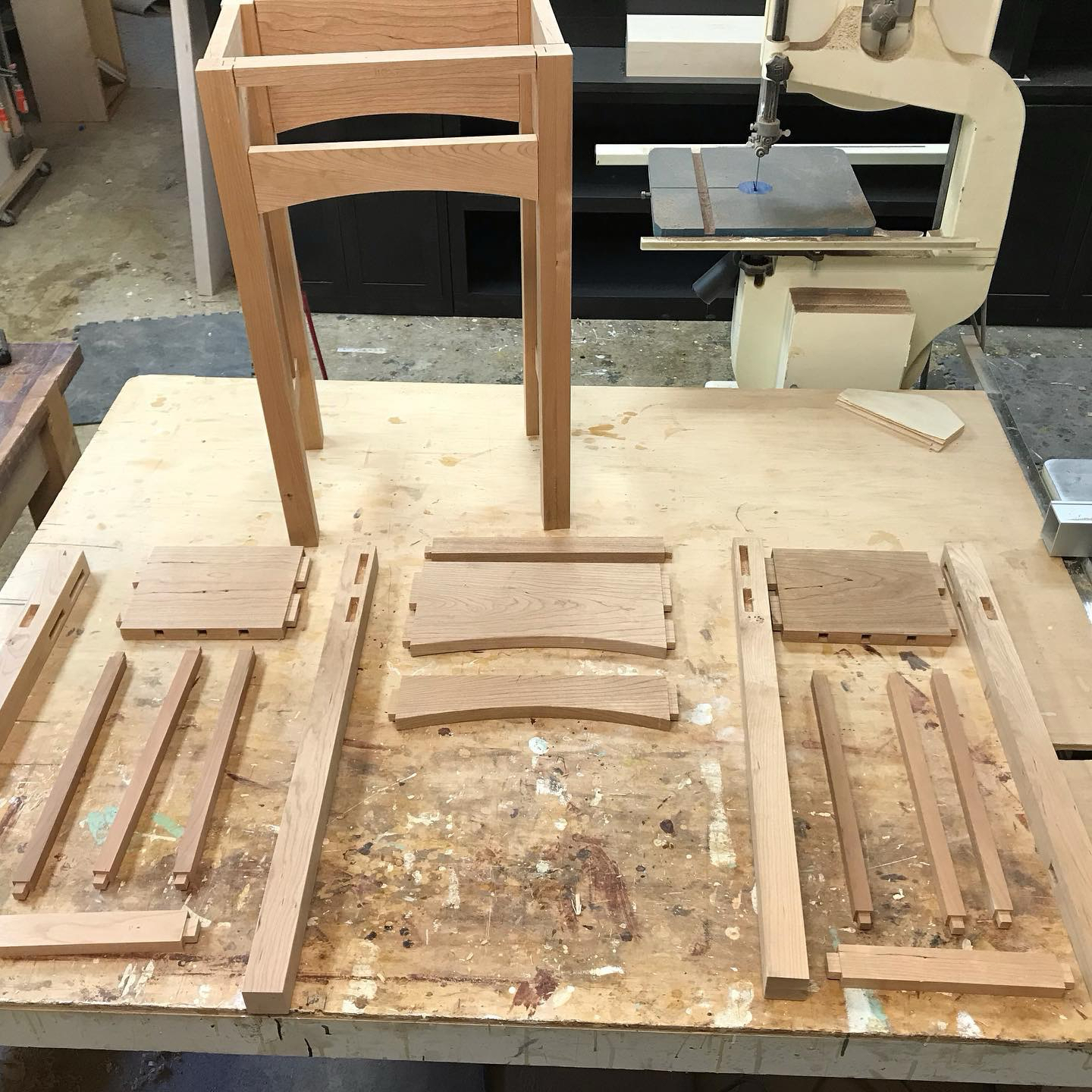
The mortise-and-tenon joint is the structural backbone of furniture making. A rectangular projection (the tenon) fits precisely into a corresponding cavity (the mortise), and the connection is locked with a wooden peg driven through both. This joint has been found in furniture dating back 7,000 years in China and 3,000 years in Egypt. In a well-cut mortise and tenon, the joint can bear shearing forces that would snap a metal bracket clean off the wall. Modern timber framers, boat builders, and furniture makers still rely on it as their primary structural connection.
The Wedged and Drawbored Tenon
A variation of the mortise and tenon, the wedged or drawbored tenon introduces deliberate mechanical tension to pull the joint tight and hold it permanently. A peg is driven through slightly offset holes in the tenon and mortise walls, creating a self-tightening connection that requires no glue and never loosens. Medieval timber-framed buildings across Britain still stand — some after 600 years — because their joiners understood this principle with extraordinary precision.
Japanese Kumiko and Complex Lattice Joints
Japan’s tradition of complex joinery reached its apex in kumiko — the intricate geometric lattice work found in shoji screens and cabinet panels — and in the extraordinary three-dimensional wooden puzzles used to connect structural timbers. Some Japanese joints interlock in three dimensions with no fasteners at all, relying entirely on geometry. Contemporary architects working on wooden structures in Japan still use these joints, often with computer-aided precision to cut what was once achieved by hand.
Why These Techniques Are Still Best Practice
It would be tempting to view the revival of hand joinery as mere nostalgia — a craft hobbyist’s retreat from the modern world. But that would be a serious misreading of what is happening. Across the furniture industry, from bespoke workshops in Vermont to high-end studios in Copenhagen, traditional joinery is being re-embraced not for sentimental reasons, but because it produces objectively superior furniture.
Longevity That No Modern Fastener Can Match
Wood is a living material. It breathes. It expands in summer and contracts in winter. A joint that is rigid — one fastened with screws or metal brackets — will eventually work loose or split the surrounding wood as it fights against the wood’s natural movement. A traditional mortise-and-tenon or dovetail joint, by contrast, allows for controlled movement while maintaining structural integrity. That is why antique furniture survives centuries while flat-pack particleboard begins to fail within a decade.
Sustainability and Environmental Responsibility
In a world increasingly focused on sustainability, traditional joinery offers something that mass production cannot: true longevity. A piece of furniture that lasts 200 years represents a radically lower environmental footprint than one replaced every ten. Moreover, furniture built without glues, screws, or synthetic adhesives can be disassembled, repaired, and repurposed indefinitely. The old masters, it turns out, were sustainability pioneers long before the concept had a name.
Structural Superiority
Engineering studies of traditional joints consistently confirm what craftsmen have known intuitively for centuries: a well-cut mortise and tenon in hardwood is stronger than any mechanical alternative at the same scale. The large surface area of wood-on-wood contact distributes stress far more effectively than a screw’s point load. A properly fitted dovetail in tension literally cannot pull apart — the geometry of the joint prevents it. These are not decorative techniques; they are solutions to real engineering problems.
Repairability
There is a brutal honesty to traditional joinery: when a joint fails — after many decades, perhaps — it can be knocked apart, cleaned up, and reassembled. A broken screw or failed pocket joint, by contrast, often requires replacing the entire component. In an age when repair culture is finally being taken seriously as both an economic and environmental imperative, the repairability of joinery-built furniture is a significant competitive advantage.
The Modern Revival
Today’s handcrafted furniture movement is not a rejection of modernity. It is a synthesis. Contemporary makers are using computer-aided design to plan joints of extraordinary precision, then cutting them by hand — or using CNC machinery as a sophisticated chisel — to achieve fit and finish that the old masters themselves would admire.
Schools like the North Bennet Street School in Boston, the Furniture Society, and Rycotewood College in England are graduating skilled joiners who combine deep historical knowledge with modern material science. Online communities have made the accumulated wisdom of centuries accessible to hobbyists and professionals alike, creating a global conversation about craft that would have been unimaginable a generation ago.
In Japan, the government has formally designated master woodworkers as Living National Treasures — a recognition that their knowledge is as culturally precious as any ancient monument. In Scandinavia, the concept of slow furniture — pieces made slowly, intentionally, and for life — is reshaping how consumers think about what they bring into their homes.
The market is responding. Custom furniture made with traditional joinery commands prices that reflect its true value: not the cost of materials and hours, but the cost of mastery — of the years spent learning to read wood grain, to feel when a joint is perfectly fitted, to understand how a piece will age across a human lifetime and beyond.
What the Old Masters Teach Us
The legacy of the handcrafted furniture makers of the past is not just technical. It is philosophical. These craftsmen operated under a set of values that have become almost countercultural in our disposable age: that things worth having are worth making properly; that mastery takes time and cannot be shortcut; that the maker’s integrity is expressed in the parts of the work no one will ever see.
A Shaker craftsman famously said: “Make every product better than it’s ever been done before. Make the parts you cannot see as well as the parts you can.” That ethos — invisible excellence — is the defining quality of great joinery. The hidden shoulders of a tenon, the interior faces of a dovetail, the back of a drawer: these are where the master reveals himself. In a world saturated with the merely adequate, these ancient techniques offer something rare and increasingly precious: proof that human hands, guided by deep knowledge and honest intention, can produce things that truly last. Not just for a lifetime. For many lifetimes.
The next time you sit at a wooden table, look underneath it. If you find a clean mortise-and-tenon at every corner, you are sitting at the intersection of past and present — at a joint that has been proven across centuries and continents, cut by hands guided by knowledge that has been passed, person to person, across a thousand years.
That is not nostalgia. That is wisdom.
ANDERSON WOODWORKS LLC
Handcrafted Furniture Built to Last a Lifetime — and Beyond
At Anderson Woodworks LLC, we carry forward the same traditions you just read about. Every piece we build is joined by hand using time-honored techniques — dovetails, mortise-and-tenon, drawbored pegs — in solid hardwoods chosen for character and longevity. No shortcuts. No staples. No compromises.
Whether you are looking for a heirloom dining table, a custom bookcase, or a piece designed around your exact space and life — we would love to build it for you.
→ Schedule a free consultation today
A.woodworks@hotmail.com | Text or call 360-259-0232
Discover more from Anderson woodworks custom furniture & cabinets
Subscribe to get the latest posts sent to your email.

Leave a Reply