
I get the question often enough that it deserves a direct answer.
“Why does your marquetry piece cost $2,500 when I can buy wood wall art at West Elm for $300?”
It’s a fair question. At first glance, they might look similar—both are wood, both hang on a wall, both feature natural imagery. But the difference between handcrafted marquetry and mass-produced wood decor is the difference between a hand-forged knife and a stamped blade. They may serve similar purposes, but they’re not the same thing.
Let me walk you through what separates them.
The Material Question: Solid Hardwood vs. Printed Veneer
Most wood wall art you’ll find in furniture stores or online retailers isn’t actually made from solid wood in the way you might imagine.
The typical construction:
- MDF or particle board base
- Thin printed veneer or vinyl film applied to the surface
- Wood grain pattern is photographed and printed, not real
- “Wood” frame is often plastic with wood-grain texture
What this means: The wood you’re seeing is decorative surface treatment, not structural material. It’s designed to look like wood from a distance, photograph well for catalogs, and ship cheaply in flat boxes.
Marquetry construction: Every element you see in one of my marquetry pieces is solid hardwood—cherry, walnut, maple, oak—the same species I use in dining tables and cabinets. Each leaf, each petal, each branch is cut from boards that were once living trees, with real grain patterns, natural color variation, and the character that only comes from decades of growth.
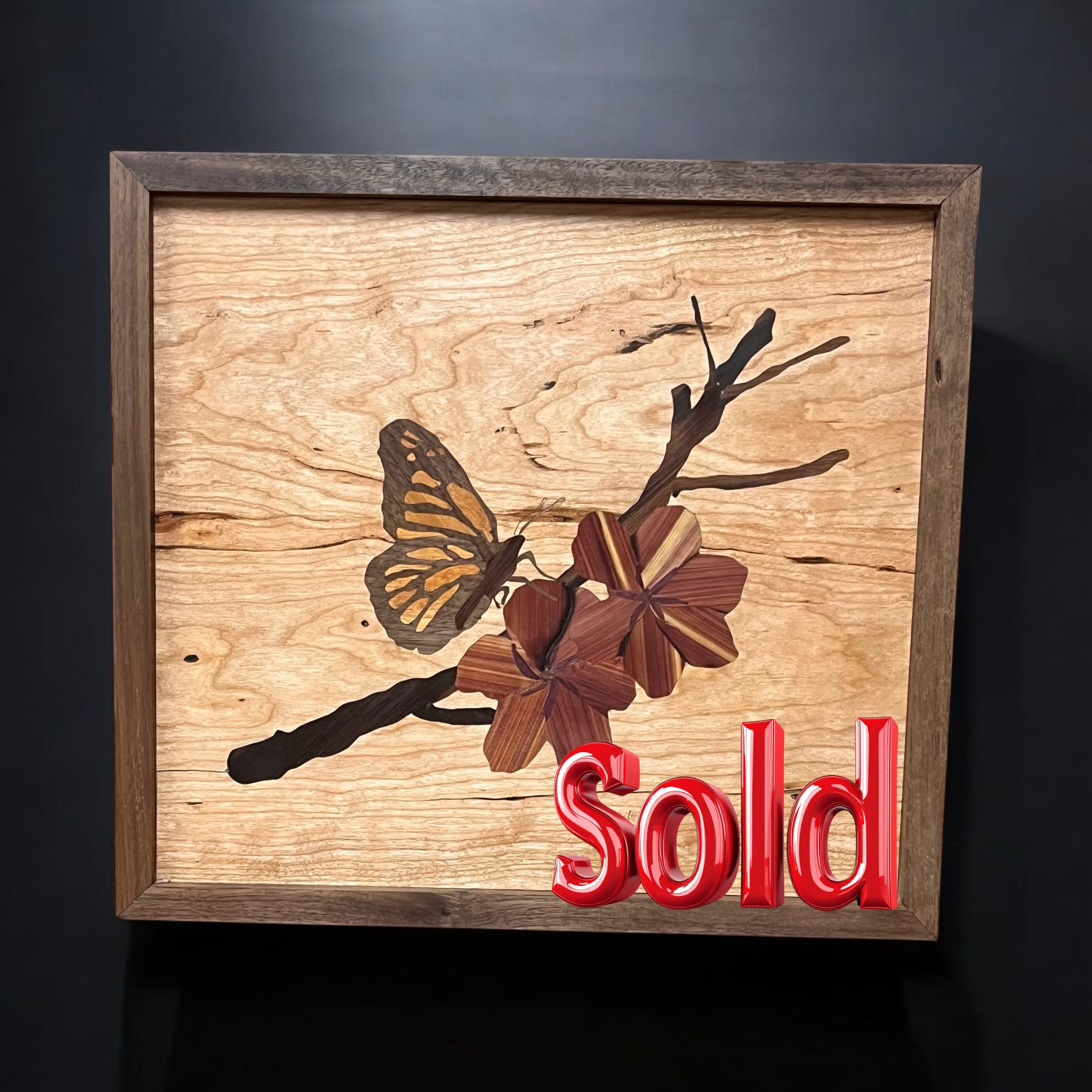
The butterfly wings in the piece I just completed? Book-matched cherry, meaning I split a single board and opened it like a book to create perfect natural symmetry. The darker elements? Walnut heartwood, selected for its deep chocolate tones. The background? Spalted maple with natural figuring created by fungal patterns in the living tree.
You can’t print that. You can’t fake it. And you can’t get it for $300.
Material cost reality: A typical mass-produced piece uses $15-30 in materials. My marquetry pieces use $130-250 in premium hardwoods alone, before factoring in the walnut frame, backing, and non-toxic finishes.
The Craftsmanship Divide: Laser Cutting vs. Hand Fitting
Here’s where the real difference lives.
Mass-produced wood wall art—even the “handmade” versions on Etsy that use real wood—are typically created using:
- CNC routers or laser cutters (computer-controlled machines)
- Pre-designed templates downloaded or purchased
- Assembly-line production (one person cuts, another assembles, another finishes)
- Minimal hand-fitting or adjustment
What this enables: Speed. A laser cutter can produce 20 identical pieces in the time it takes me to cut and fit a single butterfly wing. There’s nothing inherently wrong with this—it’s efficient manufacturing. But it’s manufacturing, not craftsmanship.
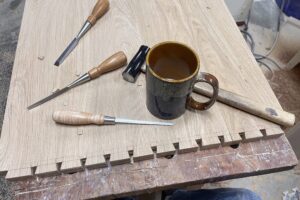
Traditional marquetry: Every piece I create is hand-cut using the same tools furniture makers have used for centuries—coping saws, chisels, planes, and scrapers. Each element is individually fitted, adjusted, and refined until the joints are tight enough that you can’t see glue lines.
This is furniture-grade joinery applied to wall art. The same mortise and tenon precision, the same attention to grain direction, the same zero-tolerance fitting I use in heirloom dining tables.
Why hand-cutting matters: It allows me to respond to the wood itself. When I’m cutting a butterfly wing and encounter unexpected figure in the cherry, I can adjust the design to feature it. When two pieces don’t quite fit, I can plane them by hand until they do. When the grain wants to run a certain direction, I can honor that.
A CNC router follows the program. A craftsman follows the wood.
The Time Investment: Hours vs. Minutes
Let’s talk about what “handmade” actually means in terms of time.
Mass-produced timeline:
- Design: 0 hours (template purchased or downloaded)
- Cutting: 15-30 minutes (machine does the work)
- Assembly: 30-60 minutes (glue and clamp)
- Finishing: 15-30 minutes (spray finish, quick dry)
- Total: 2-3 hours per piece
My marquetry timeline:
- Design and layout: 2-4 hours (sketching, wood selection, planning grain direction)
- Cutting individual elements: 10-20 hours (hand-cutting 80-150 pieces)
- Fitting and adjustment: 4-8 hours (ensuring tight joints, no gaps)
- Assembly and gluing: 2-4 hours (careful clamping, cleanup)
- Finishing: 2-4 hours (multiple coats of oil and wax, hand-rubbed)
- Framing: 2-3 hours (mitered frame corners, French cleat mounting)
- Total: 22-43 hours per piece
That’s not an exaggeration. The butterfly piece I posted yesterday? Thirty-two hours of focused work over six weeks, fitted around furniture projects.
Why this matters: Time is the most honest measure of value. When you purchase one of my marquetry pieces, you’re not just buying wood and glue—you’re buying 30-40 hours of my attention, skill, and intention. Every hour I spend on that piece is an hour I’m not building furniture, not taking on another project, not doing something else.
Mass-produced pieces minimize labor to maximize profit. Handcrafted pieces honor labor as the source of value.
The Longevity Question: Decoration vs. Heirloom
Here’s the uncomfortable truth about most mass-produced wood wall art: it’s designed to last 5-10 years, not generations.
Typical construction weaknesses:
- Printed veneers fade with sunlight exposure
- MDF cores absorb moisture and swell
- Spray finishes chip and peel
- Glued joints separate over time
- Thin materials warp in seasonal humidity changes
I’m not saying these pieces are poorly made for what they are—they’re designed to hit a price point and aesthetic trend. But they’re not built to become family heirlooms.
Marquetry built to furniture standards: When I create a marquetry piece, I’m using the same construction principles I use in dining tables that will serve families for 50+ years:
- Solid hardwood construction (no veneer, no MDF)
- Traditional joinery (fitted joints, not just glue)
- Non-toxic oil and wax finishes that penetrate the wood (can be refreshed in 20 years)
- Proper wood movement accommodation (pieces can expand and contract with seasons)
- Quality frame construction with furniture-grade joinery
What this means: The marquetry piece you purchase today should look essentially the same in 2075. The wood will develop a richer patina. The finish can be refreshed if needed. But the piece itself—the craftsmanship, the joinery, the integrity—will endure.
Your great-grandchildren will inherit it, and it will still be beautiful.
Can you say that about something from HomeGoods?
The Investment Perspective: Cost vs. Value
Let’s address the elephant in the room: price.
A mass-produced wood wall art piece costs $150-400.
My marquetry pieces cost $1,800-5,500.
That’s a significant difference, and it deserves honest examination.
What you’re paying for with mass-produced:
- Materials: $20-40
- Labor (2-3 hours at $15-25/hour): $30-75
- Overhead and profit margin: $100-285
- Total: $150-400
What you’re paying for with handcrafted marquetry:
- Materials (premium hardwoods, frame, finish): $130-250
- Labor (30-40 hours at $97/hour): $2,910-3,880
- Overhead (workshop, tools, maintenance): Included in labor rate
- Total cost: $3,040-4,130
- Retail price: $1,800-5,500 (I’m actually underpricing based on pure labor costs because I fill gap time between furniture projects)
The value equation: When you buy mass-produced, you’re paying for convenience and trend-matching. When you buy handcrafted, you’re paying for:
- Irreplaceable skill (decades of furniture-making mastery)
- Irreplaceable time (30-40 hours of focused craftsmanship)
- Irreplaceable materials (solid hardwoods with natural character)
- Lasting value (heirloom quality that appreciates over time)
Consider this: A $300 piece that lasts 7 years costs $43/year. A $2,500 piece that lasts 75+ years costs $33/year—and can be passed down with increasing sentimental value.
Which is the better investment?
The Story Behind the Work
There’s one more difference that’s harder to quantify but impossible to ignore: provenance.
When you purchase mass-produced art, you’re buying a product. You don’t know who designed it, who cut it, who assembled it. It was likely created by multiple people across multiple facilities, none of whom will ever know where it ended up or who’s living with it.
When you purchase one of my marquetry pieces, you’re buying a story:
You know it was created in a 250-square-foot workshop in Yelm, Washington, by a self-taught furniture maker who learned the craft from his grandfather’s tools. You know the cherry came from Edensaw, a local lumber supplier I’ve worked with for years. You know I selected each board personally, looking for grain and color that would serve the design.
You know I cut each piece by hand, fitted each joint, applied each coat of finish. You know that when I signed the back of the piece, I was signing something I’m proud to have created.
And if something ever goes wrong—if the piece is damaged, if you want to commission a companion piece, if you just want to talk about the wood—you can call me. I’m here.
That’s not something you get from a factory in China or a fulfillment center in Ohio.
Making the Choice
I’m not here to tell you that mass-produced wood wall art is bad or that you should never buy it.
If you’re furnishing a rental apartment, decorating a vacation home, or simply want something trendy and affordable to fill a wall, mass-produced pieces serve a purpose. There’s no shame in that.
But if you’re looking for something more—something that carries meaning, that reflects your values, that will outlive you and become part of your family’s story—then handcrafted marquetry is worth the investment.
The difference isn’t just in the price tag. It’s in the materials, the time, the skill, and the intention behind every cut.
It’s the difference between decoration and legacy.
About Anderson Woodworks
I’m Brian Anderson, a furniture maker and marquetry artist working in Yelm, Washington. I create heirloom-quality custom furniture and wall art using traditional hand-tool techniques and Pacific Northwest hardwoods. Every piece is built to last generations.
If you’re interested in commissioning a marquetry piece or learning more about the process, visit www.andersonwoodwork.net or reach out directly.
Current lead time for marquetry commissions: 6-8 weeks.
Discover more from Anderson woodworks custom furniture & cabinets
Subscribe to get the latest posts sent to your email.