
Walk into almost any home and you’ll find furniture that does its job—holds clothes, supports a lamp, fills a wall. But every so often, you come across a piece that feels different. It has weight, not just in pounds, but in presence. The difference between those two experiences is the story of how furniture is made—and why it matters.
A few years ago, I was helping a client redesign a bedroom.
She had two dressers sitting side by side.
One came from a big retail store—clean lines, solid wood label, perfectly nice at first glance. The other was a piece her grandfather had commissioned decades earlier. You could see the difference before you even touched them, but the real story was deeper than appearance.
Those two pieces told the entire story of what separates manufactured furniture from handcrafted custom work.
Where the Story Begins
The store-bought dresser began its life as part of a plan—an efficient one. Designers created it to fit a broad audience, to ship flat or stack easily in a warehouse, to hit a price point that made sense for thousands of homes.
It was never meant for a specific room. It was meant for any room.
The custom dresser started with a conversation. Someone measured a space, talked about how it would be used, chose a wood species that felt right. It was imagined before it existed—built with a person and a place in mind.
From the very beginning, one was a product. The other was a response.
The Wood Itself
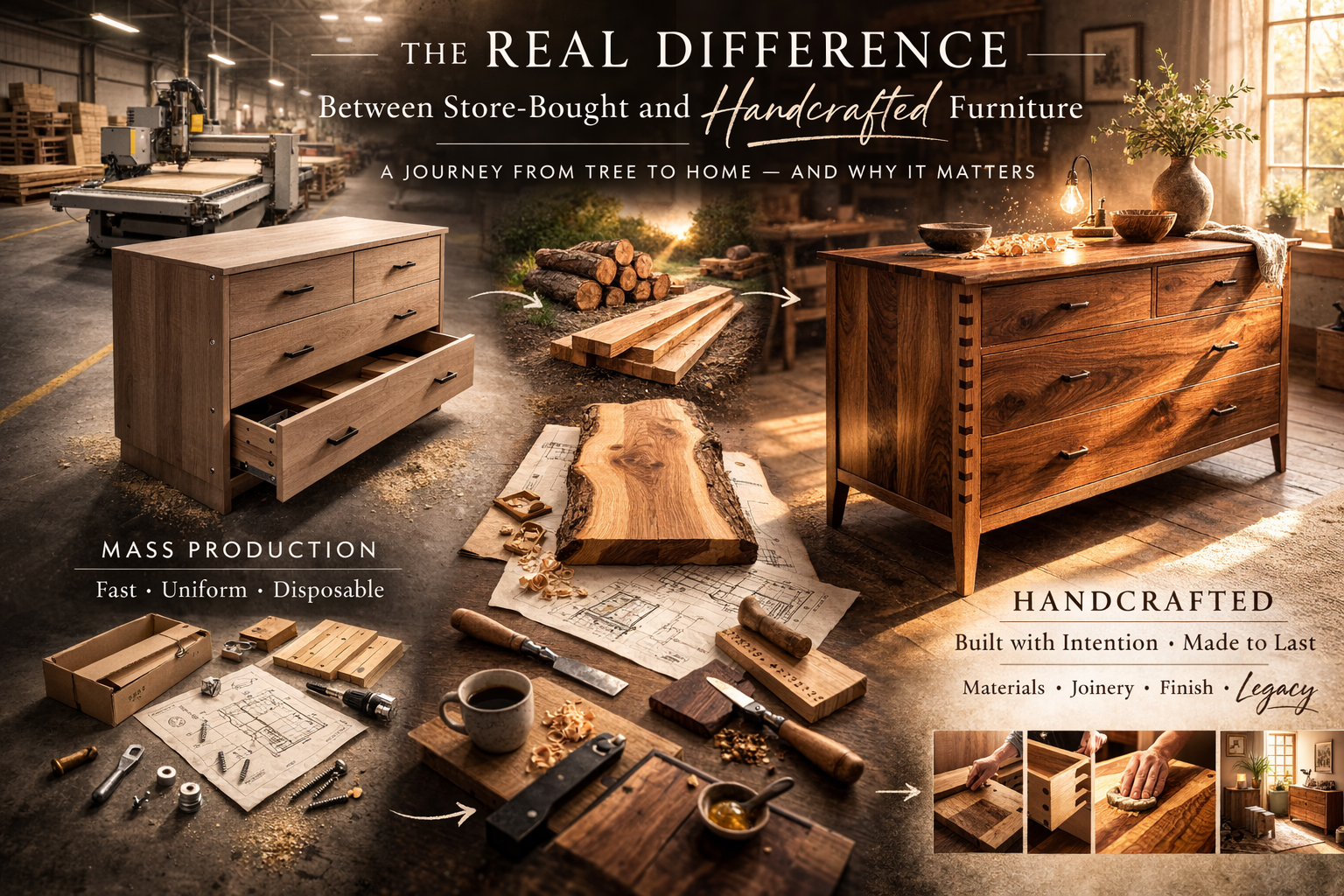
If you looked closely at the manufactured piece, you could see panels made from shorter boards joined together. Perfectly functional, carefully engineered, but chosen for efficiency. The goal was to use material wisely, keep costs predictable, and produce consistent results.
The custom piece told a different story. Long boards with grain that flowed from drawer to drawer. Subtle color shifts that felt natural rather than uniform. You could tell someone had stood in a lumberyard, turning boards in the light, imagining how they would live together.
It felt less assembled and more composed.
How They Were Built
Inside the drawers is where the truth usually lives.
The store-bought dresser used modern hardware and fasteners—smart, efficient solutions that allow furniture to be built quickly and shipped safely. It did its job well, but it relied on mechanical strength rather than the structure of the wood itself.
The custom dresser had joinery that almost felt invisible—wood locking into wood in a way that allowed it to move with the seasons. It wasn’t just built to hold together; it was built to adapt, to breathe, to last.
You got the sense it wasn’t trying to survive time. It was designed to travel through it.
The Finish and the Feel
Run your hand across a factory finish and it’s smooth, consistent, protective. It’s designed to look the same on every piece coming off the line and to resist the bumps and scrapes of a showroom floor.
The handcrafted piece felt different—softer somehow, like the surface still belonged to the tree it came from. Light didn’t just bounce off it; it sank in slightly, revealing depth in the grain. It felt less like a coating and more like a conversation between the material and the maker.
And importantly, it could be renewed. Scratches weren’t the end of the story.
Living With the Pieces
Over time, the difference becomes even clearer.
Manufactured furniture often lives a practical life. It serves a purpose, and when styles change or wear accumulates, it’s replaced. There’s nothing wrong with that—it’s part of how modern homes evolve.
Custom furniture tends to stay. It gathers small marks, subtle shifts in color, memories tied to places and moments. It becomes familiar in a way that feels less like ownership and more like companionship.
You don’t just use it. You grow alongside it.
The Experience Behind It
Buying furniture from a store is simple. You see it, you like it, it arrives. It’s efficient and predictable, and sometimes that’s exactly what you need.
Commissioning a piece is different. It’s a process—ideas sketched, materials chosen, details refined. You watch something move from imagination to reality. By the time it arrives, it already carries meaning.
It’s not just furniture anymore. It’s a story you’re part of.
Why This Difference Matters
At the end of that bedroom project, the client decided to keep both dressers. One for everyday function, one for the connection it carried.
That’s the truth about this comparison: it isn’t about declaring a winner. It’s about understanding intention.
Manufactured furniture gives us accessibility, speed, and practicality.
Handcrafted furniture gives us individuality, longevity, and a sense of connection to the people and processes behind what we bring into our homes.
One fills a space.
The other helps define it.
Ready to create a piece that’s made just for your home?
Let’s start the conversation and bring your vision to life.
Email: a.woodworks@hotmail.com
Discover more from Anderson woodworks custom furniture & cabinets
Subscribe to get the latest posts sent to your email.