A custom piece can fail long before the first board is milled. It usually happens at the moment a homeowner asks for something “beautiful” without defining how it needs to work, where it needs to live, or what kind of life it is meant to support. If you want to know how to commission bespoke furniture properly, start there. This is not about ordering an object. It is about making a series of good decisions so the piece earns its place in the room for decades.
Bespoke furniture should solve a real problem and bring order to a space. It might anchor a dining room, correct the scale of an awkward study, or give a home office the kind of storage and proportion that off-the-shelf furniture never can. The best commissions begin with function, then move into form, then into the finer points of material and construction.
How to commission bespoke furniture with a clear brief
The first job is not choosing wood species. It is defining the piece with precision. A good brief answers practical questions before aesthetic ones. What does the piece need to hold? How often will it be used? Who uses it daily? Does it need cable management, hidden storage, leaf extensions, soft-close drawers, display shelves, or room to age with children in the house?
This is where many projects either become excellent or expensive in the wrong way. If you ask for a statement piece without clarifying its purpose, the maker has to fill in too many gaps. Some can do that well, but you will still get a better result if you provide a disciplined starting point.
Measurements matter, but so does context. Bring room dimensions, ceiling height, window and door locations, adjacent furniture sizes, and photos from multiple angles. If the piece is meant to relate to architecture, that relationship should be explicit. A built-in writing desk under a window asks for different proportions than a freestanding executive desk in the center of a room.
You do not need a complete design vocabulary to commission well. You do need clarity about what you like, what you dislike, and what frustrates you about what you already own.
Choose the right maker, not just the right style
A furniture maker is not interchangeable with a cabinet shop, and neither is automatically an interior designer. Some excel at highly sculptural one-off pieces. Others are strongest in architectural millwork and room-specific storage. Some can guide the room around the furniture. Others need a fully developed plan before fabrication starts.
That distinction matters. If you are commissioning a dining table, the project may be relatively self-contained. If you are commissioning a library wall, a mudroom system, or a study built around a custom desk, the furniture is setting the rules for the room. In those cases, design judgment is as important as technical skill.
Ask to see work that resembles your project in complexity, not just in style. A maker may produce elegant coffee tables and still be the wrong fit for a room-scale installation. Look for consistency in proportion, detailing, joinery, and finish quality. More importantly, look for evidence that the work feels resolved within the space rather than merely attractive in isolation.
A serious craft-led studio will also have a process. That should include consultation, design development, revisions, approvals, fabrication timelines, and installation where relevant. If the process is vague, expect avoidable problems later.
Budget for quality with open eyes
One of the most useful steps in how to commission bespoke furniture is learning what you are actually paying for. You are not simply buying materials and labor. You are paying for design intelligence, problem-solving, prototyping when needed, joinery decisions, finish testing, hardware selection, shop overhead, delivery logistics, and time.
This is why bespoke work costs more than retail furniture and why it should. A well-made custom piece is built around your dimensions, your use, and the realities of your home. It is also built in low volume, often by a small team or a single maker with deep expertise.
That does not mean every project needs to be extravagant. It does mean you should be honest about priorities. If budget is firm, say so early. A good maker can often adjust complexity, wood selection, edge details, drawer construction, or finish schedule to protect the integrity of the piece without pretending the same budget can buy anything.
There are trade-offs. Solid walnut throughout may not be necessary if a veneered panel construction delivers better stability for large surfaces. Hand-cut details may be worth the investment on a collector-level piece but unnecessary on a simpler built-to-order design. The point is not to make the project cheaper at any cost. The point is to spend where it changes the result.
Material selection should follow use
Clients often lead with wood species because it feels like the most visible decision. In practice, material selection should come after use, scale, and setting are understood.
A dining table sees impact, moisture, heat, and constant abrasion. A display cabinet has different demands. A built-in in a bright room near south-facing windows raises finish and movement considerations that do not apply in the same way to a hallway bench. The right material is not simply the prettiest option. It is the material that suits the job, the scale, and the life of the piece.
This is also where restraint pays off. Highly figured lumber, mixed metals, specialty stone, and custom hardware can all be beautiful, but not every commission benefits from stacking distinctive elements together. Often the strongest work comes from disciplined choices and excellent execution.
If you are trying to match existing architecture, flooring, or older furniture, say that plainly. Exact matches are not always desirable. Sometimes a close tonal relationship is better than a forced imitation. A good maker should tell you when contrast will serve the room better than mimicry.
Understand the design and approval process
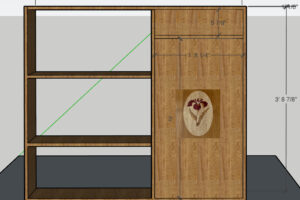
Custom furniture should not move from conversation to fabrication without a clear design phase. That phase may include sketches, dimensioned drawings, finish samples, hardware options, and sometimes 3D views or full-room planning depending on the scope.
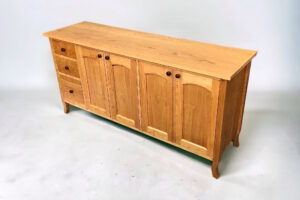
This part of the process is where you confirm proportion, not just dimensions. A sideboard can technically fit on a wall and still feel wrong because its mass is too heavy, its legs are too slight, or its storage is arranged in a way that fights how you use the room.
Review drawings carefully. Ask practical questions. How far do drawers extend? Where do doors swing? Is there enough knee space? Will a chair arm clear the apron? Can the shelves be adjusted later? If lighting, outlets, or vents are involved, those need to be resolved before fabrication begins.
Approvals matter because changes after build start are costly. The more settled the design is before production, the better the outcome tends to be.
How to commission bespoke furniture without weakening the design
Clients sometimes worry that being decisive will sound inflexible. The opposite is usually true. A strong commission comes from clear priorities and respect for expertise.
State what matters most. It may be storage capacity, visual quiet, heirloom durability, or a very specific fit in a difficult room. Then let the maker challenge weak ideas. If you want a delicate open shelf system for a family entry where bags, shoes, and sports gear pile up daily, you need honest pushback. Good design is not agreement for its own sake.
At Anderson Woodworks, that principle guides the entire process. Furniture is not treated as decoration added at the end. It is often the foundation that determines layout, circulation, and the character of the room itself.
That approach is especially valuable when commissioning for studies, dining rooms, entry spaces, or home offices where proportion and utility carry equal weight. The piece should look right, but it should also correct the room around it.
Plan for lead times, delivery, and living with the piece
Fine furniture takes time. Design development, material sourcing, shop scheduling, fabrication, curing, and installation all add up. If you need a piece by a holiday, a move-in date, or a renovation milestone, discuss timing at the start.
Delivery conditions should also be considered early. Stair access, elevator dimensions, floor protection, wall clearances, and whether a piece must be assembled on site can influence design decisions. A massive one-piece table base may be elegant in theory and impossible in practice.
Once installed, ask how to care for the finish and what natural changes to expect. Wood moves. Color shifts. Surfaces record use. That is not failure. It is part of owning real materials. The goal is not to keep the piece frozen in time. It is to have something that wears with dignity.
The best custom furniture does not beg for attention every time you enter the room. It simply feels right there – scaled correctly, built properly, and aligned with how you live. If you commission with that standard in mind, you are far more likely to end up with a piece that keeps proving its value long after the excitement of delivery has passed.
Discover more from Anderson woodworks custom furniture & cabinets
Subscribe to get the latest posts sent to your email.