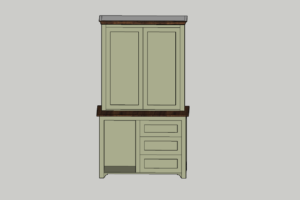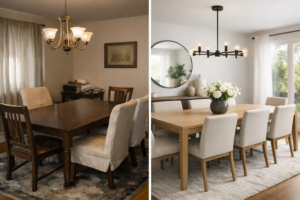
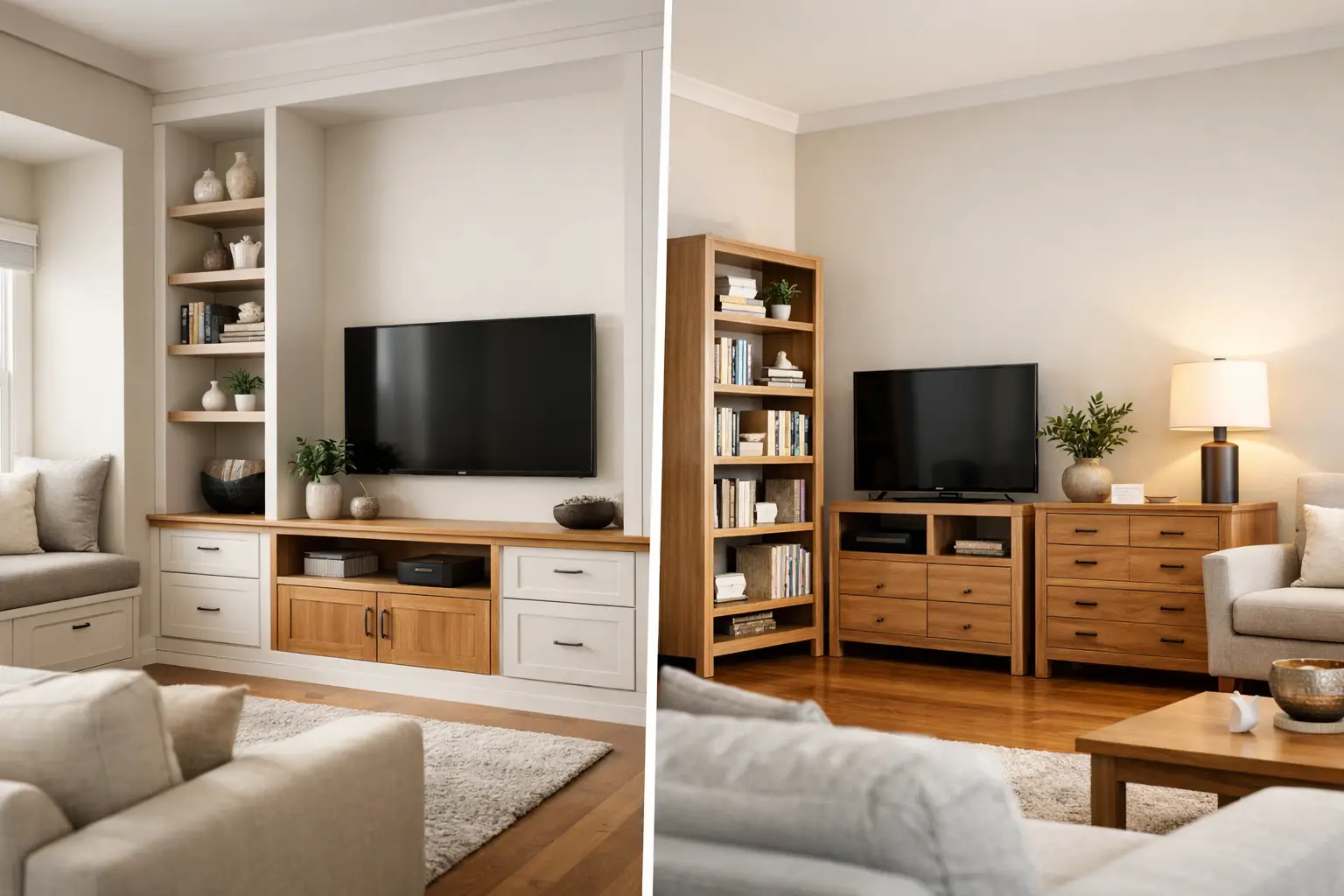
A room usually tells you the truth faster than a mood board does. If the walls are awkward, storage is lacking, and furniture keeps floating without purpose, the real question is not what style to buy. It is built in furniture vs freestanding, and the answer affects how the room works every single day.
This is not decorating. It is a design decision about proportion, circulation, storage, permanence, and how much authority each piece should have in the room. Both approaches can be right. Both can also be badly used.
Built in furniture vs freestanding: what actually changes
Freestanding furniture is movable. It sits in the room without being physically integrated into the architecture. A dresser, sideboard, bookcase, dining cabinet, or writing desk can all be freestanding, whether custom made or purchased.
Built-in furniture is anchored to the room itself. It is designed for a specific wall, niche, alcove, or condition and often resolves several problems at once – storage, visual order, awkward dimensions, and the relationship between furniture and architecture.
That distinction sounds simple, but the implications are not. When you choose freestanding pieces, you preserve flexibility. When you choose built-ins, you gain precision. One gives you mobility. The other gives you integration.
The better choice depends on what the room is failing to do now.
When built-ins are the stronger decision
Built-ins earn their place when the room needs discipline. If a study has dead corners, a dining room lacks meaningful storage, or an entry needs both concealment and structure, freestanding pieces may only partly solve the problem. A well-designed built-in can correct the room, not just occupy it.
This is especially true in older homes or houses with uneven walls, odd ceiling lines, shallow recesses, or architectural gaps left unresolved by the builder. In those cases, custom built-ins create alignment where there was none. They give the eye a place to rest because the proportions are settled intentionally.
Functionally, built-ins are often the strongest answer when storage needs are exact. Media equipment, office files, serving ware, collections, and family overflow all benefit from storage that is sized to real use rather than whatever dimensions happen to be available in retail furniture.
There is also a material and visual advantage. Built-ins can pull from the room’s trim, wall finish, flooring, and overall architectural language. When done well, they feel native to the house. That sense of belonging is difficult to achieve with a piece that was never designed for that location.
But permanence is part of the bargain. Built-ins ask for commitment. They are less forgiving if your habits change, your needs shift, or you simply chose poorly at the start.
Built-ins work best when the room needs to do more
A home office that must handle work, paper storage, technology, and video-call background is rarely served well by a desk and two random cabinets. A wall of built-in storage with a properly scaled work surface can solve function and composition at the same time.
The same applies to dining rooms that need serving storage, studies that need display and concealment in balance, and entry spaces that need a clear landing zone. In these rooms, built-ins can establish a backbone for everything else.
When freestanding furniture is the better choice
Freestanding furniture is not the lesser option. In many rooms, it is the more intelligent one.
If the room already has good bones and does not need architectural correction, a strong freestanding piece can provide character without overcommitting the space. A custom sideboard in a dining room, a substantial bookcase in a study, or a well-proportioned cabinet in an entry can define the room while preserving future flexibility.
Freestanding furniture also allows for evolution. Families change. Work patterns change. Homes are renovated. A piece that can move from one room to another has a practical life beyond its first placement, especially if it is well made and materially honest.
There is another advantage that matters more than people admit: presence. A freestanding piece has edges, shadow lines, and visual independence. It reads as furniture. That distinction can bring warmth and depth to a room that might otherwise feel overfitted.
For homeowners who value craftsmanship but do not want every solution tied to the house, freestanding furniture offers permanence of quality without permanence of installation.
Freestanding pieces reward good selection
The weakness of freestanding furniture is not mobility. It is poor scale. Too small, and the room feels underfurnished and uncertain. Too bulky, and circulation suffers.
This is where many rooms go wrong. People buy furniture by isolated dimensions, not by relationship. A cabinet may technically fit the wall and still look wrong because the height ignores the window line, the depth interrupts movement, or the visual weight fights the architecture.
Good freestanding furniture requires just as much design judgment as built-ins. Sometimes more, because it has to hold its own without the help of walls and trim.
Cost, value, and what you are really paying for
Built-ins usually cost more upfront. They involve site-specific design, precise measurements, fabrication, finishing, installation, and often coordination with electrical, trim, or wall repair. That cost is not arbitrary. You are paying for a tailored solution and for the room to function at a higher level.
Freestanding furniture can offer a wider range of price points. But cost comparisons get distorted when people compare custom built-ins to mass-produced case goods. The fairer comparison is built-ins versus well-made custom or bench-crafted freestanding furniture.
At that level, the question becomes less about cheap versus expensive and more about where you want the value to live. Do you want the investment embedded in the architecture, or embodied in a movable piece? Both can be worth it. Both can be wasteful if they are solving the wrong problem.
A built-in that creates order in a difficult room can return value daily in a way that is hard to measure but easy to feel. A finely made freestanding piece can follow you through decades and multiple homes. Longevity takes different forms.
Built in furniture vs freestanding in specific rooms
In a home office, built-ins often win when storage demands are substantial or when the room must present well during work calls. Freestanding furniture works better when the office may later become a guest room, library, or second living space.
In a dining room, a freestanding sideboard or cabinet often brings enough storage and much more flexibility. But if the room has one long blank wall and repeated storage pressure, built-ins can make the space feel complete rather than loosely furnished.
In an entry, built-ins are especially effective because they control clutter at the point of arrival. Shoes, bags, coats, keys, and seasonal overflow need disciplined containment. Still, a freestanding bench and cabinet can be the right answer when the entry is small or the house benefits from lighter visual touch.
In a study or library, either approach can be excellent. Built-ins create calm and order. Freestanding bookcases and cabinets create texture and a more collected atmosphere. The better choice depends on whether you want the room to feel architectural or furnished.
The decision most homeowners should make first
Do not start by asking which option looks more expensive or more custom. Start by asking what the room needs to accomplish, what must be stored, what should remain visible, how permanent the solution should be, and whether the architecture needs correction.
If the room is fundamentally unresolved, built-ins may be the right move. If the room is already sound and needs strong furniture rather than structural intervention, freestanding pieces may serve it better.
The best interiors often use both. A built-in may establish order on one wall while a freestanding cabinet, table, or bench adds warmth and independence elsewhere. That combination can feel more natural than forcing the entire room into one category.
At Anderson Woodworks, that is often the real work – deciding what should belong to the house and what should remain distinctly furniture.
A good room does not care whether the answer was built in or freestanding. It cares whether the decision was deliberate, properly scaled, and made to last.
for information on starting the process give me a call or text 360-259-0232
Discover more from Anderson woodworks custom furniture & cabinets
Subscribe to get the latest posts sent to your email.