
Why the “sensible” furniture purchase is often the expensive one — and what collectors know that buyers don’t.
There’s a moment I’ve watched play out in a lot of beautiful homes across the South Sound. Someone builds or renovates a house with real intention — the right architect, the right finishes, the right light. Then the furniture arrives on a truck from a showroom, and something doesn’t sit right. Not literally. The pieces function fine. But the room feels like it was furnished rather than finished.
That feeling has a cause, and it’s worth naming.
The decision that looks smart on paper
Manufactured furniture — even the expensive kind — is designed backward from a spreadsheet. A production run has to justify itself across thousands of units, which means every decision bends toward what ships flat, assembles fast, and survives a warehouse. Veneered particleboard instead of solid hardwood. Cam locks and dowels instead of joinery. Finishes sprayed in seconds instead of built up in coats.
None of that is visible in the showroom. What’s visible is the price tag, and next to a custom quote, it looks like the responsible choice.
Here’s what the price tag doesn’t show:
The lifespan math. A manufactured piece is engineered to a warranty period, not a lifetime. When a cam-lock joint loosens or a veneer chips through, there’s no repairing it — the material underneath was never meant to be seen. You replace it. Then you replace the replacement. A solid hardwood piece with hand-cut joinery is the opposite kind of object: dovetails and mortise-and-tenon joints get tighter with seasonal movement, and a solid wood surface can be repaired, refinished, and handed down. One purchase versus a subscription.
The fit problem. Manufactured furniture is sized for an average room that doesn’t exist. Your bay window, your ceiling height, your record collection, your particular way of living in a space — none of it was in the room when that piece was designed. Custom work starts with your room and your habits and works outward. That’s the difference between furniture that occupies a space and furniture that resolves it.
The sameness problem. This is the one high-end buyers feel most acutely. You can spend serious money at a design showroom and still own the same console as a thousand other households. In a home where everything else was chosen deliberately, a catalog piece reads as the one decision someone else made for you.
What collectors understand
The clients I build for tend to arrive at the same realization, usually after living with the alternative: the best furniture isn’t a purchase, it’s a commission. It’s closer to art with a function than product with a finish.
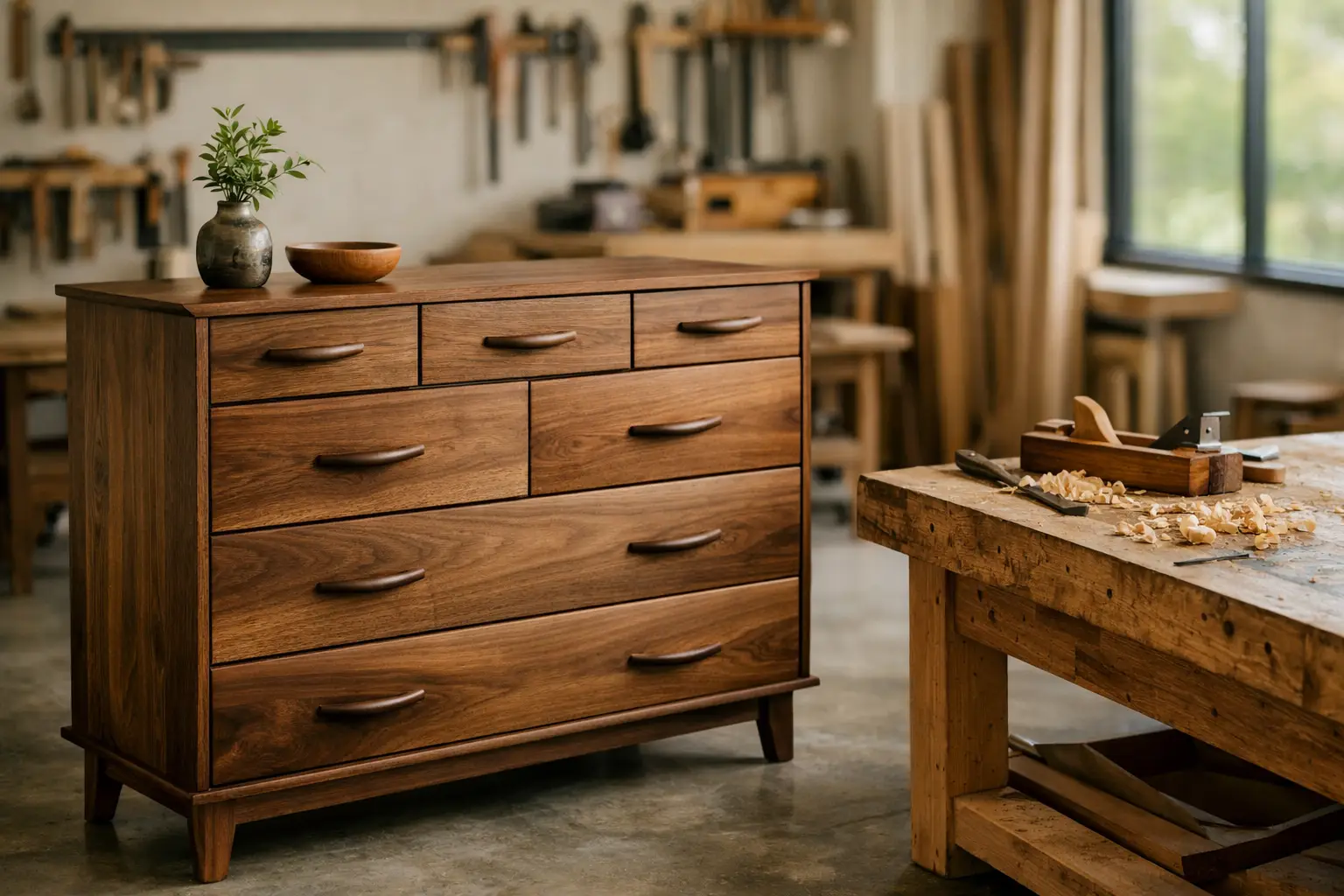
A commissioned piece carries things a factory can’t produce — the specific figure of a board chosen for that tabletop, a marquetry detail that means something to your family, joinery cut by hand for the piece it lives in. Fifty years from now, the manufactured version is in a landfill. The commissioned version is in your daughter’s dining room, with a story attached.
That’s the real comparison. Not this price versus that price — this decade versus the next three.
If you’re furnishing a home worth furnishing well
I’m Brian Anderson. I design and build custom furniture, cabinetry, and built-ins by hand in Yelm, Washington, for clients across Thurston and Pierce Counties — heirloom work, one commission at a time.
If you have a room that deserves better than a catalog, the first conversation is easy: I offer a free on-site visit and rough estimate, and we go from there.
andersonwoodwork.net · A.woodworks@hotmail.com

Discover more from Anderson woodworks custom furniture & cabinets
Subscribe to get the latest posts sent to your email.