
Nov 15, 2026 · @Brian Anderson
Here I am on a Sunday morning, coffee in hand, scrolling through Pinterest looking for inspiration for a piece of wall art.
I’ve noticed something about myself. When I’m not distracted by social media, the TV, or even thoughts of the work already waiting in the shop, my mind drifts to the marquetry corner of my shop and to making some kind of art. I enjoy that work. It’s an extension of my creativity beyond furniture.
This morning, what’s pulling me in is Art Nouveau.
What Caught My Eye
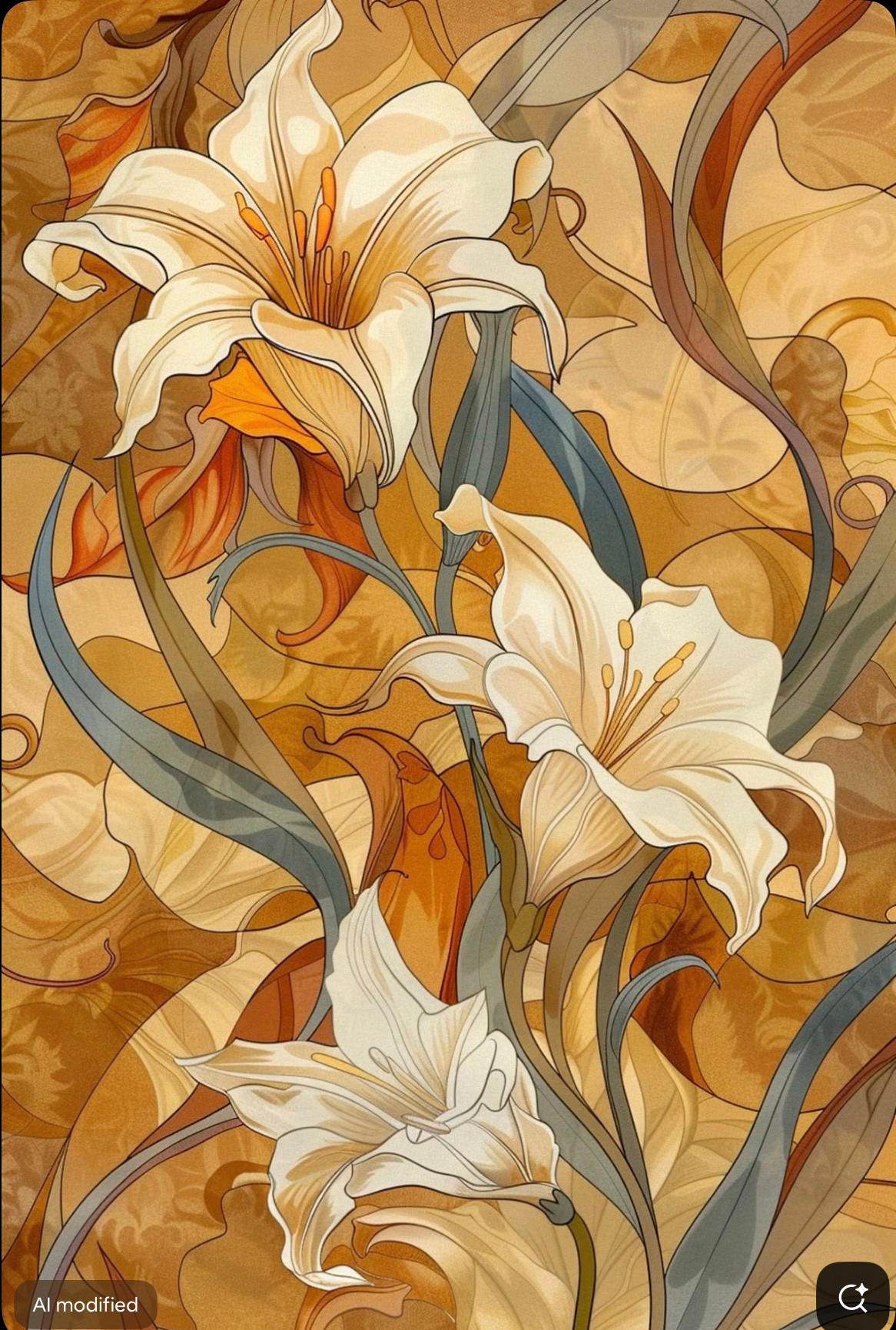
The images I’ve been collecting share a handful of things, and every one of them reads like a cut list to me:
- The arch. Almost every piece is framed in a rounded or Gothic-style arch, sometimes with scrollwork tucked into the corners. That frame does half the work. It turns a bunch of flowers into a window.
- The line. Nothing is straight. Stems bend, leaves curl back on themselves, tendrils loop off into the background. Art Nouveau artists called it the “whiplash” curve, and it’s the whole personality of the style.
- The palette. Warm cream petals, burnt orange trumpets, muted sage and teal leaves, a deep espresso or green background, and a little gold in the trim. Those are wood colors. I don’t have to fake any of them.
- The layering. Flowers sit in front of stems, stems in front of leaves, leaves in front of a textured background. That depth is exactly what marquetry is good at.
Why This Style Speaks to a Woodworker
Art Nouveau came out of the late 1800s as a reaction against factory-made everything. The artists and craftsmen behind it wanted objects that looked grown rather than manufactured, and they leaned hard on nature: lilies, irises, vines, dragonflies, butterflies. Furniture makers of that era were inlaying these same motifs into cabinet doors and tabletops with veneer.
That’s the part that gets me. The style was born in workshops, not just on paper. Bringing it back into wood feels less like copying a picture and more like returning it home.
It also lines up with what I care about in my own work: hand-cut, slow, and built to be handed down. A printed poster fades and gets replaced. A marquetry panel gets inherited.
Turning Paint Into Wood
The first real design question is color, and in marquetry, color means species. Here’s where my head is right now (this will shift once I’m standing at the veneer rack):
- Lily petals (cream/white): holly or sycamore, with sand-shading along the petal edges to give them that curl and depth.
- Orange trumpet blooms: padauk or a warm figured cherry, depending on how loud I want it.
- Stems and leaves (sage/olive): poplar with green heartwood streaks, plus a darker olive tone for the leaves that sit further back.
- Background: walnut or fumed oak for a dark ground like the moody versions, or a mottled figured maple for the warm golden versions.
- Arch and corner scrollwork: a contrasting border, possibly with a brass-toned species like satinwood for that gilded look.
I’m not reproducing any single image. I’m pulling the arch, the curve, the lily, and the palette, and drawing my own composition from there.
How I Plan to Build It
This piece pulls together almost every skill I use in the shop, which is part of why I’m excited about it:
- Drawing. Full-size pattern on paper first, working out where every petal overlaps every leaf. This is where the whiplash curves either flow or fall flat.
- Cutting the marquetry. Packet-cutting the veneer on the scroll saw so the pieces nest tightly, then sand-shading the petals in hot sand to create shadow without stain.
- Pressing. The assembled veneer face goes onto a stable substrate in my new vacuum press, which is exactly the kind of job I bought it for.
- The frame. I’d like the arch to be real, not just drawn in. A bent-lamination arched top on a solid frame would echo the shape in three dimensions.
- Finish. A clear finish that lets the wood colors deepen and glow over time instead of sitting under a plastic-looking film.
What’s Next
I’ll be sharing the process as it happens: sketches, the species pull, the cutting, the first time the panel comes out of the press. If you’ve ever wanted to see how a painting-style image becomes a piece of wood you can hang on the wall, follow along.
And if Art Nouveau speaks to you too, I’d love to hear about it. A custom wall panel built around your own favorite flower, or a motif inlaid into a cabinet door, is exactly the kind of commission I live for.
Anderson Woodwork · Yelm, WA · Serving Thurston & Pierce Counties Call or text (360) 259-0232 · andersonwoodwork.net


Discover more from Anderson woodworks custom furniture & cabinets
Subscribe to get the latest posts sent to your email.

Leave a reply