

Federalist furniture was born in a moment of pause.
The war had ended. The dust had settled. America, new and uncertain, stood still long enough to ask a quiet question: Who are we now?
The answer wasn’t shouted. It was measured, thoughtful, and carved—sometimes in mahogany, sometimes in cherry—but always with intention.
Between 1780 and 1820, as the Constitution took shape and the idea of a republic became real, furniture began to change. Heavy colonial forms gave way to something lighter. More deliberate. Less about authority, more about ideals.
This was the Federalist style.
A Style That Chose Restraint
Federal furniture doesn’t overwhelm a room. It waits for you to notice.
Where earlier styles leaned on mass and ornament, Federalist pieces relied on proportion. Lines were straight but never rigid. Curves appeared gently, like a breath held and released. Nothing was accidental—nothing was loud.
Influenced by ancient Greece and Rome, by the symmetry of classical architecture, Federalist furniture reflected a belief that beauty comes from order. That reason and balance could be built, not just written into law.
The Language of the Details
Federal furniture speaks in details meant to be discovered, not announced.
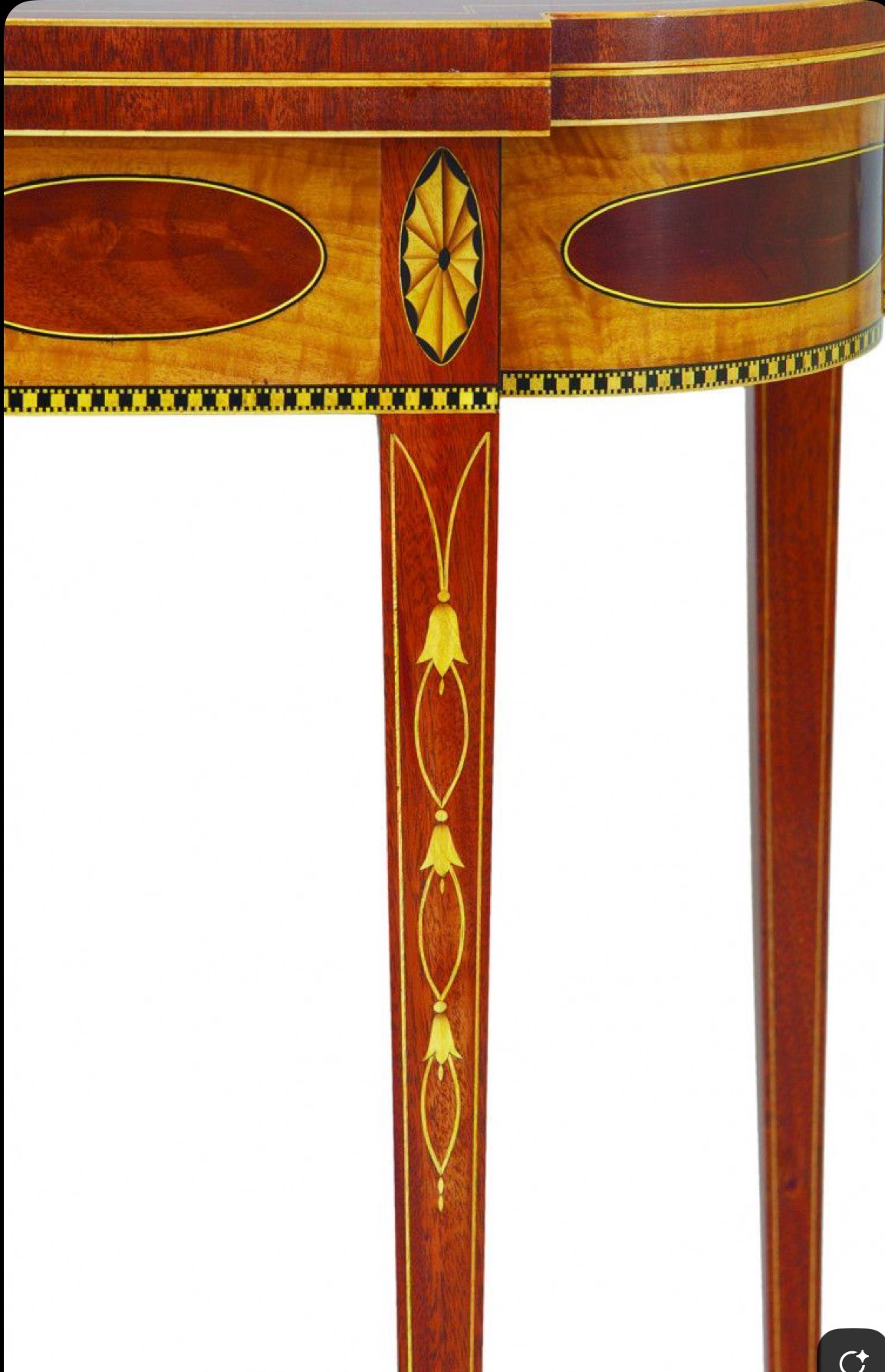
A fine line of inlay tracing the edge of a tabletop.
A fan motif tucked into the corner of a drawer.
A bellflower descending a tapered leg like a quiet signature.
These weren’t decorations for the sake of decoration. They were moments of pause—places where the maker left evidence of care. Where skill revealed itself only to those willing to look closely.
Carving stepped back. Inlay stepped forward. Precision replaced excess.
Wood as Character
The makers of the Federal period understood wood not as a surface, but as a voice.
Mahogany carried authority without arrogance.
Cherry warmed with age and light.
Maple caught reflections and softened them.
Contrasting woods were used sparingly, like punctuation in a sentence. The grain was allowed to speak. The finish was meant to protect, not distract.
This furniture trusted the material. And in doing so, it trusted the viewer.
Furniture for a Republic
Federalist furniture was made for homes where ideas mattered.
These pieces lived in parlors where books were read, letters were written, and conversations stretched late into the evening. They framed bay windows and hearths, held desks where decisions were made, and chairs where people sat upright—not from discomfort, but from intention.
This was furniture for citizens, not subjects.
Why It Still Feels Right
Two centuries later, Federalist furniture still belongs.
It works because it doesn’t chase attention.
It holds space rather than filling it.
It respects the room, the material, and the hand that made it.
In a world that often favors more, Federalist design reminds us that less—done well—lasts longer.
It is furniture with a spine. With patience. With quiet confidence.
And like the ideals that shaped it, it was built to endure.
Carrying Federalist Ideals Forward
Federalist furniture was never about nostalgia. It was about intention.
That idea translates cleanly into modern custom work—especially here in the Pacific Northwest, where craftsmanship is still measured by hand, not by speed. In a place shaped by forests, water, and weather, we understand restraint. We understand letting materials speak. We understand that the best work doesn’t rush you.
As a maker, Federalist design feels familiar. The demand for precision. The insistence on proportion. The quiet discipline of doing something the right way, even when no one will ever notice—except you.
Those fine lines of inlay from two centuries ago become today’s tight reveals.
The tapered legs become carefully chosen joinery.
The balance becomes the way a piece sits in a room and feels like it has always belonged there.
Using woods like walnut, maple, cherry, or alder sourced close to home, modern Federal-inspired furniture carries the same DNA—built to age, to patina, to gather stories instead of trends.
A Style That Respects Time
Federalist furniture doesn’t beg for attention. It earns it slowly.
It’s the kind of piece you live with for years before fully understanding. The drawer that still glides smoothly. The proportions that never feel dated. The way it holds books, light, or silence without trying to define the space too tightly.
That philosophy aligns perfectly with custom furniture: building fewer things, better things, and building them to last.
Built Then. Built Now. Built to Last.
The craftsmen of the Federal period were shaping more than furniture—they were shaping identity. Today, the work continues in small shops, garages, and studios, where hands still guide the process and decisions are still made one cut at a time.
Federalist furniture reminds us that good design is not loud.
Good craftsmanship does not explain itself.
And the best work—whether built in 1790 or today—stands quietly, doing its job well.
That’s not old-fashioned.
That’s timeless.
Discover more from Anderson woodworks custom furniture & cabinets
Subscribe to get the latest posts sent to your email.



1 Comment
Leave your reply.