
She came to me with a list. A wine fridge that needed a home. Pantry storage that was running out of room. A few drawers for the odds and ends that pile up in every kitchen. And she wanted it all in one piece — something freestanding, something solid, something she could paint to match her space.
That’s a great brief. Clear, functional, and with just enough creative latitude to do it right.
Built for the Space, Not the Box Store
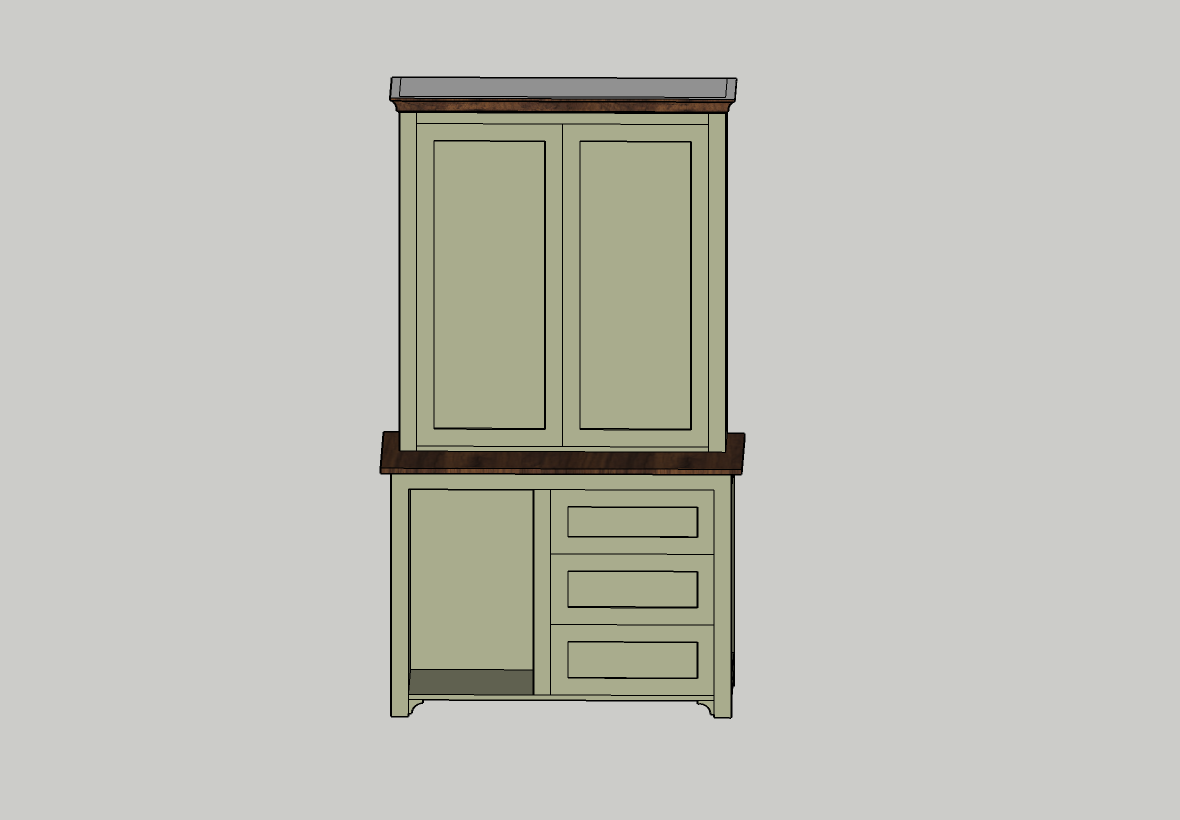
The first thing we worked out was the layout. The lower base needed to do two jobs at once: house the wine fridge in an open bay on the left, and provide three full-extension drawers on the right for dry goods, linens, or whatever ends up living in a pantry long-term. No wasted space, no awkward gaps — just a base that fits the way she actually uses her kitchen.
Above that, the upper hutch sits on a solid walnut countertop and gives her two large cabinet doors and real interior storage. The piece is fully freestanding, so it can move with her if she ever needs it to.
Why Solid Wood Changes Everything
This piece is built entirely from solid wood — not plywood core with a veneer face, not MDF with a paint-grade skin. Solid wood. That distinction matters more than most people realize.
A solid wood frame moves as a unit. It’s repairable. It can be stripped, refinished, or repainted fifty years from now without losing integrity. When you’re building something to last in a home — especially something in a kitchen or pantry environment where humidity fluctuates — solid construction isn’t a luxury, it’s the right call.
Paint + Walnut: A Combination That Earns Its Place
My client chose to paint the body, which I fully support. Paint reads clean and timeless on a piece like this, and it gives her flexibility to update the color if her kitchen ever changes direction.
But here’s the move that ties the whole piece together: solid walnut for the crown and the countertop surface.
Walnut against a painted body — especially a muted sage or cream — is one of those pairings that works because of contrast. The dark, figured grain of the walnut reads warm and rich next to the painted finish. The crown detail draws the eye upward and gives the piece architectural presence. It stops being a cabinet and starts being furniture.
That’s the difference between a functional piece and one that someone points out to guests.
What “Custom” Actually Means
I hear this a lot: I didn’t know I could get something custom without it costing a fortune. And honestly, that’s a fair assumption if you’ve only ever looked at showroom pricing.
Here’s how my process works. We start with a free on-site rough estimate — I come to your space, look at what you’re working with, and give you a real ballpark before any money changes hands. If the project makes sense and you want to move forward, we go into a paid design phase where I produce the actual plans and specs. From there, I build it.
No guesswork. No surprises. Just a piece built to fit your space and your life.
If You’ve Got a Pantry Problem
A wine fridge that doesn’t have a real home. Storage that’s been cobbled together from pieces that don’t quite fit. A corner of your kitchen that’s functional but not finished.
That’s exactly the kind of problem I build for. Reach out and let’s talk about what’s possible.
Book Your Free On-Site Estimate
Discover more from Anderson woodworks custom furniture & cabinets
Subscribe to get the latest posts sent to your email.