
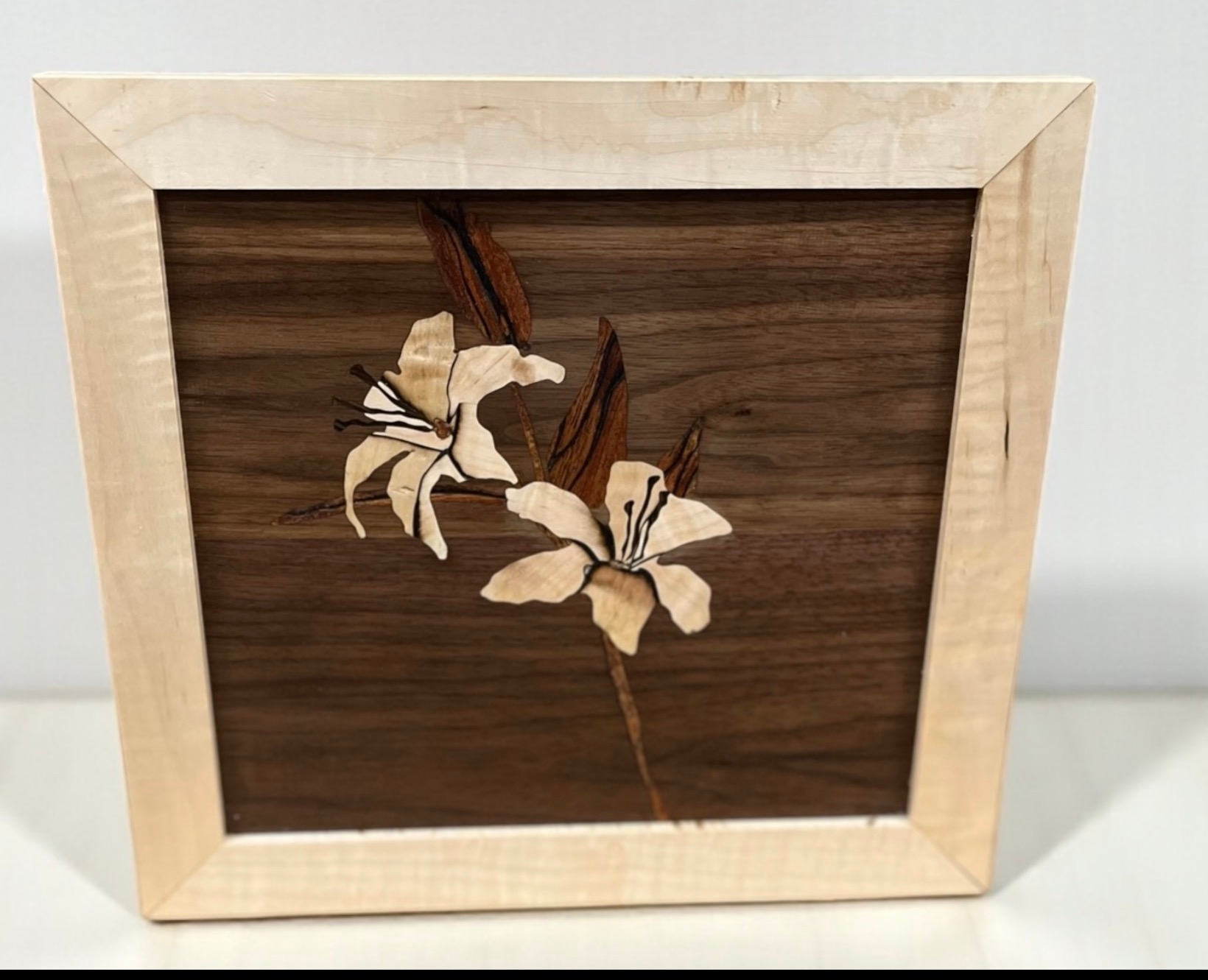
There’s a moment when you’re standing in front of a great piece of marquetry and your eye tells you it’s a painting a spray of flowers, a bird mid-flight, a ribbon caught in a breeze and then you lean in and realize there isn’t a drop of paint on it. Every shade, every shadow, every soft gradient of color is a separate sliver of wood, cut and fitted like a jigsaw puzzle so tight the seams nearly vanish. That’s marquetry, and it’s one of the oldest and most demanding decorative arts in woodworking.
At Anderson Woodwork, hand-cut detail is the heart of what we do, so this is a tradition close to home. Here’s a look at where marquetry came from, the masters who defined it, and the famous homes where you can still find it today.
A Quick Word on What Marquetry Actually Is
People use “marquetry,” “inlay,” and “intarsia” interchangeably, but they’re three different things.
Inlay is the oldest: you carve a recess into a solid piece of wood and set another material wood, ivory, stone, shell down into the cavity. The decoration lives inside the surface.

Intarsia is a Renaissance-era cousin, where shaped blocks and sections of wood are fitted together, often thick enough to create real depth and contour. Italy still uses the word today to describe the craft.
Marquetry is the veneer art. Instead of carving into solid wood, you build a picture out of thin wood veneers some no thicker than cardstock and glue that assembled “skin” onto the surface of the piece. It’s the technique that lets an artisan create sweeping pictorial scenes, and it’s what most people picture when they imagine a flower-covered French cabinet.
Ancient Roots
The impulse to decorate wood with contrasting materials is genuinely ancient. Some of the earliest surviving examples of inlay trace back to Mesopotamia and ancient Egypt one remarkable casket from the city of Ur, dated around 2600 BC, uses ivory set in bitumen to depict scenes of royal and everyday life. The Egyptians were inlaying furniture with ivory and precious stones thousands of years ago.
Even Homer knew the appeal of it. Writing around 700 BC, he has Ulysses describe to Penelope the bridal bed he built himself, made fair “with inlaid work of gold, silver and ivory.” The idea of prized materials worked into fine furniture is about as old as civilization.
But marquetry as we know it pictures built from wood veneers rather than carved recesses really arrives with the European Renaissance. Italian craftsmen revived and reinvented the tradition, first through intarsia used to decorate church furniture and paneling, and by the 16th century the technique had begun to spread north and evolve into true veneer marquetry.
The Golden Age: France in the 17th and 18th Centuries
If marquetry has a golden era, it’s the France of Louis XIV, XV, and XVI. The technique reached a peak of refinement in the royal workshops that has arguably never been surpassed. A handful of names defined it.
André-Charles Boulle (1642–1732)
Boulle is often called the father of marquetry not because he invented it, but because he elevated it to a fine art. Louis XIV granted him the rare privilege of lodging and working in the Palais du Louvre, and his contemporaries nicknamed him le joailler du meuble “the furniture jeweler.”
His signature was a dramatic style using brass and tortoiseshell, cut together so that a single design yielded two contrasting panels: the première-partie (tortoiseshell background, brass inlay) and its mirror-image contre-partie (brass background, tortoiseshell inlay). This “Boulle work” was so distinctive and so widely imitated that any piece with copper inlay on a dark ground eventually came to be called buhl. He worked with exotic woods from India and South America and drew inspiration from Raphael and Rubens. His clients included the King of Spain and the Duke of Bourbon.
Jean-François Oeben and the Riesener Line
The Boulle tradition passed down through a workshop lineage. Jean-François Oeben a German-born marquetry artist famous for building ingenious mechanisms into his furniture carried it forward, and from Oeben it passed to his most celebrated successor.
Jean-Henri Riesener (1734–1806)
Riesener may be the most admired cabinetmaker of the entire period. A German immigrant who made his career in Paris, he became court cabinetmaker to Louis XVI in 1774 and, more famously, the favorite maker of Queen Marie-Antoinette. He completed the legendary Bureau du Roi (the King’s Desk), started years earlier by Oeben, and signed the marquetry with his own name alone.
His work is instantly recognizable: delicate floral and figurative marquetry, precise trellis and lattice-pattern grounds, and gilt-bronze mounts finished so carefully he’d hide the screwheads under overhanging bronze foliage. Many of his pieces contained clever mechanisms that raised tabletops or angled reading stands. He developed a personal design language specifically for Marie-Antoinette, and her furniture remains some of the most coveted in the world.
David Roentgen (1743–1807)
A German master who sold to the courts of Germany, Russia, and France, Roentgen was renowned for bold, vigorous marquetry pictures and for astonishing mechanical furniture desks and cabinets full of hidden drawers, springs, and moving parts. His pictorial marquetry was considered even bolder than Riesener’s.
Where You’ll Find Famous Marquetry Today
The “famous people with marquetry in their homes” story is really a royal story the great pieces were made for kings and queens, and today they live in palaces and world-class museums.
Marie-Antoinette is the standout patron. She commissioned the finest craftsmen of her age, and Riesener’s pieces filled her private apartments at Versailles and her personal retreat, the Petit Trianon. Her furniture is scattered across the world’s best collections today:
• The Wallace Collection in London holds roughly ten pieces attributed to Riesener, many from Marie-Antoinette’s private rooms considered some of the most important French furniture in existence.
• The Frick Collection in New York holds a chest of drawers and a fall-front desk made for the Queen.
• Waddesdon Manor (the Rothschild estate in England) has her writing table from the Petit Trianon, bought at the famous Hamilton Palace Sale of 1882.
• The J. Paul Getty Museum in Los Angeles holds Versailles pieces, including a marquetry table and chairs made for the Queen.
• The Palace of Versailles itself, of course, remains the original home for much of this tradition.
The through-line: if you visit almost any major decorative-arts museum the Getty, the Frick, the Met, the Wallace the marquetry on display was very often made for European royalty.
Marquetry Isn’t a Dead Art
It would be easy to file marquetry under “Renaissance relic,” but that would be wrong. The craft is alive, and a small community of artists keeps it thriving.
The best-known contemporary American practitioner is Silas Kopf (b. 1949). A Princeton architecture graduate who apprenticed with art-furniture pioneer Wendell Castle, Kopf studied traditional technique at the École Boulle in Paris the school that bears the old master’s name. His work ranges from classical floral cabinets to witty trompe-l’œil scenes so convincing you do a double-take, and he’s built marquetry pianos for Steinway & Sons. The Smithsonian’s James Renwick Alliance named him a Master of the Medium in 2015.
He’s far from alone. A 2025 international survey exhibition called Free Verse, at the Center for Furniture Craftsmanship in Maine, gathered artists from six countries makers like Adrian Ferrazzutti, Paul Schürch, and many others all pushing the veneer tradition in new directions using everything from the traditional foot-powered chevalet to modern laser cutting.
Why We Love It
Marquetry sits right at the intersection of patience, precision, and artistry the same place hand-cut joinery lives. There’s no filler, no shortcut, no paint to cover a mistake. Every piece has to be cut true and fit clean, and the beauty comes entirely from the wood itself: its grain, its figure, its natural range of color.
That’s the same philosophy behind heirloom furniture built to last generations. Whether it’s a dovetailed drawer or a marquetry panel, the goal is the same work that rewards a closer look, and keeps rewarding it a hundred years from now.


Discover more from Anderson woodworks custom furniture & cabinets
Subscribe to get the latest posts sent to your email.