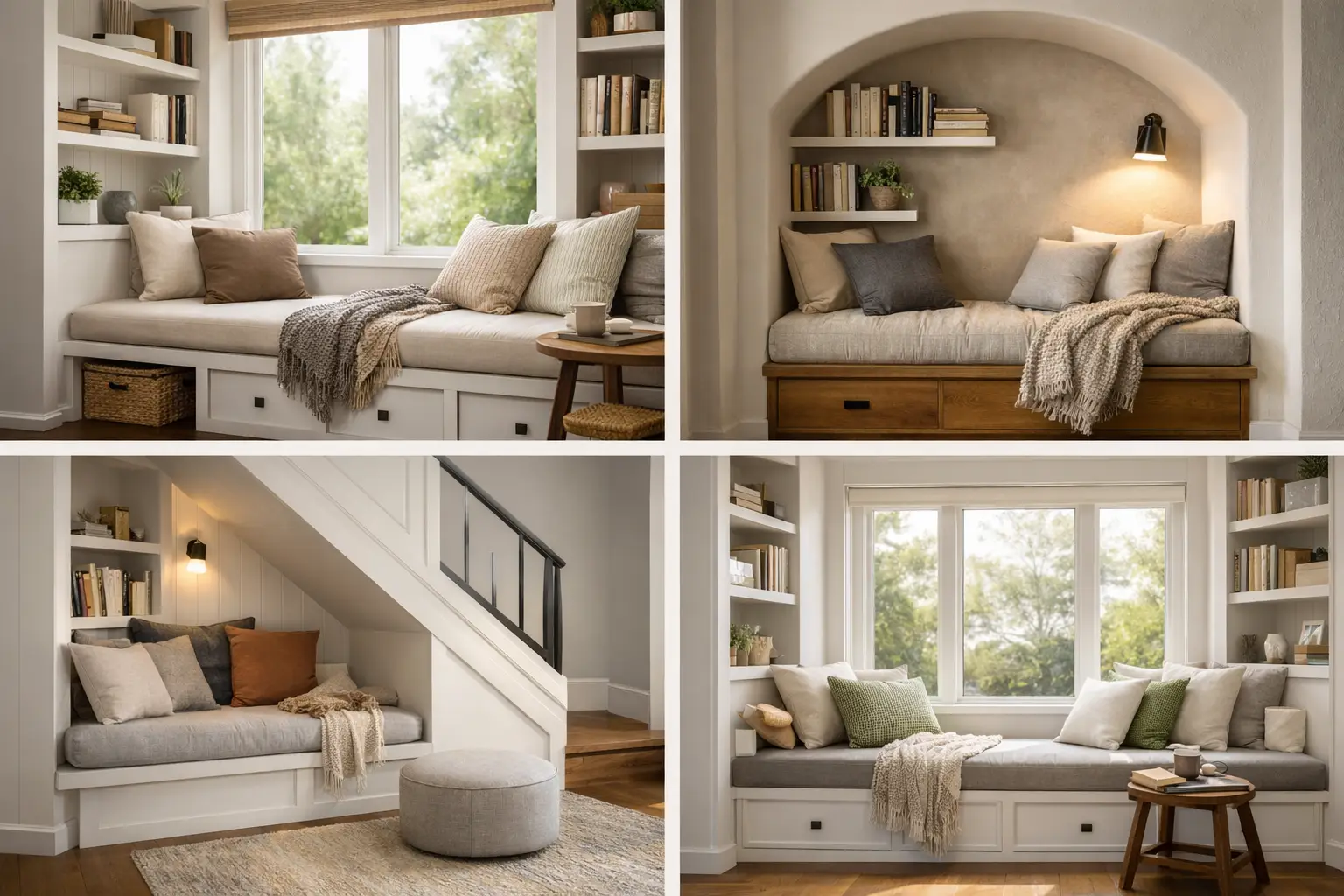
A reading nook should not be a leftover chair beside a window. The strongest reading nook built in ideas treat it as a small architectural destination: a place with enough comfort for an hour, enough storage for the books in rotation, and enough visual weight to belong to the room long after decorative trends have moved on.
This is not decorating. A built-in nook changes circulation, wall proportion, light, and storage. It deserves the same disciplined planning as a cabinet wall or a home office.
Reading Nook Built-In Ideas Begin With the Room
Before selecting a cushion fabric or sketching shelves, establish what the room needs the nook to do. A library-like study may need a quiet, enclosed seat and deep book storage. A family room may need an open perch that keeps sightlines clear. In an entry-adjacent space, the same built-in can combine reading, shoes, bags, and a place to wait.
The wall should determine the form. A shallow wall often calls for a bench integrated into low cabinetry, while a recessed window bay can support a deeper, more enveloping seat. Forcing the same Pinterest-ready window bench into every room usually produces an awkward result: too shallow to lounge in, too tall to sit on comfortably, or too bulky for the architecture around it.
1. Frame a window without crowding it
A window nook works because daylight makes reading easier and the view provides a natural pause. The seat should frame the opening rather than bury it under excessive millwork. In many rooms, simple side bookcases and a substantial bench are more effective than wrapping cabinets over the window.
Keep the sill height in mind. A bench typically lands around 18 inches high before a cushion, but a low window may require a lower, lounge-oriented platform. That is a design decision, not a mistake to hide. If the proportions do not support a conventional seat, build for the actual window instead of fighting it.
2. Use full-height bookcases to give the nook a center
A bench between bookcases creates an immediate focal point, especially in a study, den, or living room with one underused wall. The shelves add vertical structure; the seat creates relief from that structure. Together, they make a reading nook feel intentional rather than inserted.
Do not make every shelf identical. A practical bookcase needs a mix of adjustable shelves for changing collections and fixed elements where they strengthen the composition. A few taller bays can accommodate art books, baskets, or objects without turning the entire wall into display shelving.
3. Build storage under the seat, but choose the right access
Under-seat storage is valuable only if it can be used without frustration. Deep drawers are usually the strongest choice for blankets, games, or seasonal items because their contents remain visible and reachable. Hinged lids can work in a low-traffic nook, but they are less convenient when cushions, books, or people occupy the seat.
Avoid assuming every bench needs storage. In a refined room, a clean plinth or recessed base may be more appropriate than adding compartments simply because space exists. Good built-ins solve real needs. They do not advertise every possible feature.
4. Create a library alcove from an ordinary recess
A shallow recess is often too small for freestanding furniture and too useful to ignore. Lining it with shelves, adding a fitted bench, and carrying the woodwork to the edges can turn an architectural inconvenience into the most memorable part of the room.
The key is depth. Bookshelves can function at roughly 10 to 12 inches deep, but a genuinely comfortable adult seat generally needs closer to 20 inches of finished depth, often more when the back cushion is included. If the recess cannot support that depth, consider a compact chair with shelving instead of an uncomfortable built-in bench.
5. Let a corner nook remain open on one side
Corner reading nooks are useful where a room has two adjacent walls but no natural window bay. The common mistake is overbuilding them into a heavy box. A better approach may be one tall bookcase wall, a bench that turns the corner, and an open outer edge that allows the room to breathe.
This arrangement works particularly well in a family room, where the nook needs to feel connected to conversation rather than isolated. It also allows the bench to double as extra seating without announcing itself as a specialty feature.
6. Add a proper reading light at the planning stage
A beautiful nook with poor light will be used less than intended. Natural light is not enough, particularly during Pacific Northwest winters or in a room used after dinner. Plan for a focused, warm reading light that can be controlled from the seat.
Wall-mounted sconces preserve bench space and make the cabinetry feel finished. A recessed adjustable fixture can work where side walls are unavailable. Whatever the solution, locate it for the reader, not for a photograph. Light should fall across the page without creating glare or casting the reader’s shadow over the book.
7. Include power where daily life actually happens
Even a room designed for reading may hold a phone, tablet, or laptop. A discreet outlet inside a side cabinet, below the bench edge, or behind a shelf keeps cords from crossing the room. It is a small decision with a large effect on how composed the space remains.
This is also the moment to account for existing outlets, return-air vents, baseboard heat, and window treatments. Built-ins cannot simply cover these conditions. They must be designed around them, with proper ventilation and access where needed.
8. Use a back panel to create depth and character
The back of a nook is an opportunity to create material contrast. Painted paneling, clear-finished hardwood, linen-wrapped panels, or a carefully selected wallpaper can give the seat its own visual identity without making it feel disconnected from the larger room.
For a quieter result, use the same species and finish as the surrounding cabinetry but change the panel direction. Vertical grain can make a low nook feel taller. A horizontal detail can emphasize a long, low window. The decision should come from the room’s proportions, not a catalog of trends.
9. Make the cushion substantial, not decorative
A thin pad placed on a hard bench looks finished for about five minutes. A reading nook cushion needs enough density and thickness to support actual use, typically two to four inches depending on seat height and desired feel. The final compressed height matters more than the foam sample in a showroom.
Consider whether the cushion should be one tailored piece or several sections. One piece creates a cleaner line; multiple sections are easier to remove, rotate, and reupholster. For homes with children or pets, durable upholstery and removable covers may be worth the slightly more tailored construction required.
10. Build a shelf ledge for the book in progress
A narrow ledge beside or behind the seat is more useful than it sounds. It gives a reader a place for a mug, glasses, a notebook, or the current stack of books without requiring a separate table to crowd the nook.
Keep it intentional. A ledge around six to eight inches deep is often enough, and it should be positioned where it can be reached from a seated position. If it becomes too deep, it steals seat depth and turns into a surface that collects clutter.
11. Consider a paired nook for shared rooms
In a large family room or library, two smaller built-in seats can be stronger than one oversized bench. They can flank a fireplace, a central cabinet wall, or a pair of windows, creating balance without forcing everyone into one continuous upholstered expanse.
Paired nooks are especially effective when the room serves different activities at once. One person can read while another works nearby, and both have a defined place. The furniture plan becomes clearer because the built-ins establish zones before loose pieces enter the room.
12. Choose materials that improve with use
A built-in nook is part of the house, and its materials should have the same staying power. Solid hardwood edges, durable cabinet construction, well-fitted drawers, and finishes that can be maintained are more meaningful than a complicated profile or an expensive but fragile surface.
Painted cabinetry can be entirely appropriate, particularly when it supports the room’s architecture. Wood deserves consideration when grain, warmth, and tactile quality are central to the design. The question is not whether one is more luxurious than the other. It is whether the material choice gives the room the character and durability it needs.
The Details That Separate a Built-In From a Box
Proportion is where most reading nooks succeed or fail. Shelf widths, drawer reveals, bench height, trim scale, and the relationship between the nook and adjacent doors all need to be resolved together. A built-in that is technically useful but oversized by two inches can make an entire wall feel crowded.
Start with how you read, where you place your feet, and what you want within reach. Then let those daily habits determine the construction. The best nook does not ask you to admire it from across the room. It makes sitting down with a book feel like the most natural thing in the house.
Discover more from Anderson woodworks custom furniture & cabinets
Subscribe to get the latest posts sent to your email.