Why Fine Furniture Is Made for Real Families
Handcrafted, solid wood furniture isn’t a fragile luxury for showrooms. It’s practical, repairable, affordable over the long run, and built for the way real families actually live.
There’s a myth that follows handcrafted furniture everywhere it goes: that it’s fragile, impractical, unaffordable, or “just not for people like me.” As a furniture designer and craftsman and a father of four energetic boys, plus a Labrador who behaves like a fifth — I’ve heard every version of it.
So let’s set the record straight. Here are the three biggest myths I hear about owning fine furniture, and the truth behind each one.
Myth #1: “My Kids Will Destroy Fine Furniture”
This is the myth I hear most at art shows, and it’s the easiest to bust. My own home is a battleground of Nerf wars, wrestling matches, muddy paws, and everyday chaos and my furniture has held up through all of it. Here’s why solid wood furniture is built for real life:
It’s repairable. Scratches buff out. Dings can be steamed. A tired finish can be refreshed to look new again. Damage isn’t the end of the story it’s just the next chapter.

Real joinery is rock solid. Mortise-and-tenon, hand-cut dovetails, and pinned tenons don’t simply snap under pressure. These time-tested joints are built by hand to last generations, not seasons.
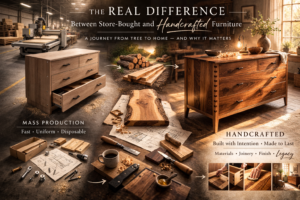
Mass-produced furniture is designed to fail. When a factory chair loses a leg, you throw the whole thing out and buy another. That’s not an accident disposable goods create repeat customers. Handcrafted furniture does the opposite. It creates legacy.
If a piece ever is damaged, it can almost always be repaired often easily. That’s the quiet beauty of real wood and real craftsmanship.
Myth #2: “I Can’t Afford Handcrafted Furniture”
This one is rooted in the economics of quality, and in a culture that has quietly normalized disposable everything. But the math tells a different story.
Quality saves money over time. When you stop buying disposable furniture, you stop replacing it. One well-made piece ends the cycle of churn, waste, and repeat purchases and over a decade, it often costs less than the flat-pack pieces you’d have bought and tossed along the way.
Your labor has value and so does theirs. We live in a moment where wages don’t always reflect the worth of a person’s time. I believe they should. But even within your current budget, there’s a shift available to you: moving from spending to investing.
Myth #3: “It’s Not My Style”

Start small. You don’t have to furnish an entire home overnight. One quality piece at a time. One handcrafted item instead of a mass-produced one. Do that, and your home starts to feel different, your relationship with your space changes, and over time your bank account notices too.
This one always makes me smile, because the solution is usually standing right in front of the person saying it. If you’re talking to a craftsperson, you’re talking to the one person who can design your perfect piece.
Style isn’t a barrier to custom furniture it’s the whole point. Custom work is a collaboration. It’s about building something that fits your home, your story, and your aesthetic. Whether you love mid-century modern, Art Deco, Greene & Greene, farmhouse, or something entirely your own, a good craftsperson can bring it to life.
I don’t want you to settle for the closest thing on a showroom floor. I want you to own something you genuinely cherish.
You Are Worthy of Beautiful Things

Underneath all three myths is a single idea worth saying plainly: you are worthy of owning beautiful, intentional, handcrafted things.
Not because they’re expensive. Not because they’re status symbols. But because your home should feel like a place of comfort, identity, and intention. Handcrafted furniture isn’t really about luxury it’s about legacy. It’s about slowing down in a world obsessed with speed, and choosing something that will outlive trends and outlast chaos.
If more of us allowed ourselves to own things made with care, creativity, and soul, our homes and honestly, the world would feel more grounded, more joyful, and more beautifully our own.
One piece at a time. That’s all it takes.
Frequently Asked Questions
Is solid wood furniture really more durable than manufactured furniture?
Yes. Solid wood can be sanded, steamed, and refinished, and furniture built with traditional joinery like mortise-and-tenon and dovetails is structurally far stronger than the glue-and-staple construction of most mass-produced pieces. When solid wood is damaged, it’s repaired. When particleboard fails, it’s replaced.
Is custom furniture worth the cost?
Over time, it often costs less than repeatedly buying and replacing disposable furniture. A single well-made piece can last for generations, which makes handcrafted furniture an investment rather than an expense.
Can custom furniture match my existing style?
Absolutely. Custom furniture is designed around your home and taste — whether that’s mid-century modern, Art Deco, farmhouse, or a look entirely your own. Style is a starting point for the design, never a limitation.
Commission a Piece Made for Your Life
Every heirloom starts with a conversation. If you’re in the South Sound — Olympia, Yelm, and the surrounding Thurston and Pierce County communities — I’d love to talk through what you have in mind. It begins with a free on-site estimate, and there’s no pressure to commit.
Anderson Woodwork · andersonwoodwork.net · (360) 259-0232 · A.woodworks@hotmail.com
Discover more from Anderson woodworks custom furniture & cabinets
Subscribe to get the latest posts sent to your email.