
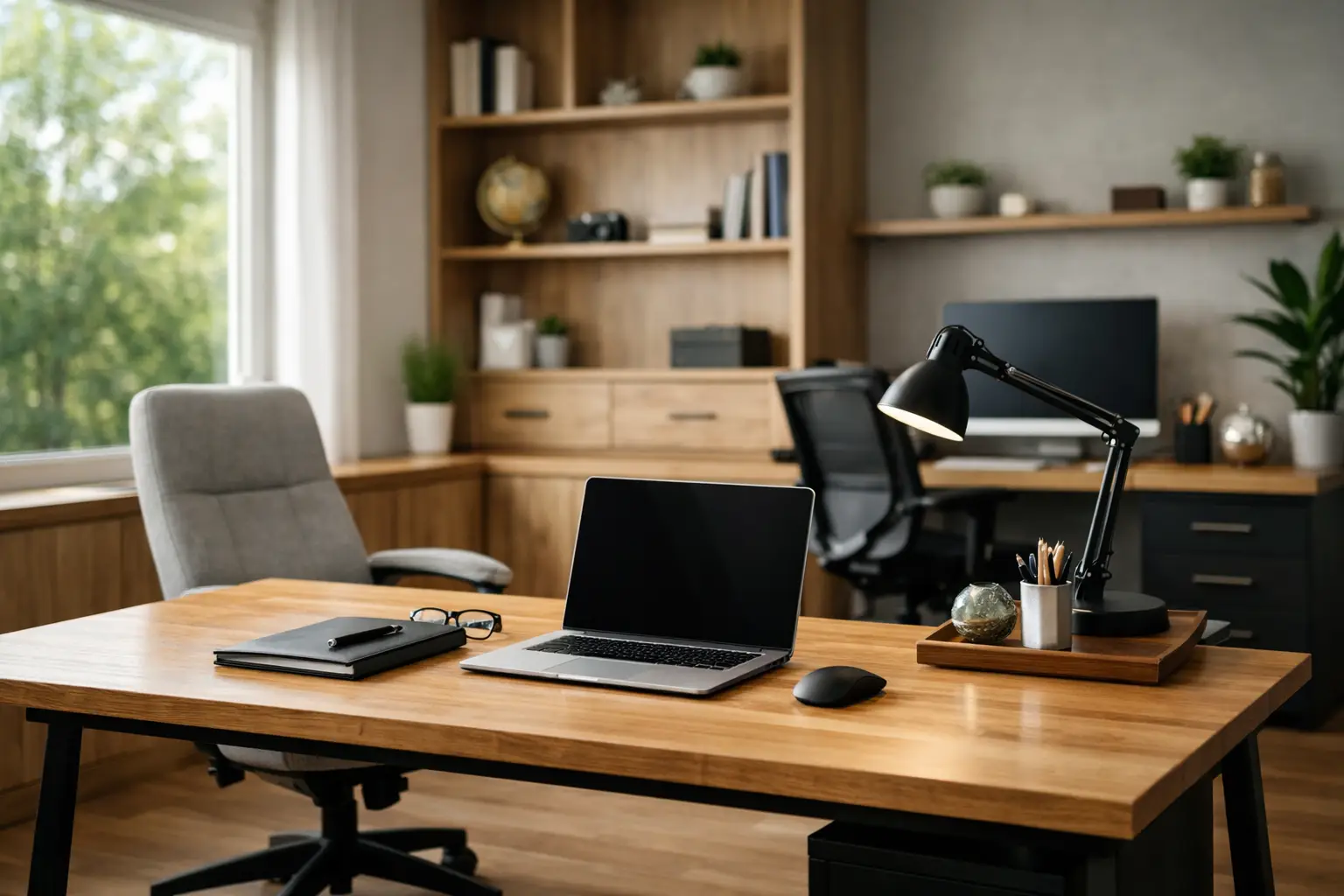
A home office fails long before the wrong paint color goes on the wall. It fails when the desk is too shallow for the work being done, when storage is an afterthought, when glare hits the screen at 2 p.m., and when the room is arranged around leftover furniture instead of daily use. This custom home office design guide starts where good rooms actually begin – with function, proportion, and furniture that sets the terms for everything else.
This is not decorating. A serious home office needs to support concentration, posture, storage, technology, and the specific kind of work that happens there. Whether the room is used for private client calls, focused writing, household management, or a mix of all three, the best results come from designing the office around behavior rather than filling it with generic pieces and hoping it feels finished.
What a custom home office design guide should solve
Most homeowners already know when a room is not working. They feel it in the friction. Papers migrate to the dining table. Cords collect at the baseboard. The printer has no real home. Video calls reveal a background that looks temporary because it is. In many cases, the issue is not a lack of square footage. It is a lack of intention.
A strong office plan solves for workflow first. That means identifying what needs to stay within reach, what should disappear behind doors, and what deserves a permanent surface. A room for deep solitary work will not be planned the same way as a shared office or an executive-style study that also hosts meetings. The right answer depends on how the room earns its keep.
Custom work matters because standard office furniture is built for broad appeal, not for your architecture or your habits. It often misses the wall by an inch, leaves vertical space unused, or forces compromises in cable management, storage depth, and ergonomics. Those small misses add up. Over time, the room feels unsettled because it was never truly resolved.
Start with the work, not the style
Before choosing wood species, finish color, or cabinet door profile, define the workload of the room. Do you work primarily on screen, on paper, or both? Do you need dual monitors, reference shelving, concealed filing, a layout surface, a standing-height perch, or a library wall? Will the office double as a guest room, or does that compromise the quality of the workspace too much? Sometimes a dual-purpose room is sensible. Sometimes it weakens both functions.
The desk is usually the governing piece, and it should be sized with conviction. A desk that is too small creates visual clutter because necessary tools have nowhere to land. A desk that is too large can dominate the room and force awkward circulation. Width, depth, and height all matter, but so does what surrounds the desk. The chair clearance, the reach to storage, and the sightline from the seated position affect whether the room feels calm or constantly demanding.
This is where furniture-led design changes the outcome. Instead of treating furniture as a finishing touch, it becomes the framework that determines layout, lighting placement, outlet strategy, and the balance between open and closed storage.
The case for built-ins and fitted furniture
A custom home office design guide should address one fact plainly: fitted pieces often outperform freestanding furniture in small and mid-sized rooms. Built-ins use the full height of the wall. They create a cleaner visual line. They allow storage to be tailored to the objects that actually need to live there rather than whatever dimensions a manufacturer chose for mass production.
That does not mean every office needs wall-to-wall cabinetry. In some rooms, a single purpose-built desk with a companion credenza is enough. In others, full-height shelving with integrated lower cabinets creates the right mix of display and concealment. The point is not to make the room look expensive. The point is to make it precise.
There are trade-offs. Built-ins require stronger early decisions because they are not easily moved later. They also ask more of the design process up front. But for homeowners planning to stay in their home and use the office regularly, that permanence is often the advantage. The room stops behaving like a temporary setup and starts functioning as part of the architecture.
Storage should be specific, not generic
The fastest way to lose control of an office is to rely on vague storage. A drawer bank labeled for office supplies sounds useful until it has to hold chargers, notebooks, tax records, headphones, printer paper, and backup drives all in one place. Good storage is item-specific. It reflects categories, frequency of use, and what should remain visible.
Closed cabinets are essential for reducing visual noise, especially in a room used for focused work or video meetings. Open shelving has a role, but it should be intentional. Reference books, objects with meaning, and a few working materials can add depth. Random bins and exposed equipment usually do the opposite.
This is also where craftsmanship matters. Drawer depth, divider layout, shelf thickness, door swing, and hardware choice all affect daily use. Fine furniture is not just about appearance. It is about how the piece behaves under constant contact.
Materials, light, and acoustics matter more than trends
A home office does not need fashionable finishes. It needs materials that hold up and age well. Solid wood, quality veneer work, honest hardware, and durable painted surfaces all have a place, depending on the character of the room and the level of use. What matters is coherence. The wood tone should relate to the home. The finish should suit the light. The detailing should match the architecture rather than compete with it.
Natural light is an asset, but unmanaged light can ruin a workspace. Window placement affects glare, monitor position, and concentration. In the Pacific Northwest, where daylight can shift dramatically across seasons, lighting plans need to account for both gray winter afternoons and bright summer exposure. Layered lighting usually works best: ambient light for general comfort, task lighting for the desk, and accent lighting if shelving or cabinetry deserves it.
Acoustics are often overlooked. Hard surfaces can make calls sound sharp and tiring. Upholstered seating, a rug, lined drapery, or even a book-filled wall can improve the room substantially. A well-made office should support how it sounds as much as how it looks.
Layout decisions that hold up over time
The strongest office layouts preserve movement and reduce distraction. That might mean placing the desk to face the room rather than the wall, if privacy and authority matter. In another space, facing a window may be preferable if the view supports calm and glare can be controlled. There is no universal rule. There is only the right arrangement for the room and the person using it.
If two people share the office, symmetry is not always the answer. Identical workstations can look tidy but fail in practice if one person needs paper storage and the other needs open surface area. Shared rooms often work better when each zone is tuned to the user while the overall material palette remains consistent.
Technology should be integrated, not merely accommodated. Plan for outlets where equipment actually lives. Hide cables by design, not by improvisation. Make decisions about printers, docking stations, speakers, and charging before cabinetry is finalized. Retrofitting technology into finished furniture is possible, but it is rarely the cleanest route.
A practical custom home office design guide for homeowners
If you are planning your office seriously, begin with four decisions: the primary work performed in the room, the furniture that must be custom, the storage that must be concealed, and the parts of the room that need to feel quiet. Those decisions shape almost everything that follows.
From there, measure the room carefully and note windows, doors, trim, outlets, vents, and any awkward conditions. Then define what should remain flexible and what should be fixed. A custom desk and built-in wall may be worth the investment, while a lounge chair or side table can remain movable. Not every element has to be bespoke. The right custom pieces do the heavy lifting.
This is where a disciplined design process earns its value. When furniture, interior planning, and fabrication are treated as one conversation, the office becomes more coherent. Proportions improve. Storage makes sense. Materials feel resolved. At Anderson Woodworks, that integration is the difference between a room that looks finished and one that is built to support real work for years.
A good home office should make your day easier by removing friction you have stopped noticing. When the room is planned with that level of care, it does more than photograph well. It earns its place in the house.
Discover more from Anderson woodworks custom furniture & cabinets
Subscribe to get the latest posts sent to your email.
