
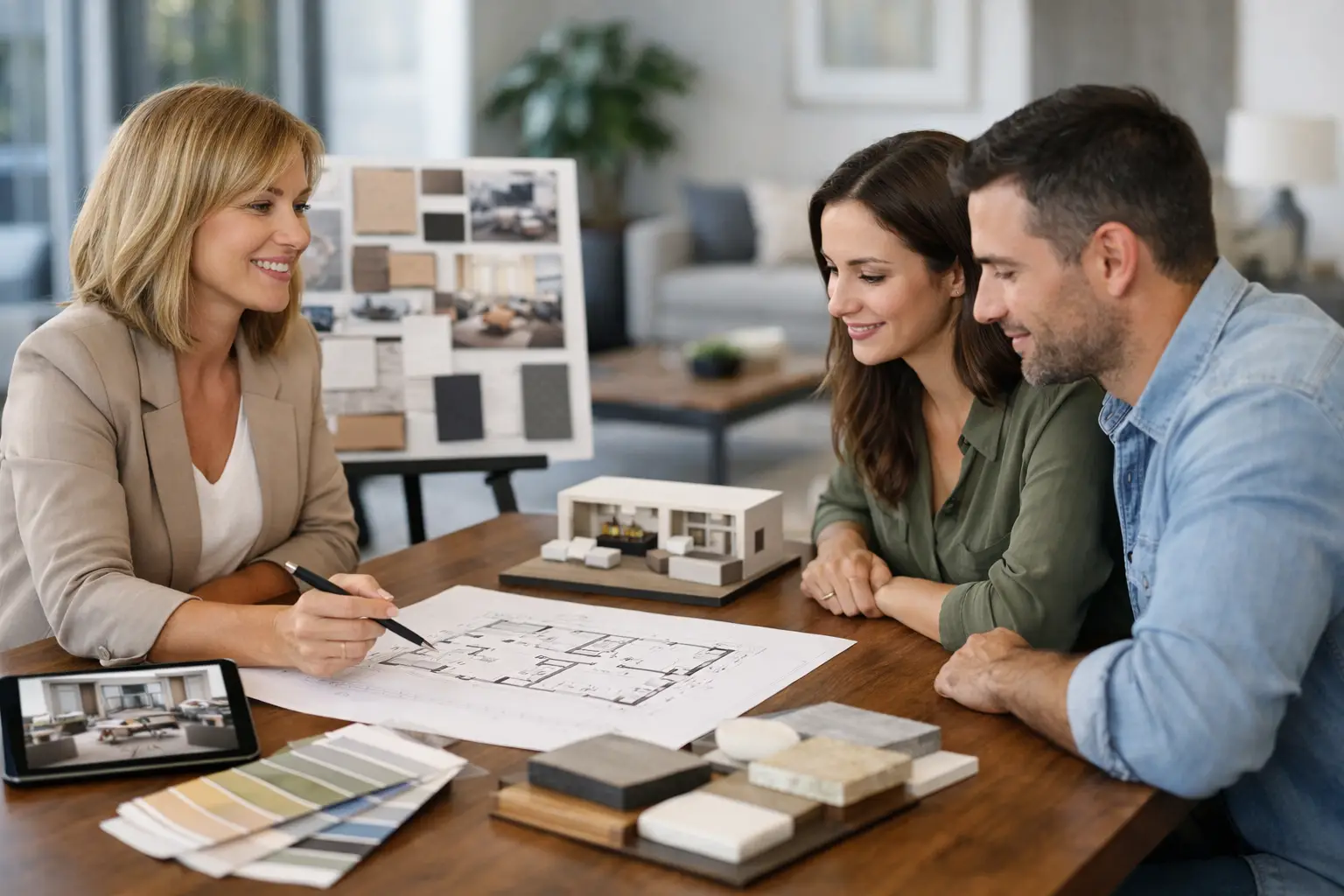
Most rooms do not fail because the paint color was wrong. They fail because the core decisions were made out of order. A proper design consultation for custom interiors corrects that problem at the beginning, before money is spent on pieces that fight the room, crowd circulation, or age badly.
This is not decorating. It is not a mood board exercise built around trends, and it is not a shopping list disguised as a design service. A serious consultation looks at how a room needs to work, what deserves to be built rather than bought, and how furniture, cabinetry, proportion, and material choices should relate to each other over time.
For homeowners investing in a study, dining room, entry, home office, or library-like living space, that distinction matters. The consultation is where the room stops being a set of disconnected wishes and starts becoming a coherent plan.
What a design consultation for custom interiors actually does
A good consultation creates decision-making structure. It helps identify what the room is being asked to do every day, what constraints are real, and where custom work will make the greatest difference. That may mean built-in storage that corrects an awkward wall, a dining table scaled precisely to the room, or a desk and shelving system designed around focused work rather than generic dimensions.
The point is not to make every element custom for the sake of saying it is custom. The point is to establish what should anchor the room. In many cases, furniture is the anchor. Once that is resolved, the rest of the room becomes easier to judge. Circulation improves. Lighting choices make more sense. Cabinet depth, shelf spacing, wall balance, and even textile decisions become more disciplined.
Without that framework, homeowners often spend heavily while still feeling uncertain. They buy pieces that are “close enough,” add storage later, adjust layout repeatedly, and end up with a room that never feels settled. Consultation prevents that drift.
Why starting with furniture changes the outcome
Many interior projects begin with surfaces. People look at paint, tile, hardware, or decor before they have resolved the object that will dominate the room. That sequence usually produces compromises.
In a custom interior, furniture is not an accessory to the room. It often defines the room. A built-in banquette changes how a dining area functions. A properly scaled desk changes how a home office feels and performs. A handcrafted credenza or library wall alters the visual weight of the space and the way movement happens around it.
That is why design consultation for custom interiors should start with proportion, placement, and use. If the table is too large, no finish choice will fix the room. If the cabinetry ignores sightlines, better hardware will not solve the problem. If storage is treated as an afterthought, clutter will eventually override the design.
Starting with furniture also forces better questions. What needs to be concealed, displayed, accessed daily, or protected? How should a room feel at 8 a.m. versus 8 p.m.? What deserves visual emphasis, and what should recede? Those are durable questions. Trend cycles are not.
What happens during the consultation
A strong consultation is part listening, part analysis, and part direction. The listening matters because clients often know exactly what frustrates them, even if they do not have the design language to explain it. They may say a room feels cramped, unfinished, cold, or generic. An experienced designer reads those reactions against scale, function, material mismatch, and poor planning.
The analysis stage is where priorities become clear. Room dimensions, architecture, natural light, circulation paths, storage needs, and existing pieces all need to be evaluated honestly. Sometimes the conclusion is that one custom piece will solve most of the room. Sometimes the conclusion is that the room needs a more complete redesign because the problems are structural, not cosmetic.
Then comes direction. This is where the consultation becomes valuable rather than merely pleasant. Clear recommendations should be made about layout, furniture size, built-in opportunities, materials, wood tones, and what not to do. That last part matters. Good design often requires restraint.
When custom is worth it and when it is not
Not every room needs a full custom buildout. Sometimes a homeowner needs a single foundational piece and a documented plan to guide the rest. Other times, a room has too many competing needs for off-the-shelf furniture to work well.
Custom is worth serious consideration when the room has unusual dimensions, the architecture calls for stronger integration, storage needs are specific, or the space serves a focused purpose such as working from home, entertaining regularly, or housing books, collections, or media. It is also worth it when the homeowner is done replacing mediocre pieces every few years and wants the room resolved properly.
It may be less necessary when the room is temporary, the use is still changing, or the budget is better concentrated on one major anchor piece rather than a fully integrated solution. A good consultation should say that plainly. The goal is not to force custom work into every corner. The goal is to make stronger decisions.
The difference between taste and design direction
Many homeowners arrive with references, saved images, and a rough sense of what they like. That is useful, but taste alone does not produce a room with integrity. Design direction is more disciplined.
A consultation should translate preferences into workable criteria. Not “warm and elevated,” but white oak versus walnut, open shelving versus paneled storage, visible grain versus quieter surfaces, legged furniture versus built-in mass, formal symmetry versus controlled asymmetry. Those distinctions affect fabrication, budget, durability, and the final character of the room.
This is where a craft-led studio brings a different level of rigor. Joinery, wood movement, finish wear, edge profiles, and construction methods are not separate from design. They are part of design. A room built around finely made furniture will always ask for more precision than one assembled from disposable pieces.
What homeowners should bring to a custom interior consultation
Preparation helps, but perfection is not required. The most useful things to bring are real dimensions if available, photos of the room, a candid description of what is not working, and clarity about how the space needs to perform. If there are existing pieces that must stay, that should be stated early. If there is a budget range, that is also worth discussing directly.
It is equally helpful to identify priorities. Is the room meant to feel calm, formal, grounded, quiet, architectural? Does it need to store paperwork, serve dinner parties, conceal technology, or display books and objects? The consultation works best when the functional stakes are clear.
Homeowners do not need to arrive with all the answers. They do need to be open to hearing that some of their assumptions may be limiting the room.
What to expect after the consultation
A useful consultation should leave you with more than general inspiration. It should create momentum. Depending on the scope, that may mean a documented design direction package, a plan for a custom furniture commission, a cabinetry proposal, or a broader room design process.
The key outcome is clarity. You should know what the room needs first, what can wait, what deserves custom fabrication, and how the major pieces should relate. Even if the project unfolds in phases, the room should have a coherent direction from the start.
For homeowners in the Pacific Northwest, where natural materials and lasting craftsmanship tend to resonate more deeply than fast design cycles, this kind of process often feels like a relief. It replaces scattered decisions with a standard.
And that is the real value of design consultation for custom interiors. It does not just help a room look better. It gives the room a stronger logic, so every future decision has something solid to answer to.
The best rooms are not the ones with the most features. They are the ones where nothing feels accidental.
Ready to Transform Your Space?
Your interior deserves more than furniture — it deserves pieces built around the way you actually live. A design consultation with Anderson Woodwork starts with a conversation about your space, your style, and what you want to feel when you walk through the door.

Custom work begins with a single message.
Book Your Design Consultation →
Or call Brian directly at (360) 259-0232. Monday–Friday, 9am–3:30pm.
Discover more from Anderson woodworks custom furniture & cabinets
Subscribe to get the latest posts sent to your email.