
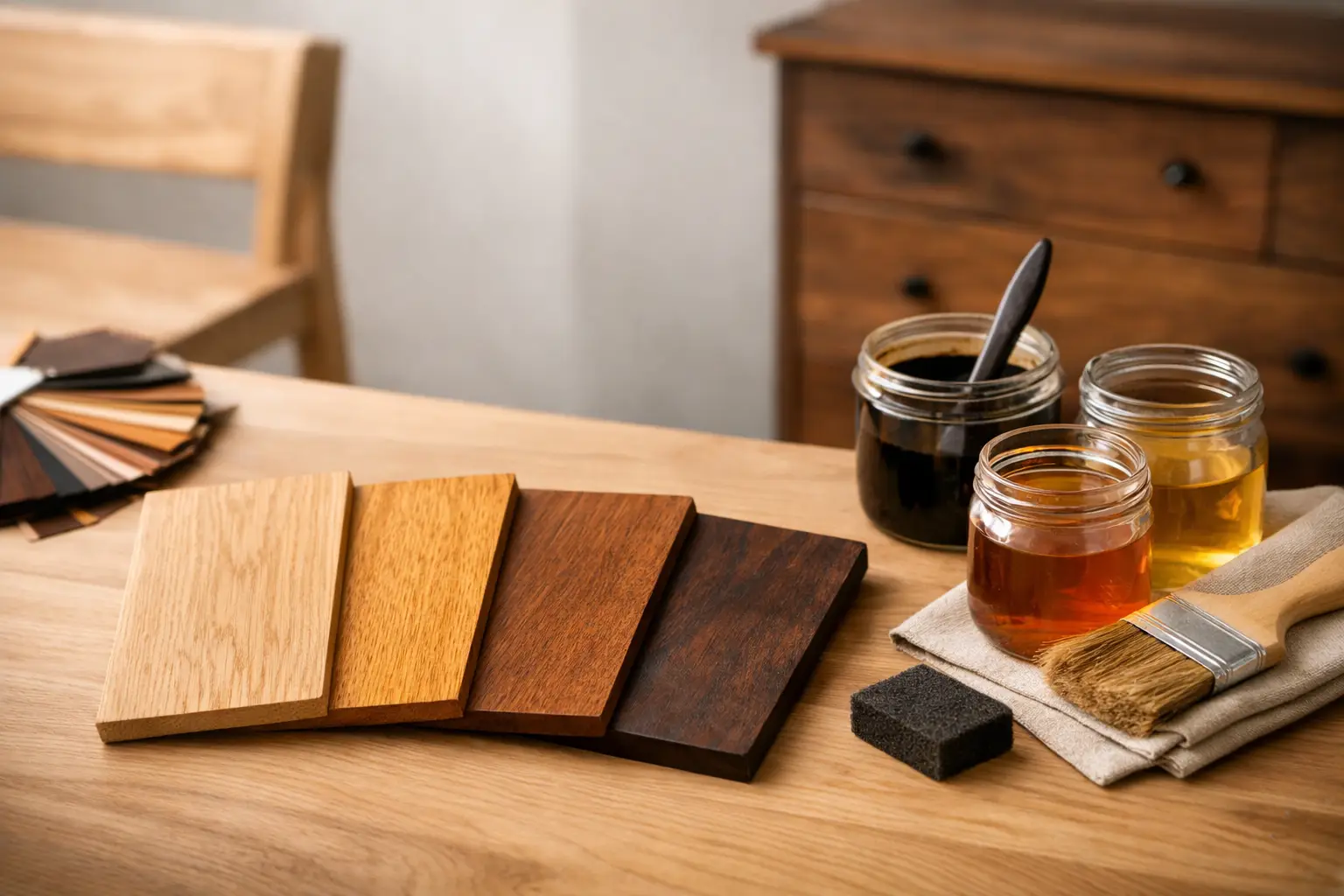
A finish can make a carefully built walnut table feel dry and gray, turn white oak orange, or leave a kitchen cabinet vulnerable to the first wet glass. That is why learning how to choose wood finish for furniture is not a matter of selecting a stain from a small sample card. It is a decision about material, use, light, maintenance, and the kind of aging you are willing to live with.
At Anderson Woodworks, finish is considered alongside proportion, joinery, and placement in the room. It is not the final decorative layer applied after the real work is done. It is part of the furniture’s architecture.
Start With the Wood, Not the Color You Think You Want
Wood is not a neutral substrate waiting to become any color you choose. Every species has its own grain, density, undertone, and response to finish. Cherry deepens dramatically with age and light. Walnut often becomes warmer and lighter over time. White oak has open pores and a strong linear grain that can either be celebrated or muted. Maple can absorb pigment unevenly and produce blotching if handled without care.
A finish should clarify what is already good about the wood. If the material was selected for its figure, pore structure, or natural variation, an opaque treatment may work against the reason for choosing it in the first place. Conversely, paint or a heavily toned finish can be the right choice when a room needs visual restraint, when cabinetry must read as one continuous architectural element, or when the selected wood is intended to serve structure rather than visual drama.
Ask a more precise question than, “What color do I like?” Ask, “What should this species reveal?” A rift-sawn white oak cabinet may deserve a low-sheen finish that preserves its quiet grain. A figured maple desk may need a finish schedule that brings out depth without making it look glossy or artificial. The answer begins with the board, not a trend board.
How to Choose Wood Finish for Furniture by Use
The demands placed on a finish should match the demands placed on the furniture. A console in a formal entry can tolerate a more delicate finish than a dining table that sees hot plates, spilled wine, homework, and daily cleaning. A built-in bookcase and a bathroom vanity do not belong in the same finish conversation.
For furniture that receives regular contact, durability matters. Tabletops, desks, kitchen cabinetry, and bathroom pieces generally need stronger resistance to moisture, abrasion, and household cleaners. That does not automatically mean the hardest finish is the best finish. Some highly protective film-building finishes can be difficult to repair invisibly if they are damaged. Others offer less surface protection but can be renewed locally with skill and patience.
This is the trade-off homeowners should understand: protection and repairability do not always move together. A finish that creates a hard barrier can be useful for a busy family dining table. An oil-and-wax finish can be appropriate for a collector-grade sideboard that is treated with care and valued for its tactile, close-to-the-wood quality. Neither is universally superior. The right choice depends on the object’s actual life.
Consider these questions before committing to a finish:
- Will this piece receive water, food, alcohol, heat, or frequent cleaning?
- Is it used by children, guests, or only adults who understand how to care for it?
- Do you want the surface to develop a visible patina, or stay visually consistent?
- If it is scratched, do you want a craftsperson to repair it, or do you need easy touch-up options?
- Is the piece freestanding furniture, built-in cabinetry, or a high-moisture installation?
Honest answers produce better furniture than aspirational ones. A pale, matte table can be beautiful, but it may not be the correct choice for every household that serves three meals a day at that table.
Decide How Much Texture and Sheen the Room Needs
Sheen changes the way a piece occupies a room. It affects light reflection, perceived color, and how clearly the eye reads the surface. High gloss reflects light sharply and can make a finish feel formal or contemporary, but it also reveals fingerprints, dust, and scratches. Matte finishes are more forgiving and often feel calmer, though extremely flat finishes can sometimes look lifeless if they suppress the wood’s depth.
For most fine residential furniture, a low-luster satin or matte sheen offers the best balance. It allows the material to read as wood rather than as a coated surface. In the soft, angled light common to Pacific Northwest interiors, a restrained sheen can also keep a room from feeling overly reflective during darker months.
Texture deserves the same attention. Open-grain woods such as oak and ash can be left with their pores visible, creating a natural tactile quality. Grain filling produces a smoother, more uniform surface. Neither approach is inherently more refined. Open pores can support a grounded, architectural look, while a filled surface may better suit a sleek desk, a formal dining table, or cabinetry with a more tailored presence.
Do not treat matte, natural-looking finishes as maintenance-free. Low sheen hides some wear, but pale stains and raw-looking treatments can show oils, dark marks, and burnishing from repeated touch. The quieter the finish appears, the more carefully its performance should be specified.
Test the Finish in the Actual Room
A finish sample viewed under showroom lighting is not a decision. It is a starting point. Natural light, paint colors, flooring, upholstery, and the direction a room faces all change how a finish reads.
Request or create samples large enough to show grain movement and tonal variation. A small square of oak cannot tell you what a six-foot cabinet bank or a dining table will look like. Place samples vertically and horizontally, because light lands differently on cabinet doors, desk tops, and table aprons. Look at them in morning light, evening light, and with the lamps you actually use.
This process is especially important with white oak, walnut, and stained finishes. White oak can shift from neutral to golden, gray, or green depending on the finish and surrounding colors. Walnut can look almost espresso in a shadowed room and considerably warmer beside cream walls. Pigmented finishes can obscure grain on one board while catching it strongly on another.
A good sample review is not about finding a perfect, fixed color. Wood is variable by nature. It is about agreeing on an acceptable range of movement so the finished piece feels coherent without looking manufactured.
Think About Aging Before You Fall for a Fresh Sample
New wood does not stay new. Light, oxygen, touch, and ordinary use change both the material and its finish. That change can be an asset when it is anticipated. Cherry gains richness. Brass hardware develops character. A well-used desk may develop a softened sheen at the edges where hands rest.
The problem is not patina. The problem is pretending it will not happen. If you need a surface to remain visually uniform, choose a finish and color strategy designed for that expectation. If you want furniture with evidence of life, select materials that age gracefully and accept the marks that come with use.
This is where trend-driven choices often fail. A dramatic pale finish may photograph well when new but become frustrating once daily life leaves its record. A deeper tone, a more forgiving grain, or a finish with a repair path can prove more enduring. Furniture should become more convincing as it settles into the home, not more difficult to live with.
Specify a Finish System, Not Just a Stain
Clients often use “stain” and “finish” interchangeably, but they solve different problems. Stain changes color. Finish protects the wood and establishes its sheen and feel. There may also be conditioners, dyes, sealers, glazes, pore fillers, and toners involved before the final protective coats are applied.
That sequence matters. Two samples with the same named stain can look entirely different depending on the wood species and finish system. A water-based system may preserve a lighter, clearer appearance. An oil-based system may add warmth and ambering. Hardwax oils create a direct, tactile connection to the wood but require an informed maintenance plan. Catalyzed coatings provide significant durability for demanding applications but should be selected with repair strategy in mind.
For custom work, specify the desired visual result and performance standard rather than becoming attached to a product label. Describe whether you want the wood to remain pale, deepen warmly, show open pores, resist water, tolerate daily cleaning, or accept visible patina. Those requirements lead to the appropriate system.
Let the Finish Serve the Whole Room
A furniture finish should not be chosen in isolation from the room it anchors. The floor, wall color, window light, metalwork, textiles, and adjacent millwork all affect the decision. A walnut credenza may need a quieter finish when it sits against dark paneling, but it can carry more presence in a light-filled room with plaster walls and linen upholstery.
The strongest interiors are built through relationships, not matching sets. You do not need every wood tone to be identical. You do need them to feel intentional. Look for shared temperature, contrast, and visual weight. A cool gray floor paired with warm cherry can work beautifully if the bridge between them is established elsewhere in the room. Without that bridge, the same combination can feel accidental.
Choose a finish that respects the material, meets the piece’s daily demands, and belongs to the larger room. When those three conditions are met, the furniture will not merely look finished. It will feel settled, useful, and increasingly at home over the years.
Discover more from Anderson woodworks custom furniture & cabinets
Subscribe to get the latest posts sent to your email.