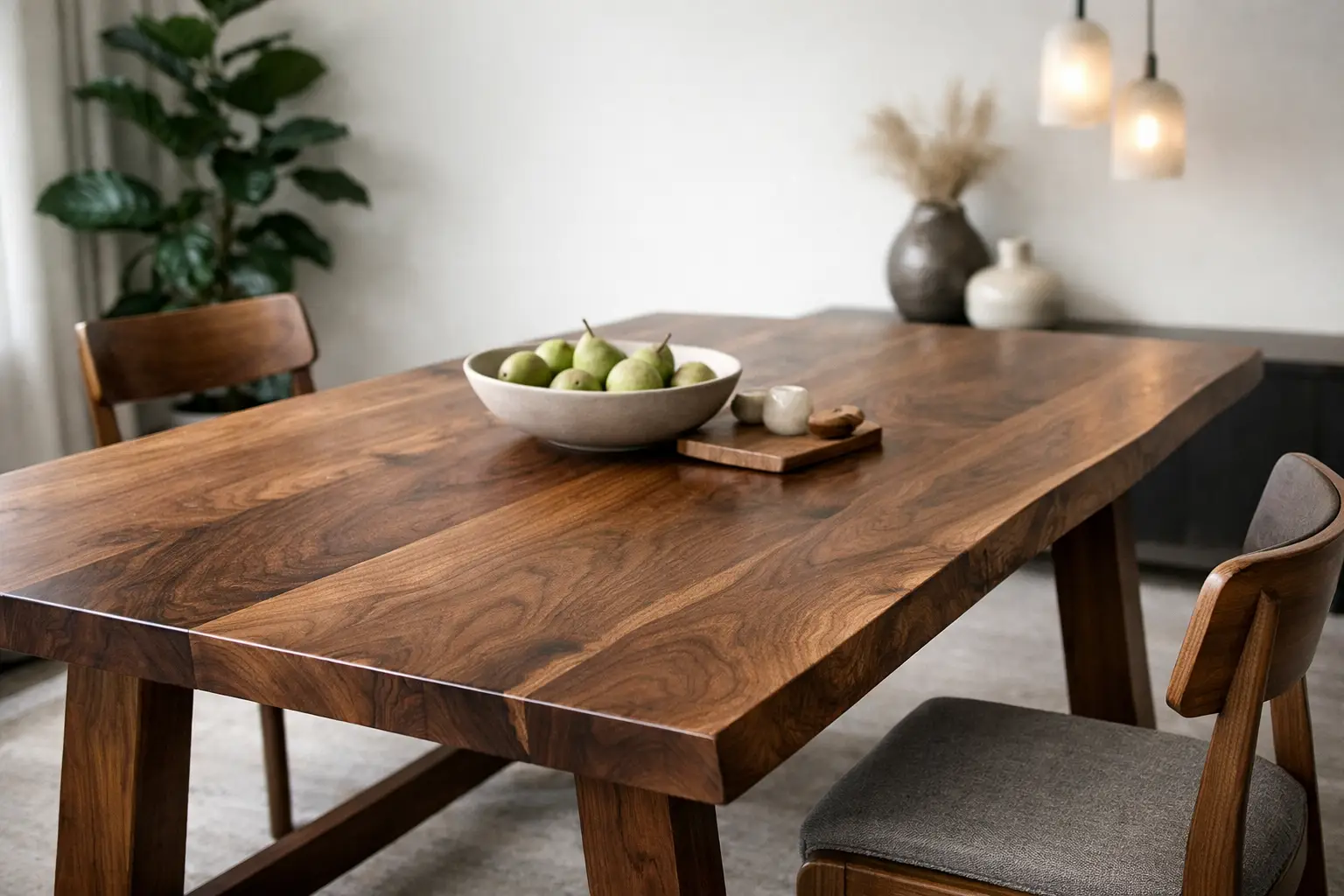
A dining table is not an accessory. It is the working center of the room: where meals stretch long, children spread out homework, guests gather, and daily life leaves its evidence. A handcrafted walnut dining table deserves to be chosen with that level of seriousness. Its beauty is obvious, but its lasting value comes from decisions most people do not see at first glance: proportion, board selection, joinery, base design, finish, and the relationship between the table and the room around it.
Walnut has a quiet authority that makes it especially well suited to a dining room. It can feel formal without becoming stiff and rich without becoming ornate. But walnut alone does not make a table exceptional. The design and construction must carry the same weight as the material.
Why Walnut Earns Its Place
American black walnut has a color range that gives a dining table real depth. Heartwood can move from warm brown to deep chocolate, often with violet, gray, or amber undertones. Sapwood is much lighter. A skilled maker decides whether that contrast should be celebrated, minimized, or excluded based on the character of the piece.
That variation is precisely why walnut furniture feels alive. No stain can manufacture it convincingly, and no printed veneer can replace the shifting grain and natural figure of solid boards. Over time, walnut typically develops a warmer, more settled appearance. The table becomes more itself through use rather than looking dated after a few seasons.
There are trade-offs. Walnut is generally more expensive than many domestic hardwoods, and it is softer than white oak or hard maple. It will collect marks if a household treats it carelessly. That is not a flaw. It is a material reality. The right finish, a well-considered edge profile, and realistic expectations allow walnut to age with dignity rather than demand impossible perfection.
A Handcrafted Walnut Dining Table Starts With the Room
The common mistake is to select a table as an isolated object, then force the rest of the dining room to accommodate it. That is decorating. Good design begins with circulation, chair clearance, ceiling height, window placement, adjacent rooms, and the number of people who actually gather at the table.
As a practical baseline, leave about 36 inches between the table edge and a wall or other fixed obstruction. More space is preferable where people need to pass behind seated diners. Each place setting generally needs 24 inches of table width, though 26 to 28 inches is more comfortable for regular entertaining. These are not arbitrary numbers. They determine whether a room feels composed or cramped.
Table length should be driven by how you live, not by the maximum number of guests you might host once a year. A family of four may be better served by a generous six-person table with the option for extensions than by an oversized table that overwhelms the room every day. Conversely, a dining room used often for large gatherings needs a top and base that accommodate additional seating without creating awkward leg positions.
A custom process earns its value here. Before selecting a silhouette, establish the table’s job. Is it a daily family table? A formal gathering place? A surface that also supports projects, meetings, and weekend cooking? The answer affects nearly every design decision that follows.
Shape Changes the Way a Room Works
Rectangular tables suit long rooms and provide the most efficient seating. They are often the correct answer, but not automatically the most interesting one. A boat-shaped top can soften a rectangle and improve sightlines across the table. An oval can create easier circulation in a tighter room. A round table makes conversation natural, though its footprint grows quickly as seating increases.
The base matters as much as the top. Four legs offer familiarity and structural clarity, but they can interfere with chairs at the corners or along the long sides. A trestle base often gives more flexible seating and creates a strong architectural presence. A pedestal can be excellent for round or smaller tables, provided the base is scaled correctly to resist movement and support the top without looking undersized.
This is where furniture should lead the interior plan. A table’s shape establishes traffic paths, defines the proper scale for a rug and chandelier, and influences what a sideboard, built-in, or nearby seating area can become. The room should be designed around that fact.
Construction Determines Whether It Lasts
A fine dining table should not rely on decorative language to explain its quality. Look at how the top is built, how wood movement is managed, and how the base connects to the top.
Solid walnut expands and contracts across its width as seasonal humidity changes. In the Pacific Northwest, interior conditions can still shift meaningfully between heated winter months and warmer, more open-house seasons. A maker must allow the top to move. Rigidly fastening a broad solid-wood top to its base can lead to splitting, cupping, or structural stress over time.
That does not mean a table needs visible hardware or a compromised appearance. Traditional fastening methods, thoughtfully engineered attachment systems, and sound joinery address movement while preserving a clean design. The point is not to romanticize old techniques. It is to use construction that respects the material.
Board selection is equally important. Wide walnut boards can be dramatic, but a tabletop should be composed with attention to grain direction, color balance, and stability. Matching boards too perfectly can make a table look manufactured. Mixing them without judgment can make it look chaotic. The best work finds a deliberate rhythm that feels natural rather than staged.
Avoid confusing excessive thickness with quality. A very thick top can look heavy and blunt in the wrong room. A thinner top can feel refined, but only if the joinery, support structure, and edge treatment are designed to carry it. Proportion is the measure. A dining table should have visual weight without becoming a block of wood occupying the center of the house.
The Finish Should Support Real Life
A dining table finish has to perform. Water rings, oils, wine, heat, and repeated cleaning are not theoretical concerns. They are the normal conditions of a table that is actually used.
A hand-rubbed oil finish gives walnut a direct, tactile quality and can be easier to renew locally. It also requires a client who understands routine care and accepts that the surface will develop a lived-in patina. A more protective cured finish offers stronger resistance to spills and daily wear, often with less maintenance, though repairs can require more specialized work depending on the system.
Neither approach is universally superior. A household with young children, frequent dinners, and little interest in maintenance may need greater protection. A client who values a finish that can be refreshed and appreciates evidence of use may prefer oil. The correct choice is the one that matches the table’s intended life.
Whatever finish is selected, skip the impulse to over-darken walnut. Heavy stain can flatten its natural range and make a new piece look artificially aged. Walnut has enough character on its own. A finish should clarify the wood, not disguise it.
Details That Separate a Fine Table From a Generic One
The most enduring details are often restrained. An edge profile can make a thick top feel lighter. A subtle under-bevel can create shadow and visual lift. The way an apron meets a leg, the transition from a trestle to its stretcher, and the placement of grain across a top all reveal whether the design was resolved or merely assembled.
Consider chairs early. Armchairs require more clearance than side chairs. Seats with wide arms may not fit between legs. Upholstered chairs bring visual mass and can make a light table appear underscaled. Even the chair fabric and wood tone affect whether walnut reads as warm, severe, traditional, or contemporary.
Lighting deserves the same attention. A fixture centered over the room is not necessarily centered over the table. If the table is intentionally positioned off-center to improve circulation or align with an architectural feature, the lighting plan must respond. This is why a room cannot be solved through isolated purchases.
Commissioning With Intention
A custom table is not simply a chance to choose dimensions and wood species. It is an opportunity to establish a piece of furniture that gives the room its order. At Anderson Woodworks, that process begins with how the space functions and what the table must carry over decades, not with a catalog of fashionable forms.
Bring useful information to the conversation: room dimensions, photographs, existing furniture that will remain, the number of everyday and occasional diners, and any frustrations with your current setup. More importantly, be clear about what you value. Do you want a quiet table that supports the architecture, or a singular piece that becomes the room’s focal point? Do you prefer a pristine surface or one that records family life? Those answers shape the work.
A handcrafted walnut dining table should feel inevitable once it is in place. Not because it disappears, but because its scale, material, and construction make the room work better around it. Choose the table that can hold the life of the house, then let the rest of the room take its direction from there.
Discover more from Anderson woodworks custom furniture & cabinets
Subscribe to get the latest posts sent to your email.