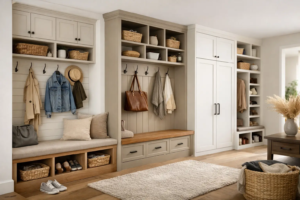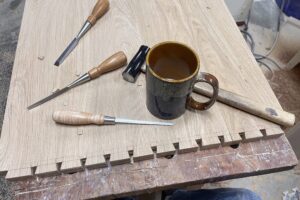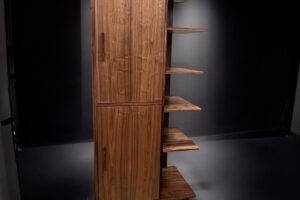

A Collector Line commission begins long before a board is selected or a joint is cut. It begins with a room, a need, and a standard that available furniture cannot meet. This collector furniture commission guide explains what a serious custom piece requires from the homeowner and the maker – and why the process produces work with far more permanence than a quick purchase ever can.
This is not decorating. A collector commission is furniture-led design: the piece establishes proportion, circulation, material direction, storage, and visual weight in the room around it. The result should feel inevitable in its setting, not simply impressive on its own.
What Makes Furniture a Collector Commission?
A collector commission is not defined by an exotic species, a high price, or a complicated silhouette. It is defined by originality and intention. The piece is designed for a specific client, a specific architectural context, and a specific way of living. Its proportions, joinery, material, and details are resolved as one complete idea.
That distinction matters. A built-to-order piece can be an excellent answer when the dimensions and finish are known, the design is already established, and efficiency is a priority. A Collector Line commission is appropriate when the question itself needs design work. Perhaps a dining table must bring authority to a long, narrow room without overpowering it. Perhaps a home office needs to organize daily work, display objects, and improve the room’s character at once. Perhaps an entry needs a singular piece that creates order the moment someone walks through the door.
The work is more involved because the answer is not predetermined. It is developed.
Begin With the Room, Not a Furniture Reference
Many clients arrive with saved images. Those images can be useful for identifying what they respond to: restraint or texture, lightness or mass, formal geometry or a more expressive line. They should not become a template for the commission.
A photograph cannot tell you whether a form will work with your ceiling height, window placement, floor finish, adjacent furniture, or daily habits. It cannot show how a chair pulls back from a table, whether cabinet doors interfere with circulation, or how a dark material will read through a Pacific Northwest winter. A good commission starts by understanding the actual conditions of the room.
Before the design conversation, consider how the space is used at its busiest, not only when it is photographed. In a dining room, that may mean the number of people seated on an ordinary weeknight and during a holiday gathering. In a study, it may mean whether paper, technology, books, and equipment need to disappear or remain accessible. In an entry, it may mean what is carried in, dropped down, stored, and seen from the front door.
The more honestly these patterns are described, the better the piece can serve them. Fine furniture should not ask a household to change its life to accommodate a design gesture.
The Collector Furniture Commission Guide to Scope
The strongest commissions have a clear brief. It does not need to dictate every dimension or detail. In fact, overly prescriptive briefs often prevent the design from improving. It should establish the problem, the priorities, and the level of ambition.
A useful brief identifies the intended room, desired function, approximate scale, material preferences, and any non-negotiable constraints. It should also address the existing architecture. A heavy walnut cabinet may be exactly right against quiet plaster walls and completely wrong in a compact room already defined by dark beams and stone. A pale, highly figured wood may bring needed lightness, or it may compete with an active floor.
Budget belongs in this discussion as well. Not because a commission should be designed backward from a number, but because design integrity requires honest decisions about scope. A piece with hand-shaped components, deeply resolved joinery, custom hardware, and rare material requires different time and resources than a simpler form with a disciplined material palette. There is no virtue in pretending otherwise.
At Anderson Woodworks, the goal is to put the investment where it has lasting value: proportion, construction, material selection, and the details a hand encounters every day. Decorative complexity is not automatically meaningful. A quiet piece can demand more judgment than an elaborate one.
Design Direction Comes Before Fabrication
Fabrication should never be the phase where major design questions are solved. Once material is purchased and construction begins, changes become expensive, disruptive, and often less successful than decisions made on paper.
The design phase establishes the framework. That may include measured drawings, elevations, material direction, finish samples, hardware decisions, and a clear review of how the piece relates to the room. For larger or more integrated work, it can also involve planning surrounding lighting, wall conditions, art placement, and circulation.
This is where a client should expect to make meaningful choices. Do you want a credenza to recede and support the room, or to act as its central visual anchor? Should a table have the visual gravity of a slab, or the refinement of a thinner top with a more articulate base? Does visible joinery reinforce the character of the work, or should construction remain quietly concealed?
There are trade-offs in each direction. A larger case piece can provide storage and visual presence but may constrict a room. A highly expressive board can be extraordinary, but it may make a composition more demanding. Natural wood movement must also be considered. Solid wood is not inert, and a responsible maker designs for its seasonal expansion and contraction rather than fighting it with shortcuts.
Material Is More Than a Finish Choice
Wood carries structure, texture, color, and time. It changes with light and use. It may deepen, mellow, or develop a patina that makes the piece more convincing after years in the home. That is part of the appeal, but it requires the right expectations.
Material selection should be based on how the piece needs to perform and how it needs to feel. Walnut can bring depth and gravity. White oak offers a different kind of clarity and resilience. Maple may give a room a quieter, more luminous presence. Each board also has its own character, from grain direction to figure and color variation. For a collector commission, those qualities are not incidental. They are composed.
The same is true of finishes. A finish should protect the work without turning wood into plastic or hiding the material under unnecessary sheen. The best choice depends on use. A family dining table needs practical resistance to spills and daily cleaning. A display cabinet may allow for a different surface treatment. Care requirements should be discussed plainly before the piece is approved, not discovered after delivery.
Approve the Work With Discipline
A commission needs a decisive approval point. Once drawings, materials, finish direction, and scope are confirmed, the work moves into fabrication. This protects both the client and the maker. It prevents a good design from being weakened by a series of late, disconnected adjustments.
That does not mean the process is rigid for its own sake. It means the sequence respects the work. Early conversations are for exploration. Design review is for resolution. Fabrication is for execution at a high level.
Clients should also understand that handcrafted work takes time. Lead time reflects design development, material sourcing, acclimation, milling, joinery, assembly, finishing, curing, and careful delivery. A rushed schedule can be reasonable when circumstances demand it, but it may limit material options or design complexity. The right timeline is one that protects the quality of the final piece.
Delivery Is Part of the Design
A collector piece should be placed, not merely dropped off. Delivery requires confirming access conditions, stair dimensions, elevator limitations, site readiness, and the condition of the room. For built-ins or large casework, wall conditions and site measurements must be exact before final fabrication.
Placement matters because furniture changes how a room is read. A desk may need to align with a window, a light source, or a view. A dining table may need careful centering within the true usable area rather than the geometric center of the room. A cabinet may be positioned to create a stronger threshold between spaces.
After delivery, live with the piece properly. Use coasters where appropriate, clean with materials suitable for the finish, and avoid dramatic swings in humidity. More importantly, allow the furniture to become part of the household. The small marks of use on a well-made piece are not a failure of the work. They are evidence that it has earned its place.
The right commission does not need to announce itself every day. It simply makes the room work better, hold more meaning, and feel more settled with every passing year.
Discover more from Anderson woodworks custom furniture & cabinets
Subscribe to get the latest posts sent to your email.