A home study fails for predictable reasons. The desk is too small for the work being done, storage is treated as an afterthought, lighting is flattering instead of useful, and the room gets filled with pieces that do not belong to one another. If you want to know how to design a home study properly, start by treating it as a working room first and a styled room second.
This is not decorating. A study should support concentration, reading, writing, planning, and often video calls or administrative work. In some homes it also needs to hold archives, display books, or serve as a quiet retreat. Those are very different demands, and the room should be designed around them with precision.
How to design a home study starts with use
Before you choose wood species, wall color, or hardware, define what happens in the room every week. A study used for bill paying and light laptop work can be modest. A study used for legal documents, large monitors, reference books, or long writing sessions needs more deliberate planning.
Start with duration and frequency. If you work in the room six hours a week, comfort matters. If you work there thirty hours a week, ergonomics and storage become non-negotiable. Then look at the tools the room must support: paper files, printers, chargers, dual monitors, task lighting, books, samples, or private call space. A room designed around real behavior will always outperform one designed from a mood board.
It also helps to decide what should not happen in the study. If exercise equipment, guest overflow, and random household storage start creeping in, the room loses clarity fast. Good design often begins with refusal.
Choose the right location and respect the room
Not every spare room should become a study. The best space is usually one with a door, controllable light, and enough wall area for furniture that actually fits the task. Natural light is valuable, but window placement matters more than window size. Glare across a screen or direct sun on a desktop can make a beautiful room irritating to use.
If the study is part of a larger room, define its boundaries with built-ins, a library wall, or a furniture layout that creates visual separation. This matters in open-plan homes where work can easily feel temporary or improvised. A study should feel claimed.
Architecture should guide the furniture plan. Pay attention to ceiling height, door swing, trim depth, outlet locations, and sightlines from adjacent rooms. These details affect whether the room feels settled or awkward. Custom solutions are often strongest when the room has quirks, because standard furniture rarely respects the architecture.
Build the room around the primary furniture
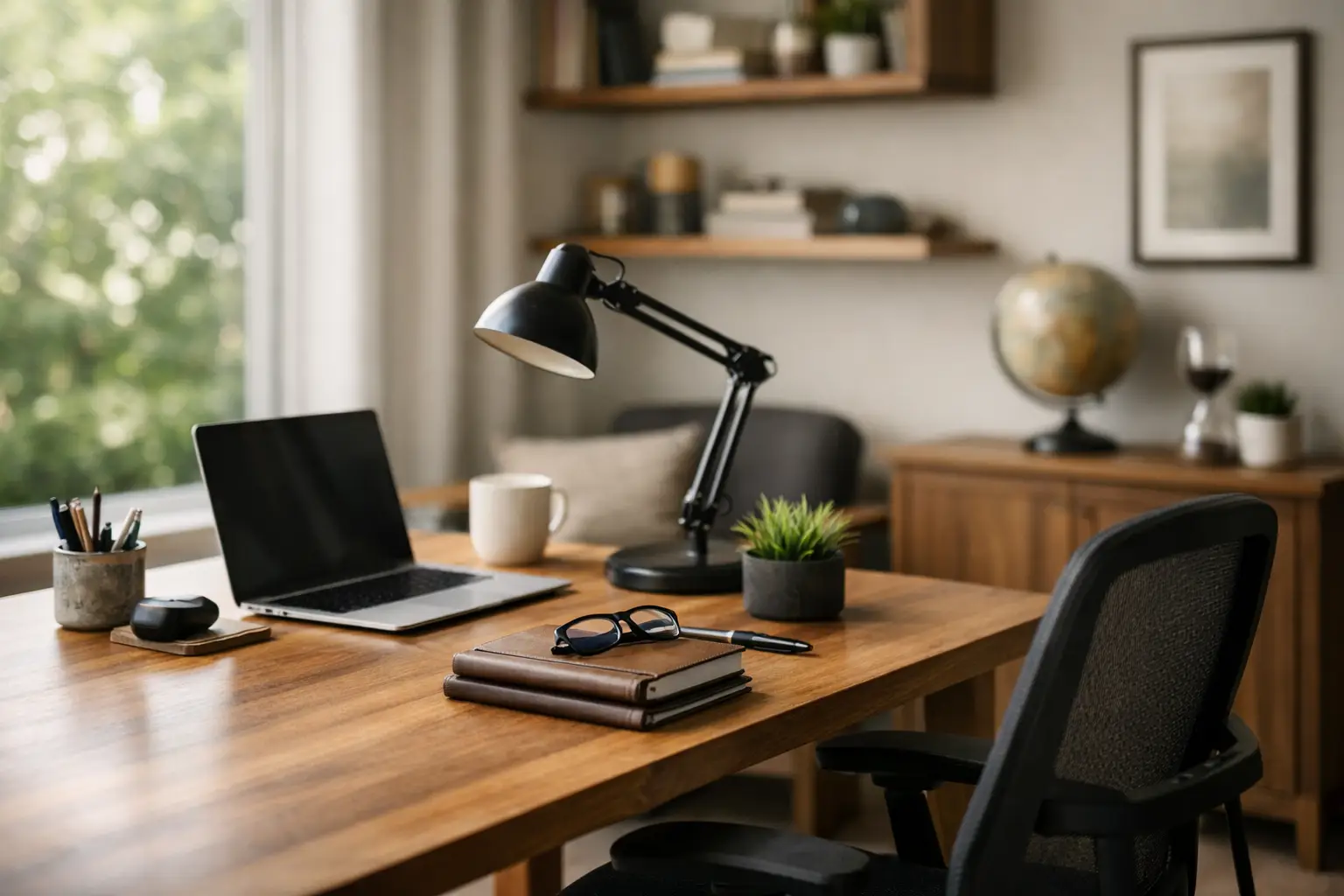
In a serious study, the foundational decision is the main work surface. That may be a freestanding desk, a wall-to-wall built-in desk, or a more substantial worktable depending on how the room is used. This piece determines circulation, storage, lighting placement, and the room’s visual weight.
A desk that is too slight for the room can make the space feel temporary. One that is too large can choke circulation and dominate the architecture. Proportion matters as much as square footage. In many homes, a study works best when the primary furniture has enough mass to anchor the room without turning it into a corporate office.
Material choice matters here too. Thin laminates and disposable surfaces undermine the purpose of a room that should improve with age. Solid wood, quality veneer work, and properly detailed cabinetry bring durability and visual calm. They also age in a way trend-driven pieces do not.
If you need both active work and quiet reading, consider two zones rather than asking one desk to do everything. A reading chair, a small side table, and well-placed lamp can turn a study into a room you want to stay in, not just pass through.
Storage is part of the design, not an accessory
Most studies break down because there is nowhere for necessary things to live. Paper stacks on the desktop because filing was never planned. Chargers, supplies, and equipment migrate into visible clutter because the room has no concealed storage. Shelves get overloaded because they were designed for appearance, not actual capacity.
The right storage plan separates what must be reached daily from what should disappear. Open shelving is useful for books and selected objects, but it should not carry the entire burden of organization. Drawers, cabinets, and integrated file storage do the harder work. A study feels calm when the room can absorb the tools of work without advertising all of them.
This is where custom cabinetry earns its keep. Built-ins can be sized to the exact dimensions of books, files, printers, and awkward equipment. They can also correct for architectural inconsistency, turning an underused wall or alcove into storage that feels inherent to the house.
That said, more storage is not always better. Oversized cabinetry can make a study feel heavy if the room is small. The better approach is edited storage with specific purpose.
Lighting should support focus, not just atmosphere
A home study needs layered light. Ambient light sets the baseline, task lighting supports concentrated work, and accent light adds depth so the room does not feel flat at night. Relying on a single overhead fixture is usually a mistake.
Task lighting should be placed with the work itself in mind. If you read physical documents, your desk needs targeted, controllable light. If you spend most of your time on screens, glare control becomes just as important as brightness. This is one of those areas where the right fixture placement matters more than a decorative statement piece.
Wall sconces over shelving, picture lights above cabinetry, or a shaded lamp near a reading chair can make the room feel composed after dark. But decorative light should not interfere with function. A beautiful fixture that throws poor light is not good design.
In the Pacific Northwest especially, where winter light can be limited, a study benefits from thoughtful artificial lighting that keeps the room usable through short days without becoming harsh.
Materials should create quiet, not noise
A study is one of the best places in a home to be disciplined about materials. Too many finishes create visual static, and visual static makes concentration harder. Limit the palette and choose materials with depth: wood with character, hardware with substance, textiles that soften sound, and paint colors that support focus rather than demand attention.
This does not mean the room must be dark or traditional. It means every material should justify itself. A warm walnut desk, painted built-ins, linen drapery, and a wool rug can create a room with real composure. So can white oak, matte metal hardware, and quieter tones. What matters is coherence.
Acoustics deserve attention too. Hard surfaces everywhere may look crisp, but they often make a study feel echoing and exposed. Upholstery, rugs, and drapery can improve how the room sounds without compromising its authority.
Technology needs a plan
A study can look refined and still support modern work, but only if technology is anticipated early. Think through outlet placement, cord management, monitor depth, printer location, charging drawers, and internet reliability before furniture is finalized.
This is where many otherwise attractive rooms fall apart. The cabinetry is complete, but there is nowhere for a modem. The desk is handsome, but cords trail across the floor. The shelves are symmetrical, but the printer has to live on top of a filing cabinet. Good design resolves these frictions before they appear.
If video calls are part of your week, consider what sits behind you and how the lighting reads on camera. A clean bookcase, paneled wall, or restrained art arrangement will serve you far better than a blank wall or visual clutter.
Make the room specific to you
The best studies have character because they are built around the owner, not around a category label. A collector of books needs different shelving than someone who works almost entirely digitally. A writer may want a larger uninterrupted work surface. Someone reviewing drawings or samples may need broader table depth and different light.
This is why generic office furniture so often disappoints in a home. It solves for averages. Strong residential design does not. It works from the person outward, then shapes the room so function and architecture support one another.
If you are investing in a home study, resist the urge to fill it quickly. Better to choose fewer, stronger pieces and let the room develop with intention than to clutter it with stopgap decisions you will regret in two years.
Anderson Woodworks approaches these rooms from the furniture outward because that is where most of the important decisions begin. When the desk, cabinetry, storage, and proportions are right, the rest of the room can fall into place with confidence.
A well-designed study should make serious work feel natural. Not glamorous, not performative – simply well supported. If the room helps you think clearly the moment you sit down, you made the right decisions.
are you ready to start your project just contact us
Discover more from Anderson woodworks custom furniture & cabinets
Subscribe to get the latest posts sent to your email.