A cabinetry decision often gets reduced to a price comparison far too early. A homeowner sees a standard cabinet box, a finish sample, and a custom quote, then assumes the question is simply whether the upgrade is worth it. It is not. Choosing custom cabinetry or prefab cabinetry determines how a room functions, how it carries visual weight, and whether the design still makes sense after the first few years of use.
Cabinetry is architecture at the scale of daily life. It sets storage capacity, establishes sightlines, absorbs clutter, and creates the proportions that make a kitchen, study, entry, or living room feel composed. The right choice depends on the room, the house, and the standard you expect the finished work to meet.
Custom cabinetry or prefab cabinetry: Start with the room
Prefab cabinetry is a manufactured system built in a fixed set of sizes, finishes, and construction options. It can be well made, especially at higher price points, and it is often a sensible choice for straightforward layouts. A utility room, a rental property, or a kitchen with long, uninterrupted walls may not require a fully bespoke solution.
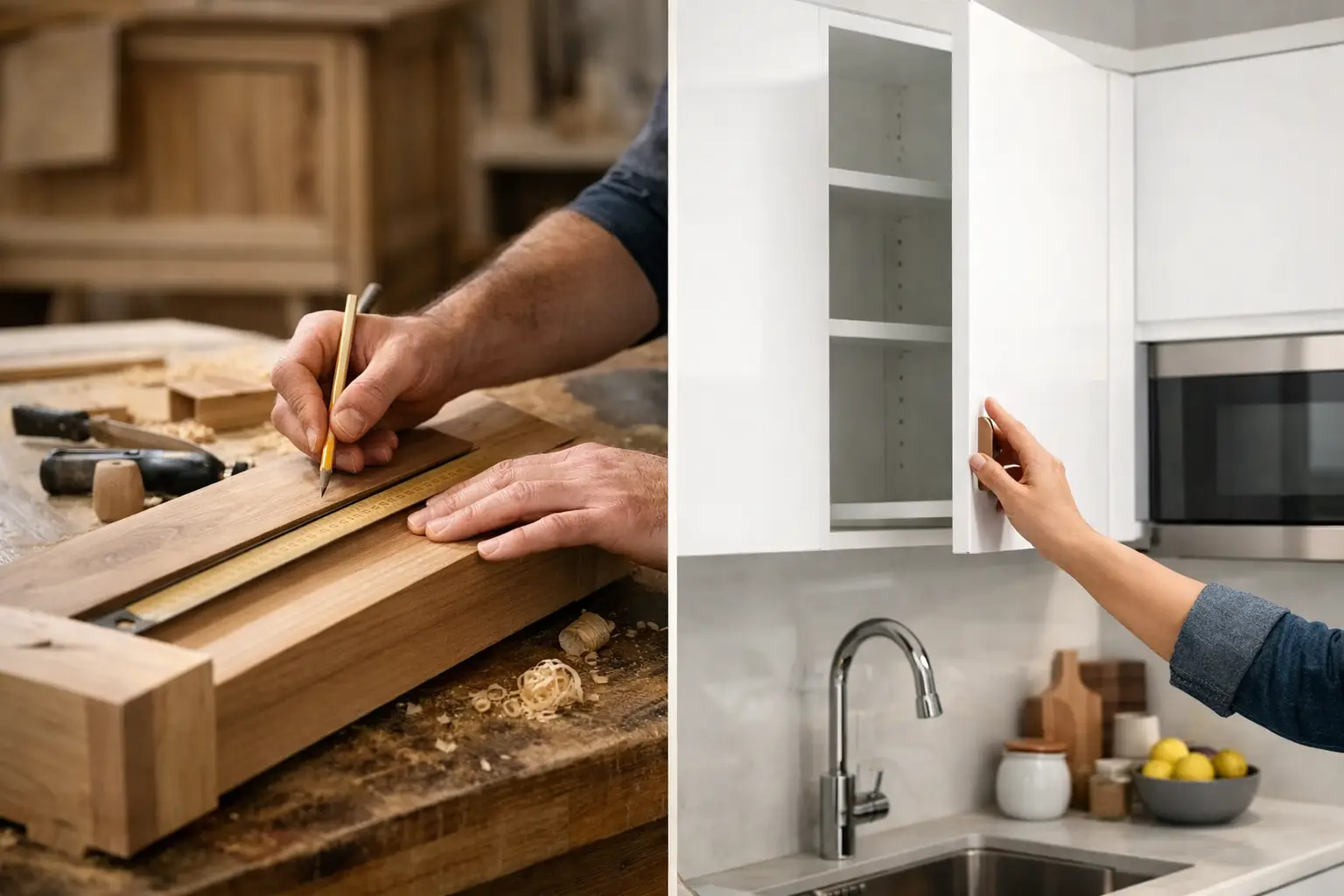
Custom cabinetry is designed and built for a specific space. The cabinet dimensions, internal organization, materials, door profiles, hardware, and surrounding details are considered together. That does not mean every room needs elaborate millwork. It means the work begins with the actual conditions of the house rather than with the limitations of a catalog.
The distinction matters most when the room has constraints. Older homes commonly have out-of-square walls, uneven floors, unusual window placements, shallow alcoves, or transitions that do not align with standard cabinet increments. Pacific Northwest homes also often ask more of their built-ins: an entry may need to handle wet outerwear and bags without becoming a visual pileup, while a home office may need to work as both a serious workplace and a quiet part of the home.
A prefab system can be adapted with fillers, panels, and trim. Sometimes that is perfectly acceptable. But those additions should be intentional, not a way of disguising an arrangement that never truly fit.
What prefab cabinetry does well
Prefab cabinetry offers speed, predictability, and a relatively clear path through the early stages of a project. Manufacturers have already resolved many basic decisions. You select from established box sizes, door styles, finish programs, and accessory options, which can shorten both design time and lead time.
It can also be the right answer when the cabinet run is simple and the project budget needs to prioritize another element. In a kitchen renovation, for example, a homeowner may choose a strong semi-custom cabinet line and direct more resources toward flooring, lighting, appliances, or structural changes. That is a disciplined decision when the layout is sound.
The limitation is not that prefab cabinetry is inherently inferior. The limitation is that it asks the room to conform to a system. Standard widths may leave awkward gaps. Available depths may compromise circulation. A finish that looked convincing on a small sample may not relate well to the wood floors, stone, or existing furniture once it occupies an entire wall.
There is also a difference between adding options and achieving a resolved design. More drawer inserts, more door colors, and more hardware choices do not automatically create cabinetry that belongs in the house.
Where custom cabinetry earns its place
Custom work earns its value when proportion, function, and material continuity matter enough to shape the room around them. It is particularly effective in spaces where cabinetry is not just storage, but the primary visual structure.
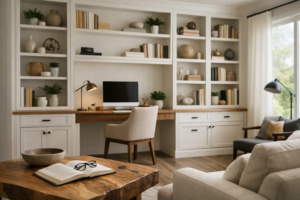
Consider a dining room built-in. Standard cabinets may provide a reasonable base, but they rarely account for the relationship between the unit and the table, windows, ceiling height, artwork, or the circulation path around the room. A custom piece can be designed with a lower visual profile, specific drawer depths for linens and serving pieces, and a wood species that connects to the dining furniture rather than competing with it.
The same is true in a study. A wall of shelves is not automatically a library. The depth of the cases, the spacing of shelves, the rhythm of vertical divisions, the placement of concealed storage, and the integration of lighting all affect whether the room feels calm or overbuilt. These are design decisions, not decorative details.
Custom cabinetry also gives you meaningful control over construction. Plywood versus particleboard, hardwood edge treatment, drawer joinery, face frames, interior finishes, and hardware specification all influence longevity. The best choice is not always the most complicated one, but it should be appropriate to the use. A frequently used drawer deserves different construction than an occasional display cabinet.
At Anderson Woodworks, cabinetry is approached as part of a complete room rather than as a separate purchase. The furniture, the circulation, and the architecture must agree. This is not decorating. It is designing a room that can carry the weight of real life.
Cost is more than the cabinet quote
Custom cabinetry generally costs more upfront because the work includes design development, detailed fabrication, skilled labor, finishing, and installation tailored to the site. A direct comparison with stock cabinets can make custom work appear expensive before the scope is understood.
The more useful comparison is total project value. If prefab cabinetry requires extensive modification, repeated compromises, costly fillers, or a later replacement because it did not function well, its initial savings may narrow. Conversely, ordering custom cabinets for a simple, low-impact room can be an inefficient use of budget.
Ask what the cabinetry must accomplish over the next decade or two. Will it support a changing family routine? Is it a permanent part of a home you intend to keep? Does it need to hold specialized items, conceal technology, or create a room’s central point of order? If the answer is yes, the investment may be justified by daily use rather than resale logic alone.
Custom work should also be priced with clarity. A serious proposal identifies what is included: design, materials, finish, hardware, installation, and site coordination. Vague allowances create avoidable frustration, especially when a project involves several trades.
The decision hinges on proportion
Homeowners often focus first on door style and color. Those choices matter, but proportion has a longer visual life. A cabinet that is too tall, too deep, too shallow, or divided into the wrong widths will continue to feel wrong even if the finish is beautiful.
This is why custom cabinetry is often most valuable on prominent walls and in rooms with architectural complexity. It allows the design to respond to ceiling lines, windows, baseboards, adjacent furniture, and the human scale of the room. A built-in should not look like a row of boxes installed against a wall. It should appear inevitable, as though the room was planned around it.
Prefab cabinetry can achieve a strong result when the designer works carefully within its dimensions. The key is honesty. Do not force a standard system into a space that requires a tailored solution simply because the initial number is easier to accept.
A practical way to choose
Before selecting a cabinet line, define the room’s job. Measure what needs to be stored, observe how people move through the space, and identify what should remain visible versus concealed. Then consider the room from a distance. Which wall carries the eye when you enter? Where does the cabinetry meet existing architecture? What furniture must it relate to?
If those answers point to simple storage in a forgiving space, prefab or semi-custom cabinetry may serve you well. Choose a quality line, insist on a coherent layout, and spend time on installation details.
If the cabinetry must solve an awkward condition, establish the room’s character, or perform several jobs at once, custom work is usually the stronger route. It provides the freedom to make fewer compromises, but it also requires a more deliberate process. That process is valuable. It prevents expensive decisions from being made by default.
The best cabinetry does not announce its price or follow a passing trend. It makes the room easier to live in, gives the architecture a clear center, and remains convincing long after the initial renovation excitement has passed.
Discover more from Anderson woodworks custom furniture & cabinets
Subscribe to get the latest posts sent to your email.