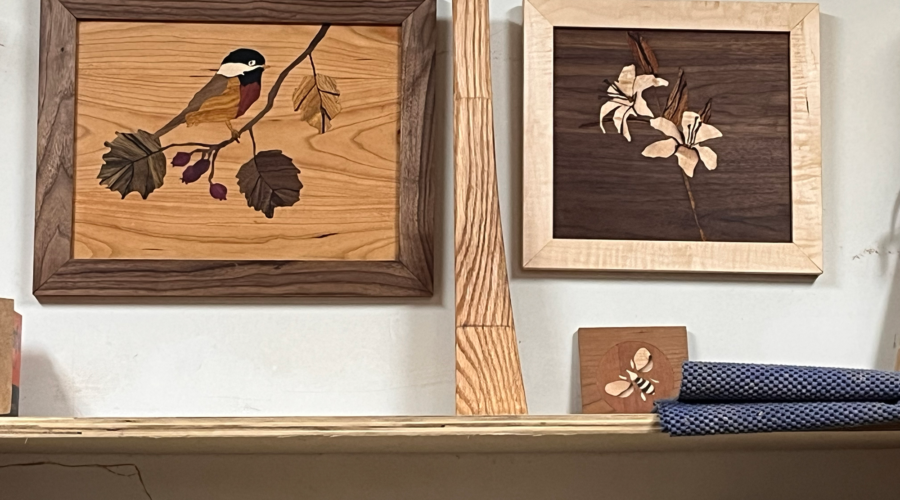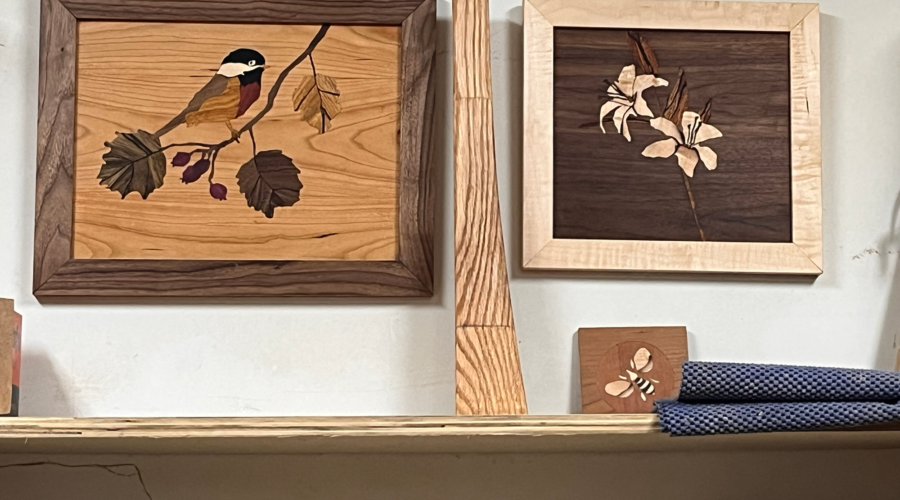
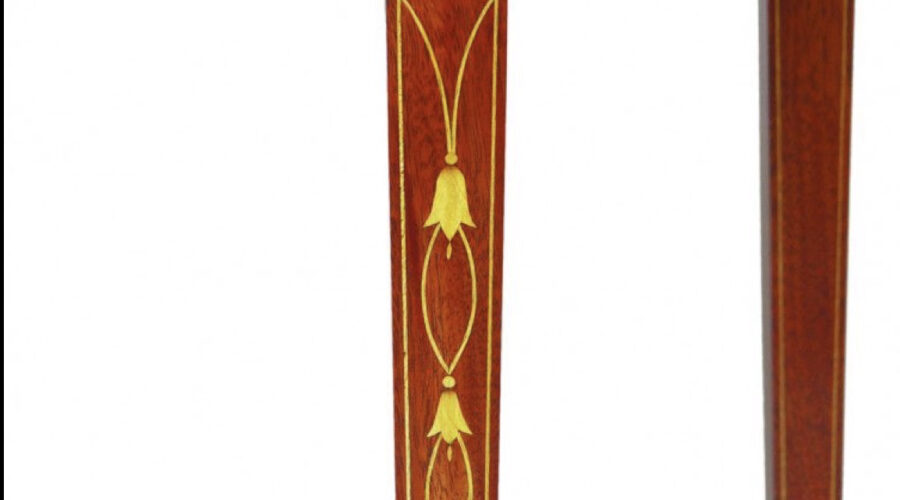
Before this marquetry panel was framed, I considered giving it a different life.
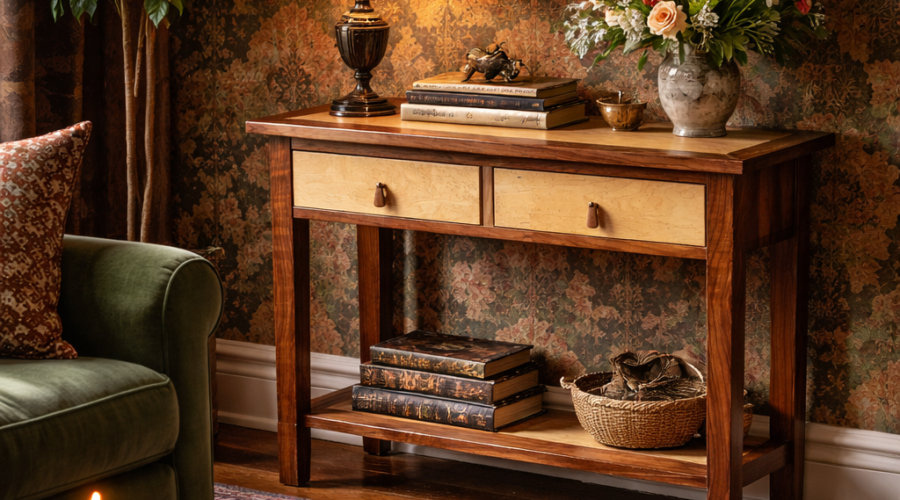
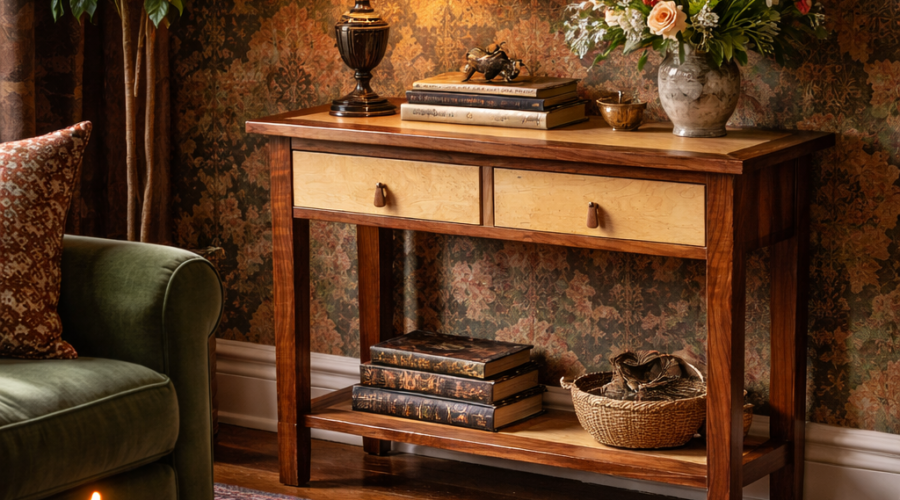
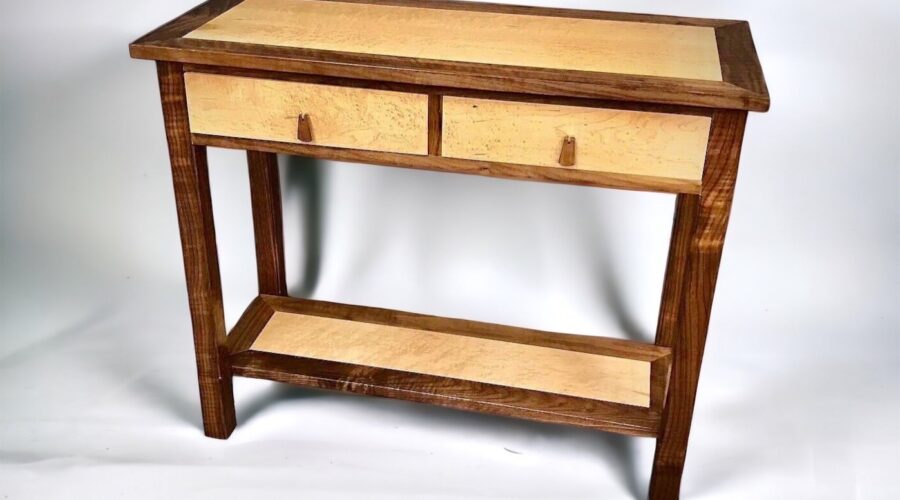
My original thought was to integrate it into this table—to let the art and the furniture become one object instead of two. Not as decoration, but as structure. Something meant to be touched, lived with, and slowly marked by time.
I was advised not to do that.
That art should remain untouched.
That no one wants to cover something so carefully made.
That a surface is meant to be protected, not experienced.
And I understand that thinking. There is a long tradition of preservation, of separating art from utility, of placing value in distance. Framed. Elevated. Observed.
But I’ve always been drawn to a different idea.
I believe the most meaningful objects in our lives are the ones we use. The table where meals are shared. The desk that holds years of thought. The cabinet door opened every morning without a second thought. These pieces don’t lose their value through use—they gain it.
Wear isn’t damage.
It’s evidence.
Evidence that something mattered enough to become part of daily life.
This table sits in that tension. Between preservation and participation. Between the desire to protect something beautiful and the instinct to let it live where it belongs—in the center of the room, not on the wall.
The marquetry itself was hand-cut from solid wood veneers, built slowly and intentionally. It wasn’t made to be precious. It was made to last. To move with the seasons. To age honestly.
When placed into the table, it asks a quiet question:
Is art something we look at, or something we live with?
I don’t think there’s a single right answer. Some pieces want stillness. Others want hands, sunlight, and time. What matters is the intention behind the choice.
For me, furniture has always been about more than function. It’s about creating objects that earn their place in a home—not because they’re perfect, but because they’re present.
Whether this panel lives framed on a wall or integrated into a table, the question remains the same.
What do we value more: preservation, or participation?
And what kind of objects do we want to carry our lives forward?
So I’ll leave this here, unfinished in the best way.
Do you believe art should be protected and preserved—kept separate from daily life?
Or do you believe it should be integrated, touched, and allowed to age alongside us?
I’d truly like to hear where you land.
Leave a comment and tell me how you see this piece.
Your perspective helps shape where this work goes next.


Please share and subscribe I appreciate the support.

Creativity has always been international. Long before trends, algorithms, or mass production, people across the world shaped wood, metal, clay, and fiber with care and intention. Different cultures, different tools, different aesthetics—but the same truth connects them all: the process mattered.
Thoughtful work asks for time. Every decision—material selection, proportion, joinery, surface, finish—requires attention. Nothing meaningful happens by accident. When makers are allowed to work slowly, they can respond to the material rather than overpower it. This is where quality begins.
(You may also enjoy reading: [Why Process Matters in Handcrafted Work])
Slow creative development is often misunderstood as inefficiency, but in reality it is discipline. Ideas need space to mature. Materials need to be understood, not rushed. When creativity is pushed too fast, depth is lost. The result may function, but it rarely endures.
(Related article: [The Philosophy of Slow Craft])
Why Price Is Part of the Conversation
Price is inseparable from process.
Handcrafted work carries the cost of time, experience, and decision-making. It reflects hours spent planning before a single cut is made, years spent learning how materials behave, and the restraint required to avoid shortcuts. Unlike mass production, where price is driven by speed and volume, handcrafted work is priced according to intention and care.
When something is made slowly and responsibly, by skilled hands, the price reflects that reality. It is not simply a number—it is a measure of time, knowledge, and respect for the craft. To lower the price is often to remove steps, dilute quality, or sacrifice longevity.
(Further reading: [What Goes Into the Cost of Handmade Furniture])
The Value of One-of-a-Kind Work
One-of-a-kind artistry exists outside of repetition. Even when two pieces begin with the same idea, they never end the same way. Materials vary. Grain shifts. Decisions evolve. The final result is shaped by countless small choices made along the way.
This uniqueness cannot be replicated or standardized. It carries presence. It carries identity. It reflects the moment in which it was made and the hands that made it. In a world filled with identical objects, one-of-a-kind work offers something rare: authenticity.
(See examples: [One-of-a-Kind Furniture & Marquetry Art])
Owning something truly original is not about luxury for its own sake. It is about connection. It is about living with objects that feel grounded, intentional, and personal—objects that don’t need to be replaced when trends change.
Why Supporting Craft Matters
Modern culture prioritizes speed and convenience, but humans are not designed to live surrounded by disposable things. We respond to work made at a human pace—work that carries thought, weight, and story.
Supporting craftspeople is not about nostalgia or resisting progress. It is about preserving knowledge, valuing skill, and choosing permanence over excess. It is a decision to invest in quality rather than quantity, and in meaning rather than immediacy.
(You might also like: [Why Handmade Furniture Matters in the Modern Home])
Slow creation is not outdated. It is essential. And when craft is supported, creativity remains thoughtful, diverse, and deeply human.
A Quiet Invitation
If this way of thinking resonates, consider supporting the craftspeople, artists, and makers who work slowly and intentionally. Read their stories. Share their work. Choose one-of-a-kind pieces when you can.
You can explore more writing like this in [The Journal], see current work in [Available Pieces], or learn about commissioning something made specifically for your space in [Custom Furniture & Cabinets].
These choices help ensure that thoughtful, human-made work continues to exist—not just as objects, but as a way of living.
If you enjoy my work and want to talk about a custom piece or a new art idea, I’d love to hear from you.
Send me a message here:

When someone books a design consultation, they usually think it starts when I open my notebook.
It doesn’t.
It starts the moment you say something like,
“Okay… so this space just doesn’t work.”
Because the second those words leave your mouth, my brain is already rearranging your house.
I’m not being dramatic—I genuinely see it. The clutter disappears. The awkward corner gets solved. The cabinet suddenly exists where there was once confusion… and a pile of stuff you meant to deal with three years ago.
At first, it’s a little fuzzy. More of a feeling than a shape.
But then you keep talking.
You mention how you actually use the space. What annoys you. What you wish you had done differently last time. And suddenly the image sharpens. The piece changes. The lines adjust. The idea starts behaving itself.
This is usually the point where I nod quietly while internally thinking,
“Ohhh. That’s the problem.”
And here’s the funny part: none of this is visible on the outside. From your perspective, I’m just listening. Maybe asking a question or two. But internally, I’m moving cabinets, stretching proportions, swapping woods, and quietly deleting about five bad ideas that almost worked.
Then comes the hard part.
I have to get what’s in my head… out of my head.
Because seeing something clearly and explaining it clearly are two very different skills. This is where drawing comes in. Not because I like drawing (I do), but because it’s the only way to make sure we’re both looking at the same thing.
The drawing is the translator.
It takes instinct and turns it into something concrete. It slows the process down just enough to catch the details that matter—proportion, balance, and how the piece will actually live in your home instead of just looking good on paper.
By the time a project makes it into my shop, it’s already been built dozens of times—quietly, in my head, while we were talking.
That’s the part most people never see.
Once the drawing is complete, everything shifts.
This is where it gets fun.
Because now the idea—the thing that only existed in your words and my head—gets to become real. I move from paper to wood. From lines to weight. From “I think this will work” to “okay… let’s find out.”
There’s something deeply satisfying about that transition. I get to see the idea all the way through. Not just imagine it. Not just plan it. But actually build it—board by board, joint by joint. Mistakes included.
And if you stop and think about it for a moment, it’s kind of incredible.
This piece didn’t exist. At all.
It was just a collection of problems, half-formed thoughts, and sentences that started with,
“What if…”
or
“I don’t know how to explain this, but…”
Those words turned into a drawing.
That drawing turned into a plan.
That plan turned into something you can see, touch, and live with.
Something solid. Something beautiful. Something completely unique—because it came from you.
That’s the part of this work that still amazes me. Taking something that wasn’t real and giving it form. Helping translate someone else’s thoughts and needs into a physical object that solves a problem and quietly belongs in their life.
To me, that’s what being human looks like.
We listen.
We imagine.
We make.
And in the process, we help each other live a little better—through objects that carry intention, care, and a story worth keeping.
Please share this post with friends if you like what you see subscribe . I also ask if there is a subject you would like me to cover leave a comment. Or just leave a comment I would love to hear from you.
To all my current subscribers thank you .
If you’d like to support the channel directly, you can make a viewer donation here
A quieter way of building
There’s a question I’ve been asked more times than I can count:
“Do you build anything simpler?”
The Studio Line is my answer.
Over the years, my work has become known for detailed joinery, marquetry, and one-of-a-kind commissions built to live for generations. I love that work—it’s the heart of what I do. But not every piece needs ornament to be meaningful, and not every home needs something that announces itself the moment you walk in.
Some pieces are meant to live quietly with you.
What the Studio Line Is
The Studio Line is a collection of furniture designed with restraint and intention.
These pieces are built in my studio from solid wood using the same principles I apply to my most complex commissions. What changes here is not quality, but complexity. The forms are simpler. The decisions are fewer. The focus shifts toward proportion, material, and longevity.
By limiting options and standardizing dimensions, I’m able to spend my time where it matters most—executing each piece carefully and consistently, without compromise.
This is furniture meant to be used every day.
Furniture that ages honestly.
Furniture that doesn’t ask for attention, but earns it over time.
Why I Created This Line
Handcrafted furniture is slow by nature. That slowness is part of its value—it allows for care, intention, and human judgment at every step. But I also understand that not everyone is ready for a fully custom commission, and not every project needs to be one-of-a-kind.
The Studio Line exists to make my work more accessible without lowering standards.
These pieces come directly from my shop, shaped by the same hands, built from the same materials, and held to the same expectations for strength and longevity. By narrowing the scope—fewer woods, fewer finishes, fixed dimensions—I’m able to offer pieces that remain honest, durable, and enduring.
What Defines the Studio Line
Each Studio Line piece shares a few key principles:
Built from solid wood Designed with clean, architectural forms Limited wood species and finishes Fixed dimensions Built to order in my studio Finished by hand to age gracefully over time
There is no veneer pretending to be something it isn’t.
No shortcuts hidden behind polish.
No trend-driven details that won’t hold up.
Just real material, thoughtful design, and careful execution.
The First Pieces
The Studio Line launches with a small, focused group of furniture—pieces I believe in and can build consistently without rushing the process:
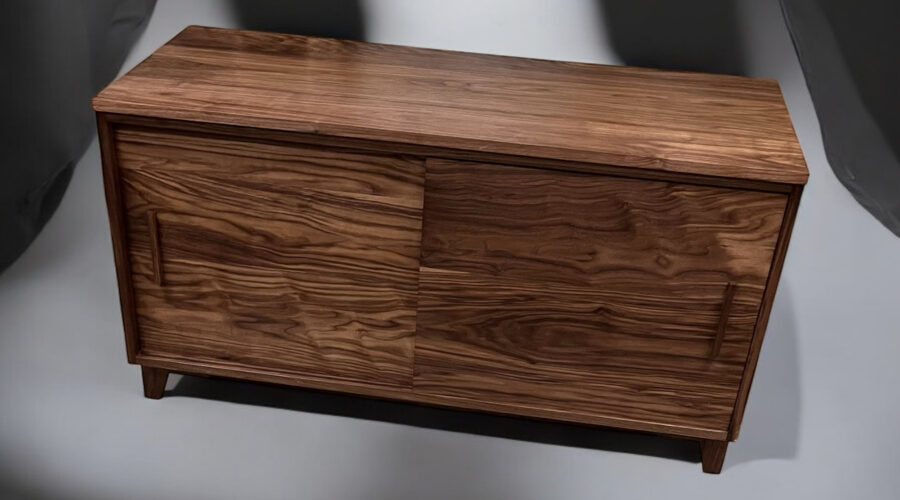
Studio Coffee Table Studio Bench Studio Writing Desk / Console
Each piece was designed to feel grounded and balanced, with proportions that work in a wide range of spaces. These are foundations—pieces meant to support daily life, not compete with it.
(Insert images of each piece here)
How This Fits Alongside Custom Work
The Studio Line doesn’t replace custom commissions—it complements them.
For clients who want something entirely one-of-a-kind, with expanded dimensions, inlay, or deeply personal details, custom work will always remain a core part of my practice. The Studio Line simply offers another way to engage with my work—one rooted in simplicity, clarity, and longevity.
Many collectors begin here. Some stay here. Others eventually move into fully custom pieces. All are welcomed.
A Final Thought
In a world that pushes speed, novelty, and constant consumption, I believe there’s value in making fewer things—better things.
The Studio Line is about slowing down, choosing carefully, and living with objects that grow more meaningful the longer they’re part of your home.
If you’ve been looking for something solid, honest, and built to last, I invite you to explore the . Studio line


I’m excited to welcome a new collector to Anderson Woodworks.
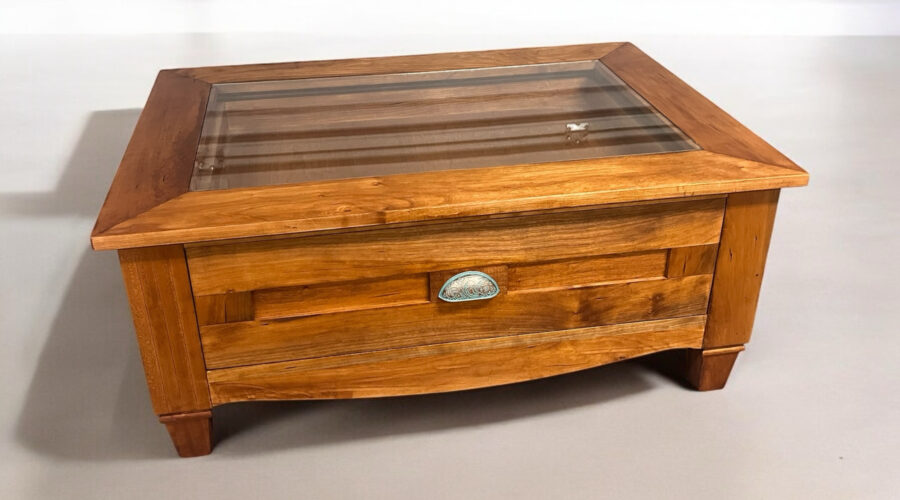
They’re new friends we met after moving to our new town—through a few game nights and local festivals. After spending some time together, they reached out about a new coffee table. Normally, they would order something from Williams Sonoma, but this time they asked a simple question: Could I build something similar, but sized specifically for their space?
That question is always an honor.
We talked through proportions, use, and materials, and decided to move forward with a custom piece that fits their home—something they simply couldn’t order off a shelf. They chose walnut, which meant a trip to one of my favorite places: Edensaw. I’ve been working with them for over twenty years, and it’s still a joy to walk through their stacks and select lumber for a new project.
At this stage, I’ve milled and glued up the top and cut three of the legs. Next comes the joinery. This piece is moving along quickly, and I’m excited to see it take shape.
More to come soon.


If you enjoy my work and want to talk about a custom piece or a new art idea, I’d love to hear from you.
Send me a message here:

Every piece I create begins with intention, precision, and a belief in craftsmanship that lasts for generations.
To thank the people who support my work—and trust it enough to share my name with friends, family, and clients—I’m offering something meaningful in return.
How It Works
• Refer someone to Anderson Woodworks
• If they book a consultation or commission, your name is entered into my Quarterly Art Giveaway
Each quarter, one name is drawn.
🎁 The Gift
A Limited-Edition Marquetry Art Piece
Hand-cut using my own thick veneers and signed on the back.
A small heirloom—crafted with the same care, patience, and precision that goes into every desk, cabinet, and table I build.
Why I’m Doing This
Referrals are the heart of my business.
When you recommend my work, you’re placing real trust in my hands.
I want to honor that trust with something lasting—not a discount or coupon, but a piece of art made by my own hands.
How to Enter
Refer someone who’s ready for custom cabinets or fine furniture Have them mention your name when they reach out Once they book a consultation, you’re officially entered
Every referral counts as one entry. Enter as many times as you’d like.
Soft Luxury Invitation
If you know someone who values solid wood, thoughtful design, and heirloom craftsmanship, send them my way.
📞 Call or text: (360) 259-0232
🌐 Visit: andersonwoodwork.net
Thank you for supporting true craftsmanship.
Subscribe to continue reading
Subscribe to get access to the rest of this post and other subscriber-only content.
When Subtle Isn’t Enough: Refining the Bench with Spalted Maple.
Subscribe to continue reading
Subscribe to get access to the rest of this post and other subscriber-only content.
A New Marquetry Piece for the Collection: “Lilies in Walnut”

Every piece of art I make begins long before the first cut is ever made. It starts with a feeling—an image that stays with me, something gentle and persistent that urges me back into the shop. This new marquetry piece, Lilies in Walnut, is one of those quiet ideas that slowly became something real, something I’m proud to welcome into the Anderson Woodworks store.
Marquetry has a way of transforming the simplest materials into stories. Thin slices of wood—each with its own grain, texture, and inherited character—come together almost like brushstrokes. What you see here is a composition built from contrast: the warmth of walnut, the light glow of maple, and the darker accents that define each petal and stem. Nothing is painted. Nothing is stained. The colors are simply the natural voice of the wood, revealed through precision cutting and placement.
The Craft Behind the Piece
To create the lilies, I used the double-bevel scroll-saw method, a technique that allows each element to fit seamlessly into place. It’s slow work—patient, exact, and deeply intentional. But I enjoy that. Craft should take time. When the hands slow down, the mind joins them, and what remains is something made with full attention.
The veneers in this artwork aren’t the paper-thin sheets you find in mass manufacturing. I make my own, thicker veneers so the art can live with the piece instead of sitting delicately on its surface. That means that long after this piece is hanging in someone’s home, if it ever needs refinishing, the artwork remains intact. You won’t sand through it—you preserve it. And that matters to me, because craftsmanship should outlive the person who made it.
Maple Frame, Walnut Canvas
The frame is solid maple, chosen for its light tone and quiet elegance. Maple has a subtle shimmer that comes alive under finish, a perfect contrast to the deeper walnut panel behind it. The walnut itself provides the stage for the flowers—dark enough to feel warm, but natural enough to carry the delicacy of the lilies without overshadowing them.
When the piece is viewed from across a room, the lilies appear almost soft, like they’re resting on the surface of the wood. But up close, the details tell the story: careful cuts, tiny joints, and the natural grain lines guiding the eye from one petal to the next.
Why I Made This Piece
I’ve always believed that art should feel alive, not sterile. Lilies carry symbolism—renewal, remembrance, celebration, and peace—but beyond meaning, they simply feel honest. They’re elegant without trying to be. They’re quiet but impossible to ignore. That’s the same feeling I aim for in my work: humility paired with intention.
This piece is also part of my ongoing effort to bring more of my marquetry into everyday spaces. Not everything has to be a large cabinet, desk, or heirloom table—sometimes beauty belongs on a small wall in a quiet corner of the home. That’s where pieces like this shine.
A Piece Made to Last
Every marquetry artwork I create is one-of-a-kind. Even if I repeated the same design tomorrow, the grain, tone, and movement of the wood would make it a completely different piece. That’s the nature of handmade work—it carries individuality the way our own fingerprints do.
When someone takes home a piece like Lilies in Walnut, they aren’t just buying wall art. They’re inviting craftsmanship into their daily life. They’re supporting the tradition of slow, meaningful creation. And they’re owning something that will look just as beautiful decades from now as it does today.
Available Now
This piece is now available in my online store, framed and ready to hang. If you’re looking for a gift, a personal art piece, or something special to add warmth to your home, this is a wonderful place to begin.
If you would like a custom marquetry design—flowers, animals, landscapes, symbolic patterns, or something meaningful to your family you can always reach out to me directly. I would be honored to create a piece uniquely for you.
Visit my contact me page
Follow me on Instagram: https://www.instagram.com/a.woodworks
Support my work or donate: link https://square.link/u/AhGH92h7?