The entry tells you the truth about a house. Not the staged version, not the holiday version – the real one. Shoes pile up, bags land where they can, coats drift from hook to chair, and the daily traffic pattern reveals whether the room has been designed or simply furnished. The best entryway built in storage ideas start there, with how people actually arrive home and what they need the space to do every day.
This is where built-ins outperform freestanding furniture. A narrow console may look finished in a photograph, but it rarely solves the practical demands of a working entrance. A built-in can be sized to the wall, tuned to the household, and detailed to hold weight, resist wear, and keep the room composed even when life is not.
What makes entryway built in storage ideas worth doing
A well-made entry built-in is not just a bench with some hooks above it. It is a room-shaping element. It establishes circulation, gives visual order to the threshold, and defines where daily objects belong. That matters more in an entry than almost anywhere else because this room handles constant transitions.
Good built-ins also correct the common problems that generic furniture cannot. They can bridge awkward wall lengths, absorb uneven alcoves, work around stair geometry, and make use of vertical space without looking improvised. Just as important, they let the storage capacity match the household. A family with school bags, sports gear, and winter layers needs something very different from a two-person household that mainly needs a place for coats, keys, and mail.
There is a trade-off, of course. Built-ins ask for more planning, a higher level of fabrication, and a stronger commitment to the room. But that is precisely why they work. They are not temporary fixes.
9 entryway built in storage ideas with real staying power
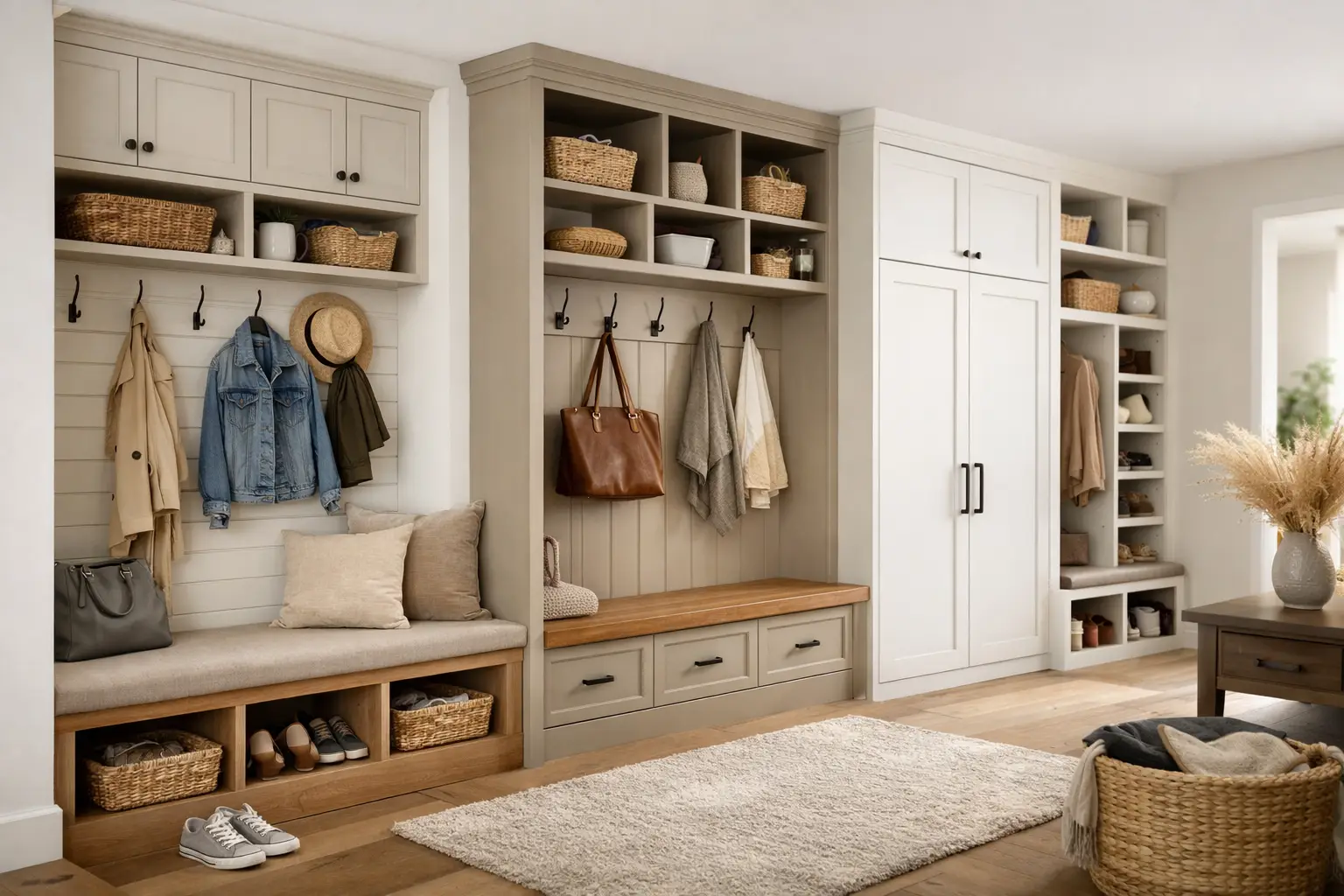
1. A bench with closed storage below
This is the strongest starting point for many homes because it solves two needs at once. You get a place to sit while putting on shoes and concealed storage below for the visual clutter that otherwise drifts into the house.
The decision is not just whether to add a bench. It is how the lower storage should function. Drawers are excellent for smaller items and are often easier to use than lift-up lids. Doors work better when you need to store bulkier boots or baskets. If the entry is tight, drawers need clearance, so hinged doors or open cubbies may be the better choice.
2. Full-height cabinetry for coats and overflow
If the wall allows it, full-height cabinetry brings the kind of control that an open mudroom-style setup cannot. Tall cabinets can hold coats, vacuum storage, cleaning supplies, seasonal gear, dog leashes, and all the unattractive things that make a house run.
This is especially useful in homes where the front entry doubles as the family drop zone. The cabinetry should not feel like a kitchen pasted into the foyer. Proportion, door detailing, and depth matter. Shallower cabinets often feel more architectural and less bulky in a formal entry.
3. Open hooks paired with a shelf above
Hooks are simple, but they must be used with discipline. In the right household, they are efficient and honest. In the wrong one, they become a wall of visible clutter.
The better version includes a continuous shelf above, giving the composition a proper top line and creating a place for baskets, hats, or less-used accessories. If you go this route, keep the hook count intentional. Too many hooks encourage accumulation rather than order.
4. Individual cubbies sized for real belongings
Cubbies work best when they are assigned and dimensioned properly. If each family member has a defined section, the room performs better and stays calmer. That sounds basic, but many built-ins fail because the compartments are based on guesswork rather than actual items.
Backpack depth, boot height, helmet storage, tote handles, and winter layers all affect sizing. Children also grow, so a built-in designed only for a small child’s current coat size will age poorly. Plan for the household you are becoming, not just the one you are today.
5. A charging drawer or concealed command center
Not every entry needs visible mail slots and corkboards. In fact, many look better without them. But most households still need a controlled place for keys, chargers, batteries, sunglasses, and the paper trail that tends to gather near the door.
A shallow drawer with fitted organizers can handle much of this quietly. In some homes, a concealed cabinet with interior outlets makes sense for device charging. The point is containment. The entry should support daily routines without advertising every object involved in them.
6. Integrated shoe storage that respects actual footwear
Shoe storage is where many entry designs become either too shallow or too optimistic. If the household wears boots for weather, work, or outdoor activity, standard shelves may be useless. Adjustable shelving or a mix of open boot bays and standard-height shelves gives far better flexibility.
Ventilation matters here as well. Fully closed compartments look clean, but damp shoes need air. Depending on the climate and how the family uses the entry, partially open storage may be the smarter long-term answer.
7. Built-ins under the stairs
When an entry sits beside a staircase, the underside is often wasted or poorly used. This is one of the best opportunities for custom storage because standard furniture almost never fits the geometry well.
The design can range from low drawers and concealed cabinets to a bench integrated into the stair profile. The success of this idea depends on restraint. The goal is to make the architecture feel more resolved, not to force every inch into visible storage.
8. A narrow built-in wall for small foyers
Not every entry can support a deep bench wall. In tighter homes, a shallow built-in can still provide substantial function. Think slim cabinets for shoes, a narrow ledge for keys, panel-mounted hooks, and an upper cabinet or shelf line that gives the wall a finished architectural presence.
This approach works particularly well when the priority is maintaining clear circulation. A crowded entry is a design failure no matter how much storage it holds.
9. A furniture-led built-in that feels like part of the house
The strongest entries often borrow more from fine furniture than from utility rooms. That means a built-in with thoughtful joinery, balanced proportions, quality wood species, and a clear relationship to the rest of the home.
This matters in visible front entries, where the first impression should not be purely utilitarian. A built-in can still be hardworking while carrying the visual weight of cabinetry or furniture made with intention. That is the difference between a storage solution and a permanent improvement to the house.
How to choose the right direction
The best solution depends on four things: traffic, volume, visibility, and architecture. Traffic tells you how people move through the space. Volume tells you how much must be stored daily versus seasonally. Visibility determines how much open storage the room can tolerate before it starts to feel messy. Architecture sets the boundaries and opportunities.
A formal front entry that sees occasional use can support more refinement and less visible utility. A family entry that handles sports gear, rainwear, and school bags needs more aggressive function. Many homes need both, even if they only have one practical entrance. That is where zoning becomes valuable – closed storage for the mess, visible surfaces only for what deserves to stay in view.
Material choice matters just as much. Painted cabinetry can feel tailored and crisp, but it shows impact differently than wood. Natural wood brings warmth and depth, though some species will mark and patina more readily. Neither is universally better. The right decision depends on the use level, the surrounding architecture, and whether you want the entry to hide wear or reveal it honestly.
Common mistakes that weaken the whole room
The first mistake is designing around a trend rather than the household. Oversized shiplap back panels, decorative baskets doing all the organizational work, and a generic row of hooks may photograph well, but they often fail in daily use.
The second is getting the proportions wrong. Bench height, cabinet depth, and hook spacing all affect whether the piece feels custom or clumsy. The entry is usually a compact room, which means poor proportions show immediately.
The third is underestimating what should be concealed. Open storage has its place, but most homes function better when at least part of the entry can close. Visual quiet is not superficial. It changes how the house feels when you walk in.
If you are investing in built-ins, treat the entry as part of the architecture of the home, not a leftover wall to decorate. The right piece will do more than hold coats and shoes. It will set the tone for how the house works, how it wears, and how it welcomes you back at the end of the day.
Discover more from Anderson woodworks custom furniture & cabinets
Subscribe to get the latest posts sent to your email.