
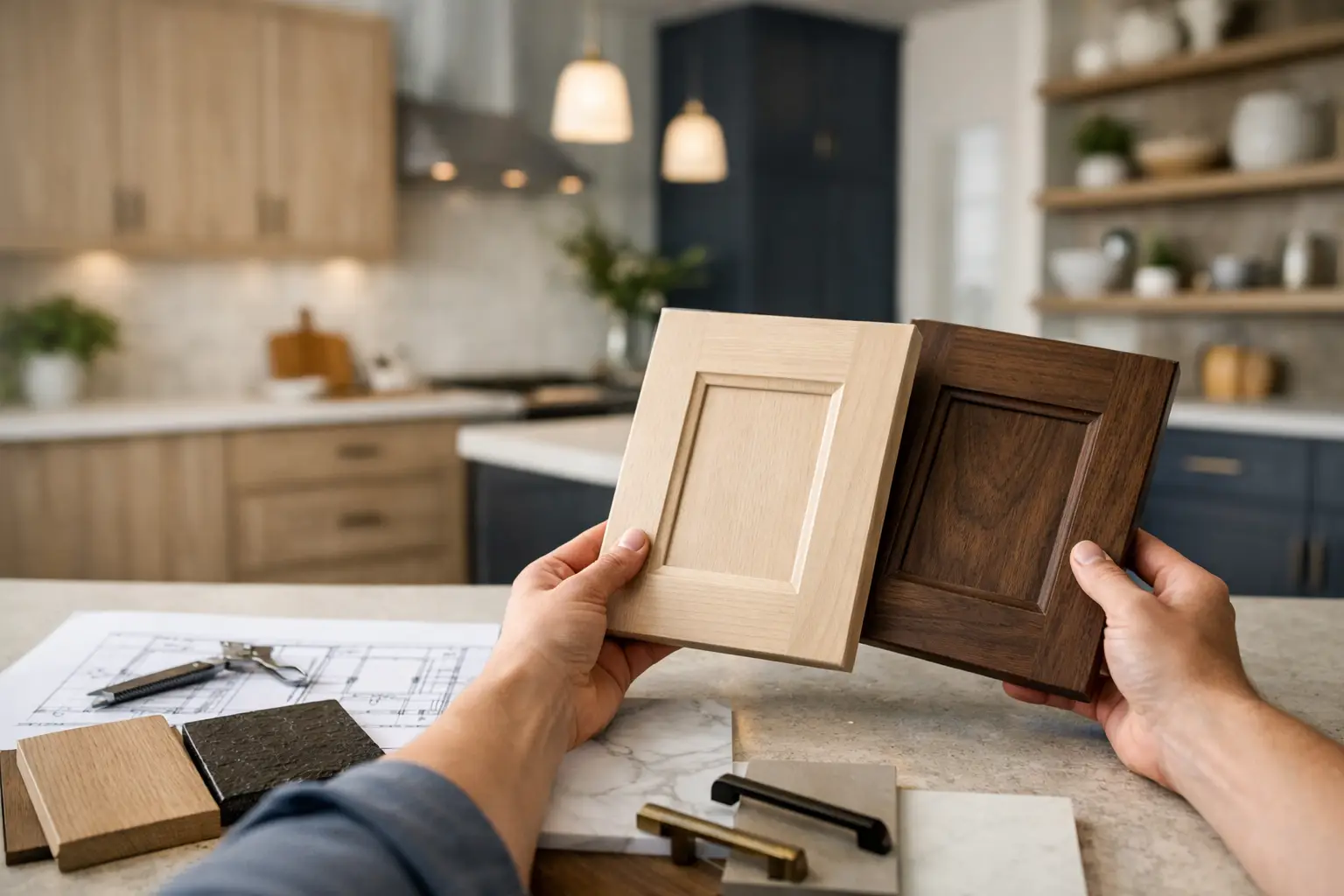
A wall of expensive cabinets can still fail a room.
That usually happens when cabinetry is treated as a finish selection instead of a design decision. If you are asking how to choose custom cabinetry, the real question is not which door style looks best online. It is how the cabinetry should work, how it should shape the room, and what it needs to endure over time.
Custom cabinetry is not worth the investment simply because it is custom. It earns its value when it solves specific spatial problems, improves daily use, and brings visual order to a room that would otherwise feel generic or forced. That requires more than picking a wood species and a paint color.
How to choose custom cabinetry starts with the room
Before you think about fronts, hardware, or finish, define what the room is being asked to do. A built-in office wall, a dining room sideboard, an entry storage system, and a library surround all demand different proportions, depths, and access points. The best cabinetry is designed from the inside out.
Start by looking at the room honestly. Where does clutter collect? What items are awkward to store? What needs to be hidden, and what deserves to be displayed? Where do you need quick access, and where do you need deeper long-term storage? These are not minor details. They determine the cabinet layout.
This is where many homeowners lose money. They begin with appearance and try to force function into it later. That approach often produces beautiful elevations with frustrating interiors. A shallow drawer where files should go, fixed shelves where adjustable storage is needed, doors that conflict with lighting or traffic flow – these are planning failures, not construction issues.
Decide what custom needs to solve
Not every room needs maximum complexity. Some spaces benefit from restraint. Others demand a highly tailored solution because off-the-shelf dimensions simply do not work.
A good custom cabinetry project should solve at least one of these problems clearly: the room has architectural constraints, you need storage organized around specific objects or habits, standard sizes waste too much space, or the cabinetry needs to carry the visual weight of the room. If none of those are true, custom may still be appropriate, but the case for it should be deliberate.
For example, a study may need cabinetry that integrates books, concealed printer storage, task lighting, and a work surface at the correct height for daily use. An entry may need a bench, closed shoe storage, durable surfaces, and upper compartments sized for seasonal items. In both cases, custom work becomes valuable because it resolves the room as a whole.
Proportion matters more than decoration
Most cabinetry mistakes are proportion mistakes.
A cabinet can be beautifully made and still feel wrong if the scale is off. Oversized stiles, undersized drawers, awkward filler strips, top sections that crowd the ceiling, or a run that ignores the rhythm of nearby windows and doors can make a room feel unsettled. Good cabinetry belongs to the architecture. It should not look dropped in.
This is one reason experienced design guidance matters. The cabinet face is only one layer. What matters just as much is the relationship between cabinet height and ceiling height, drawer stack width and room scale, open shelf placement and sight lines, and the visual weight of solid doors versus glass or open elements.
If you want the work to feel refined, ask to see not just finish samples but drawings that show proportions clearly. Elevations and dimensioned layouts reveal whether the design has discipline behind it.
When symmetry helps and when it does not
Homeowners often assume symmetry is always the answer. Sometimes it is. In a formal study or around a fireplace, symmetry can create calm and structure. But a room driven by actual storage needs may call for asymmetry that is carefully controlled.
The goal is not to force balance for its own sake. The goal is to create a composition that feels intentional while serving the way you live.
Choose materials for use, not just appearance
Wood choice matters, but not in the simplistic way it is often discussed.
The question is not only whether you prefer white oak over walnut, or paint-grade over stain-grade construction. The better question is whether the material suits the room, the wear it will take, and the atmosphere you want to create. Painted cabinetry can be exacting and architectural. Natural wood can bring depth and warmth. Either can feel timeless or disposable depending on design and execution.
Ask how the cabinet boxes are built, what sheet goods are being used where appropriate, how movement is being managed in solid wood components, and what finish system is specified for durability and repairability. True quality is usually quiet. It shows up in stable construction, clean joinery, consistent reveals, and finishes that age with dignity.
If a room gets hard daily use, durability should lead. In a calmer room, you may choose a more nuanced material expression. There is no single correct answer, but there is always a wrong one: selecting materials that look expensive and perform poorly.
Storage should reflect behavior
The most successful cabinetry is based on habits, not wishful thinking.
If papers always land near the door, that matters. If charging cables migrate across a room, that matters. If you keep buying storage baskets to compensate for bad furniture, that matters too. Good custom cabinetry pays attention to repeated behavior patterns and gives them a proper place.
This is why interior fittings should be discussed early. Drawers, dividers, trays, pull-outs, file systems, adjustable shelving, venting for electronics, and concealed power are not add-ons. They affect cabinet depth, door widths, and structural planning.
How to choose custom cabinetry interiors
When clients think about how to choose custom cabinetry, they often focus on the visible surfaces and postpone the interior details. That is backwards. The interior determines whether the piece will still work for you in five years.
You do not need every available accessory. In fact, overfitting cabinetry to a very narrow routine can make it less flexible over time. The best approach is selective customization: tailor the key storage zones tightly, and keep some areas adaptable.
Understand where to spend and where to simplify
A strong custom project is not about adding detail everywhere. It is about putting investment where it has the most impact.
Spend on dimensions that fit the room properly, construction quality, drawer hardware, durable finishes, and the design thinking that resolves awkward conditions well. Simplify where complexity adds little value. That may mean fewer material changes, quieter door profiles, or standardized interior sections where precision is less critical.
There is a difference between richness and noise. A room with too many cabinet features often feels less expensive, not more. Restraint usually ages better.
Vet the process, not just the portfolio
Beautiful photos do not tell you how a project will run.
If you are commissioning custom cabinetry, ask how the design is developed, what drawings are provided, how revisions are handled, when materials are finalized, and what level of coordination happens before fabrication begins. A disciplined process protects the quality of the outcome.
You also want clarity on lead times, installation conditions, and who is responsible for field measurements. In older homes especially, walls and floors are rarely perfect. Good cabinetry depends on careful documentation of real conditions, not assumptions.
A craft-led studio should be able to explain decisions in plain terms. Why this depth? Why this reveal? Why this material here and not there? Authority in this field is not about jargon. It is about judgment.
Look for longevity, not trend language
Cabinetry lives in the architecture longer than most furnishings. Treat it accordingly.
Trend-driven choices tend to show up first in exaggerated door profiles, novelty finishes, and decorative details that are disconnected from the room itself. Timeless cabinetry is not bland. It is specific, disciplined, and rooted in proportion, material honesty, and use.
That does not mean every project should look traditional. A contemporary cabinet wall can be just as enduring as a classic built-in if the lines are clean, the scale is right, and the detailing is purposeful.
At Anderson Woodworks, this is the dividing line. This is not decorating. It is design and fabrication shaped around daily life, architecture, and permanence.
If you are deciding how to choose custom cabinetry, choose the maker and the design process as carefully as the cabinets themselves. The right project should make your room work better immediately and feel more settled with every passing year.
The best cabinetry does not ask for attention every time you walk into the room. It quietly proves, day after day, that someone thought hard about how you live.
Contact me to set up a consultation
Discover more from Anderson woodworks custom furniture & cabinets
Subscribe to get the latest posts sent to your email.
