On art, natural form, and remembering how to slow down
I make things with my hands. That sentence sounds simple, and it should but it has quietly become a rare thing to be able to say and mean.
The pieces I care about most are the ones where art and use meet in the same object. Not a sculpture you can only look at, and not a piece of furniture you only use and forget. Something in between. Something you live with. I let the tree keep some of its own shape, I add the marks of my own hands, and somewhere in that meeting the piece stops being lumber and starts being alive. I build these for people to use, yes but also to enjoy, to admire, to run a hand across and feel that a person was here.
I also build them to honor an older way of working. We have gained a lot from our new tools and technology, and I use plenty of it. But I think we have lost something too. We traded the visual sense of beauty for a steady stream of distraction. We are always looking, and rarely seeing. So when I finish a piece, my real hope is that someone stops in front of it, slows down, touches the wood, and remembers a time that was slower and more intentional.
These are three of my most coveted pieces. Here is what I see in them.
The Dream Bench the one that arrived in my sleep
This one showed up at two in the morning not on a sketchpad, but in a dream. I woke with the whole thing already built in my head and had to get it down before it faded. That is where the name comes from, and it feels right to me: the good ideas rarely come when you’re rushing. They come when you finally slow down enough to let them.
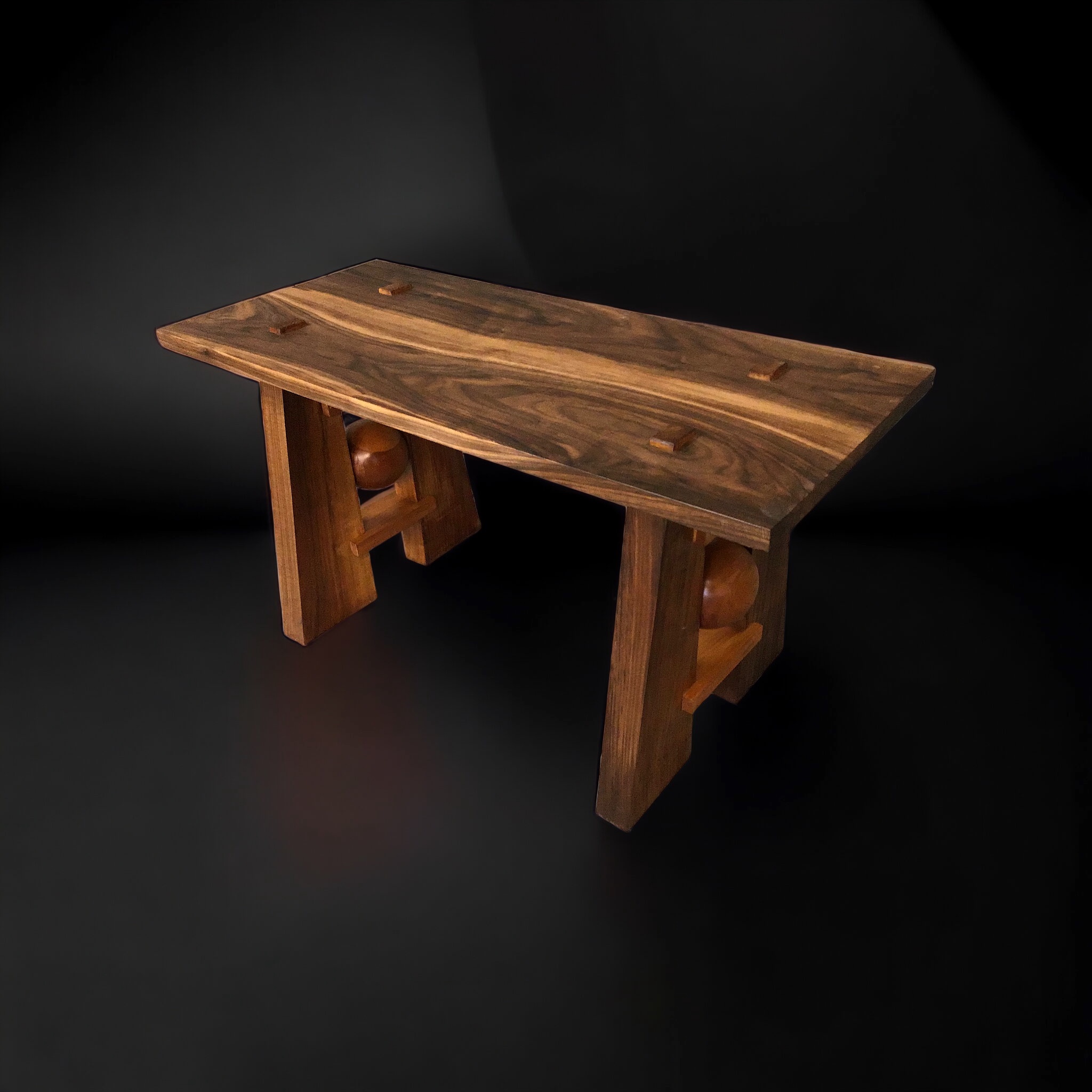
It holds no hardware. Not a single screw, not a bracket, nothing hidden. Everything holding it together is wood locking into wood.
The top is a single figured slab, and I left its natural edge alone so you can still read the outline of the tree it came from. Look closely at the surface and you’ll find small squared pins standing slightly proud those are the ends of the tenons, wedged tight and left visible on purpose. The legs splay out like an easel, and captured between them are turned wooden spheres, held in place by the structure itself rather than glued on as decoration.
I love this piece because it hides nothing. In a world that covers its seams and disguises how everything is made, this table shows you exactly how it stands up. The honesty is the art.
The Butterfly Bench a scar made beautiful
A crack ran through this slab. In most furniture that would be a defect to fill and forget. Instead I bridged it with butterfly keys the little bowtie-shaped inlays you see marching down the top in a lighter wood stitching the wood back together the way it has been done for centuries.
That is the whole idea in one object. The wood was flawed, and rather than hide the flaw I made it the centerpiece. The natural edge stays wavy and imperfect. The legs are simple and honest, tied together low with a stretcher, the way a real working piece should be. Nothing here pretends to be perfect, and that is precisely why I keep coming back to it.
We have gotten so used to the flawless and the mass-produced that we have forgotten a crack can be a feature. This bench remembers.
The Iris Table patience you can see
If the first two pieces are about natural form, this one is about the hand.
The top carries a hand-cut marquetry iris set into an oval the flower assembled from small pieces of colored wood, each shade its own species, fitted together to make petals, a stem, a single leaf. No paint. No dye pretending to be something it isn’t. Every color you see is the true color of a real wood. The square pegs on the legs and the low stretchers nod to the old Arts and Crafts furniture makers who believed a joint could be beautiful and structural at once.
This is the piece where I ask the most patience of myself, and I hope it asks a little patience of the person who owns it too. It rewards a second look. It rewards standing still.
Slow down. Touch the wood.
That is really all I am after with any of this.
Somewhere along the way we sped everything up and let the machines do the seeing for us. My small rebellion is to keep cutting joints by hand, to keep the tree’s own shape in the finished piece, to make something that asks you to stop scrolling and put your hand on it instead.
So if you ever find yourself in front of one of these slow down. Touch the wood. Feel the grain move under your fingers. See the beauty that was already in the tree before I ever picked up a tool. And maybe, for a moment, remember a slower and more intentional way of being in the world.
That is the whole reason I still do this by hand.
Brian Anderson, Anderson Woodwork


Discover more from Anderson woodworks custom furniture & cabinets
Subscribe to get the latest posts sent to your email.