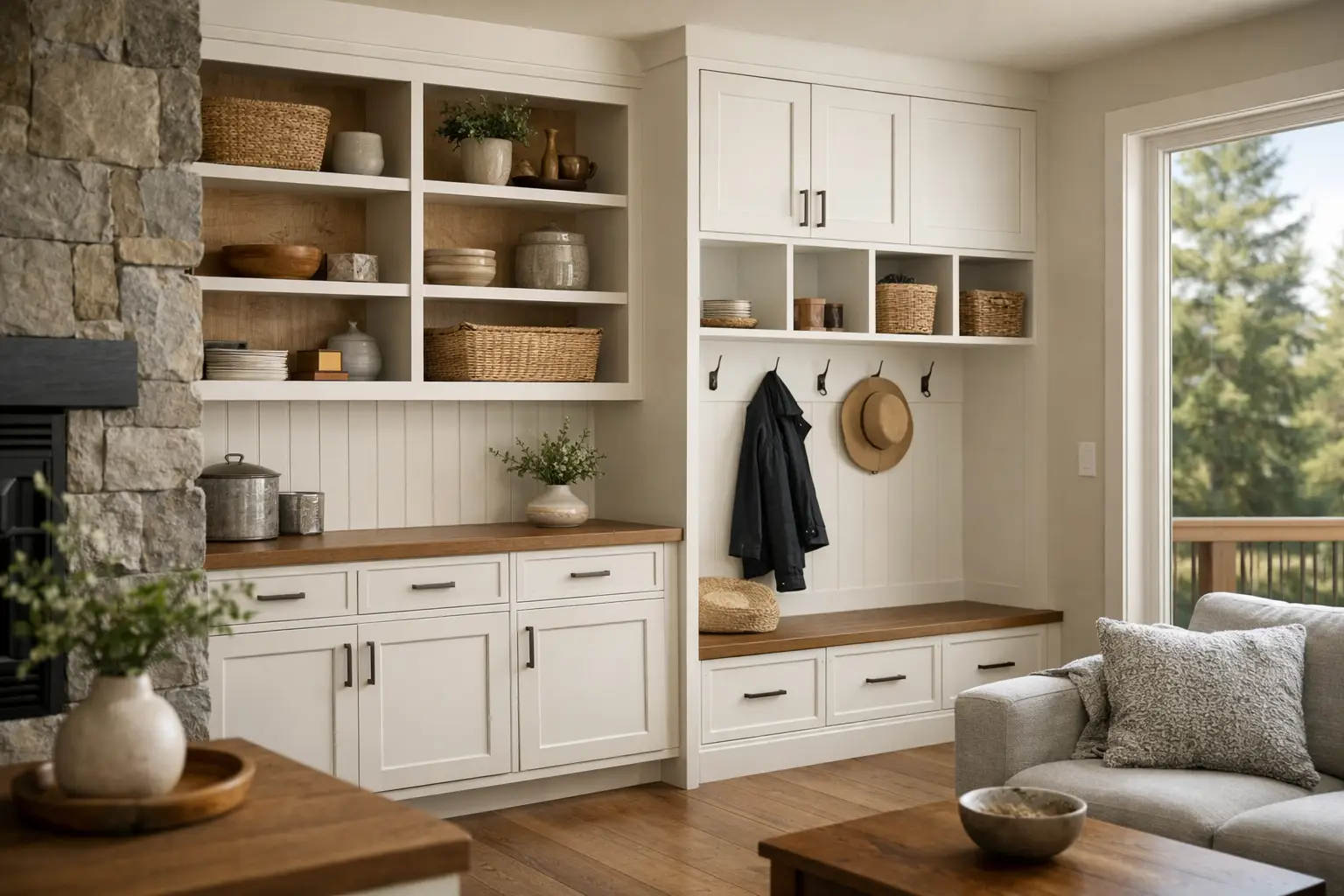
A built-in should solve a room, not just occupy it. That is the real standard for pacific northwest built in cabinetry, especially in homes where square footage matters, storage needs are specific, and the architecture deserves more than stock boxes trimmed to fit.
In this region, homes ask a lot of their interiors. Light shifts dramatically through the year. Entryways carry wet boots, bags, and dog leashes. Home offices need to work hard without looking temporary. Older houses often come with uneven walls, low clearances, or awkward alcoves that punish generic solutions. Built-in cabinetry makes sense here, but only when it is designed as part of the room itself.
What Pacific Northwest built in cabinetry should actually do
Too much cabinetry is treated as surface improvement. Add shelves, paint them a nice color, and call it custom. That approach photographs well and ages poorly.
Good built-ins begin with use. A library wall should account for book height, not just visual symmetry. A dining room hutch should support serving pieces, table linens, and the rhythm of how you host. A mudroom should handle the daily collision of weather, shoes, coats, and movement through the house. If the function is vague, the cabinetry will be too.
This is where custom work separates itself from decorative millwork. The goal is not simply to make a wall look finished. The goal is to improve how the room operates while strengthening its proportions, material language, and sense of permanence.
Start with the room, not the cabinet
The strongest cabinetry projects are rarely cabinet-first. They are room-first.
Before dimensions, door styles, or wood species, the right questions are simpler and more demanding. What is this room failing to do now? What needs to be stored, displayed, concealed, or supported? Where does clutter collect? What visual weight can the wall carry? How should the built-in relate to flooring, windows, trim, and furniture?
That process matters because cabinetry is architecture once it is installed. It changes circulation, sightlines, and how a room feels at a glance. A shallow bank of cabinets in a study can sharpen the entire room. An oversized media wall can flatten it. A beautifully made built-in that ignores scale is still the wrong answer.
For that reason, proportion is not decoration. It is the discipline that keeps a built-in from feeling heavy, busy, or accidental.
Why proportion matters more than style
Homeowners often begin by collecting inspiration images, but style references only get you so far. Shaker doors, slab fronts, bead details, white oak, painted maple – these are secondary decisions.
The first issue is mass. How tall should the unit be in relation to the ceiling? Should it read as one continuous composition or break into smaller sections? Where should closed storage sit so the piece feels grounded? How much open shelving is actually useful before it becomes maintenance?
In many Pacific Northwest homes, especially those with strong natural light and a quieter architectural palette, restraint works harder than embellishment. Cleaner lines, fewer unnecessary transitions, and a controlled mix of open and closed storage tend to hold up better over time.
Materials for the Pacific Northwest: what holds up
Climate is not the only factor in material selection, but it does matter. Pacific Northwest houses see damp seasons, fluctuating indoor humidity, and day-to-day wear that quickly exposes poor construction.
That does not mean every project requires the same material palette. It does mean shortcuts show early. Low-grade sheet goods, weak joinery, thin edge treatments, and generic hardware often reveal themselves within a few years through sagging shelves, chipped edges, and doors that never sit right again.
Well-built cabinetry depends on stable substrates, properly selected hardwoods, durable finishes, and hardware chosen for actual use, not showroom appeal. A painted built-in in a family entry needs a different finish strategy than a walnut study cabinet. A window seat with storage requires different structural thinking than a floating bookcase.
There is also a practical trade-off between visual warmth and wear tolerance. Natural wood can age beautifully, but species choice and finish matter. Painted cabinetry can feel crisp and architectural, but only if the preparation and execution are exact. There is no universally correct answer. There is only the right answer for the room, the household, and the level of use.
Where built-ins make the biggest difference
Some rooms benefit more from custom cabinetry than others. Home offices are high on that list because they ask one room to do many jobs – storage, focused work, video calls, paperwork, and often some visual calm. Off-the-shelf furniture usually handles one or two of those demands and compromises the rest.
Entry areas are another obvious candidate. These spaces take daily abuse, and a good built-in can impose order where freestanding furniture creates bottlenecks. The same is true for dining rooms that need refined storage, studies that require depth and quiet, and living rooms where media, books, and display need to coexist without visual clutter.
Bedrooms can benefit too, though the answer depends on the architecture. In some homes, integrated wardrobe storage is the cleanest move. In others, a built-in window seat or reading wall does more for the room than another bank of drawers.
When built-ins are not the right move
Custom cabinetry is not automatically the best investment in every room. If the layout is unresolved, cabinetry can lock in a bad plan. If your storage habits are unclear, you may pay for expensive square footage that does not serve you. If the room really needs better lighting, flooring, or furniture scale, built-ins alone will not fix the issue.
That is why design direction matters before fabrication starts. The point is to make fewer, stronger decisions.
The difference between custom and merely made-to-fit
Many projects are described as custom because they are built to the wall dimension. That is not the same as true custom work.
Made-to-fit cabinetry fills space. Real custom cabinetry responds to use, architecture, proportion, material relationships, and long-term wear. It accounts for how doors open, how drawers are loaded, how trim terminates, how electrical needs are integrated, and how the piece reads from across the room.
That distinction affects price, of course, but it also affects value. A cheaper solution may close the gap on day one. Five years later, the better project usually proves itself through function, stability, and the way it continues to belong in the house rather than date it.
For clients who care about permanence, this is not a small difference. It is the difference between a feature and a fixture.
Designing Pacific Northwest built in cabinetry with longevity in mind
Longevity is not about making something plain. It is about making it specific enough to be useful and disciplined enough to last visually.
That often means avoiding trend-driven details that shout their era. It also means resisting the urge to over-program every inch. Cabinetry packed with niche compartments can become obsolete faster than simple, well-scaled storage.
A better approach is to build around constants. Books remain books. Coats still need hanging space. Tableware still needs protected storage. Devices may change, but access to power, breathable shelf spacing, and concealed cable management remain practical needs. The best built-ins allow adaptation without looking temporary.
This is where an integrated design-and-build approach earns its place. When the same hand is shaping the room logic and the fabrication strategy, the final work tends to be clearer. Fewer decorative patches. Fewer awkward transitions. Better alignment between what the cabinetry looks like and what it is supposed to do.
What to expect from a serious cabinetry process
If you are investing in custom work, expect more than a quick estimate and a door sample. A serious process should clarify use, dimensions, finish direction, installation realities, and scope before fabrication begins.
That usually includes field measurements, design development, material review, and a documented plan that answers the practical questions early. Where will concealed storage go? What stays visible? How deep should shelves be for the actual objects they will hold? Does the room need furniture integrated into the composition, or should the built-in remain one disciplined architectural element?
Anderson Woodworks approaches cabinetry this way because the work is not separate from the room. It is part of the room’s structure, function, and visual order.
The right built-in should feel inevitable once installed. Not flashy. Not generic. Just correct in a way that makes the rest of the room make more sense.
If you are considering custom cabinetry, start by defining the problem with more precision than style alone can provide. The better your questions, the better the piece – and the more likely it is to serve your home for decades rather than a few passing seasons.
let’s schedule a design meeting Contact me
Discover more from Anderson woodworks custom furniture & cabinets
Subscribe to get the latest posts sent to your email.