A built-in bookcase can steady a room or quietly ruin it. When the proportions are off, the shelves are too shallow, or the millwork fights the architecture, you feel it every time you walk in. That is why learning how to choose built in bookcases starts with the room itself, not with a Pinterest image or a paint color.
This is not a decorative add-on. A proper built-in changes how a room works. It affects circulation, storage, lighting, visual weight, and even where the eye lands when you enter. If you want something that feels permanent and right ten years from now, the decision has to be made with more discipline than simply choosing a style you happen to like.
How to choose built in bookcases by starting with the room
The first question is not what profile the trim should have. It is what role the bookcase needs to play. In some rooms, built-ins are primarily storage. In others, they are an architectural anchor that frames a fireplace, defines a study, or turns an underused wall into the center of the room.
Start with the wall and the room proportions. Measure ceiling height, wall width, door swings, window trim, HVAC registers, outlets, and baseboards. Then look beyond measurements. Consider how the room is used day to day. A home office needs different shelf spacing and cabinet integration than a dining room or entry hall.
A narrow wall with low ceilings may call for restrained casework with fewer vertical interruptions. A large room with generous ceiling height often needs more visual mass, otherwise the built-in looks undersized and apologetic. Good built-ins do not just fit the wall. They answer the scale of the entire room.
Decide what the bookcases need to hold
People often underestimate this part. They say they want bookcases, but what they actually need is a combination of book storage, concealed storage, display, and sometimes media or task lighting.
Books are heavy, and they are not all the same size. Art books, binders, collected works, small paperbacks, framed objects, ceramics, and baskets all require different depths and shelf spacing. If the shelves are planned around a generic assumption, the piece will look tidy for one week and compromised for the next ten years.
Take inventory before any design decisions are made. Count the books you own, estimate growth, and note the tallest and deepest items. Decide what should be visible and what should be hidden behind doors. Closed storage at the base is often useful in family rooms, offices, and multipurpose spaces because it absorbs the visual noise that open shelving cannot.
This is where trade-offs become clear. More open shelving creates a lighter look, but it also asks more of you visually. Everything on display becomes part of the room design. More closed cabinetry gives you cleaner lines and better function, but too much can make the piece feel heavier than the room can support. The right answer depends on how you live, not on a formula.
Choose a layout that matches the architecture
When clients ask how to choose built in bookcases, they are often really asking how formal or minimal the piece should feel. The answer should come from the architecture of the house.
A traditional home can support stronger millwork, deeper reveals, inset doors, and more classical proportions. A newer or more restrained interior may call for flatter planes, simpler face frames, and fewer decorative gestures. Neither approach is better. The issue is coherence.
Bookcases should feel like they belong to the house, not like they were imported from another design language. That does not mean copying every detail already in the room. It means understanding line, proportion, and rhythm well enough to create something that extends the architecture rather than interrupting it.
Symmetry is another decision point. A symmetrical arrangement can bring calm and order, especially around a fireplace or on a major focal wall. An asymmetrical composition can be effective in modern rooms or where the architecture itself is irregular. But asymmetry requires control. If it is not carefully balanced, it reads as unresolved rather than intentional.
Get the dimensions right or nothing else matters
This is where many built-ins fail. Pretty details cannot rescue bad proportions.
Depth matters more than people expect. Shelves that are too shallow make useful storage impossible. Shelves that are too deep can create dark voids, especially in smaller rooms. For many book collections, a practical shelf depth lands in a moderate range, while oversized books and layered display may need more. The right depth depends on the contents, but also on the room size and available circulation.
Shelf span matters too. Long unsupported shelves sag. That is not a quality issue you want to discover later. Proper material thickness, joinery, and span planning are not glamorous decisions, but they are the difference between cabinetry that ages with dignity and cabinetry that starts to fail under ordinary use.
Then there is vertical spacing. Uniform shelf heights can look orderly, but they are not always the most functional. A mix of shelf heights often works better, especially when the collection includes both standard books and taller objects. Adjustable shelves offer flexibility, while fixed shelves can provide greater strength and a more deliberate composition. Again, it depends on what the built-in is meant to do.
Materials and construction tell you whether it will last
If you are investing in custom work, material choice should be treated seriously. Built-ins are touched, loaded, cleaned, and lived with for years. The finish and substrate have to hold up under that reality.
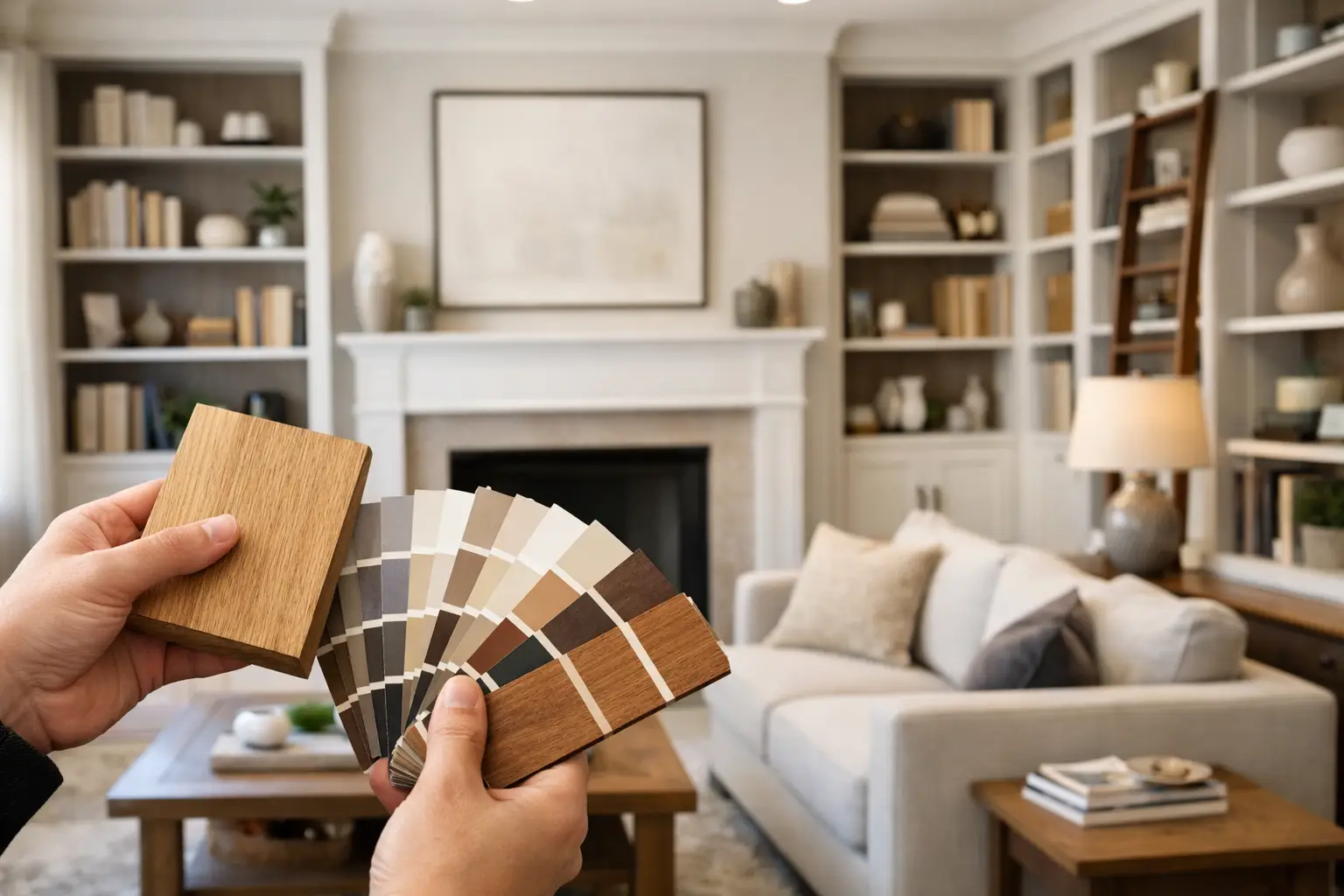
Paint-grade and stain-grade are not just aesthetic choices. They shape the entire build strategy. Painted built-ins can be crisp and architectural, but they demand careful preparation if you want the finish to look refined rather than soft or uneven. Natural wood introduces warmth and depth, but species selection, grain pattern, and color behavior all need to be considered in the context of the room.
Construction quality matters just as much as surface appearance. Ask how shelves are supported, how face frames are joined, how doors and drawers are built if included, and how the unit meets the wall, ceiling, and floor. Good built-ins look composed because they are composed well, not because they are covered with trim.
In the Pacific Northwest, where seasonal moisture shifts are a reality, material movement is not an abstract concern. It should be accounted for from the beginning. That is part of craft, not an afterthought.
Think beyond shelves to lighting, wiring, and daily use
The best built-ins are planned as part of the room, not dropped into it after everything else is decided. If you want picture lights, integrated LED lighting, concealed outlets, library sconces, or cabinet lighting, that needs to be addressed early.
The same is true for practical use. Will there be a rolling ladder, lower cabinets, a desk integrated into the run, or space for speakers and equipment? Do you need child-friendly durability, or are you creating a quieter study where open display can remain composed? These decisions shape the details long before the finish color is chosen.
A well-designed built-in should support the habits of the household. It should not demand constant correction from the people living around it.
Budget for the right things
Custom bookcases vary widely in cost because the scope varies widely. Size, material, finish, site conditions, lighting, cabinetry integration, and installation complexity all affect the final number.
The mistake is focusing only on footage or trying to compare custom work to modular shelving. Those are different categories entirely. A true built-in is part furniture, part architecture. It is made for a specific room, with specific tolerances, specific storage needs, and specific aesthetic demands.
If the budget needs to be controlled, do it intelligently. Simplify the profile. Reduce specialty lighting. Use fewer door fronts. Keep the design cleaner rather than cutting structural quality or undermining the proportions. A simpler built-in done well will always outperform an overdesigned one done cheaply.
Work with someone who can design, not just build
A cabinetmaker can execute drawings. A design-led craft studio can shape the room through the built-in. That difference matters.
The strongest projects begin with questions about architecture, use, storage, and layout. They do not begin with a stock elevation and a menu of trim options. If you are hiring for built-ins, look for someone who can talk clearly about scale, visual weight, practical function, and construction methods in the same conversation.
That is the standard Anderson Woodworks brings to this kind of work. The goal is not to fill a wall. The goal is to make the room more resolved, more useful, and more lasting.
When you choose built-in bookcases well, they stop feeling like cabinetry and start feeling like part of the house. That is the right measure of success.
Contact me to set up a consultation
Discover more from Anderson woodworks custom furniture & cabinets
Subscribe to get the latest posts sent to your email.